LinkedIn Personal Branding: Six Steps in Order, With the Source Behind Every Number
LinkedIn personal branding in six steps: positioning, profile, content, comments, consistency, measurement. Every number comes with its source and its limit.
LinkedIn personal branding starts with a precise answer to two questions: who do you help, and what should people call you about? Your profile, your posts and your comments then repeat that answer until the right people remember it.
Most guides on the topic are lists of tips with no source. They repeat rules that come with no data, tell you to switch on a profile mode that was removed in 2024, and quote multipliers nobody can check. The numbers that do exist come from LinkedIn itself or from companies that sell LinkedIn tools, and each one has a limit.
I work as a Marketing Engineer: Digital since 12, full Marketing since 20. For this guide I went through LinkedIn’s help pages one by one, set the third-party studies next to each other and wrote down what I would do.
Key Takeaways
- Positioning comes before posting. A personal brand answers who you help and what people should call you about, and everything else repeats it.
- Creator mode is gone. It was removed in 2024, according to two secondary sources, and as of November 2026 Follow as the main button is a setting anyone can switch on.
- Two to five posts a week is a vendor’s recommendation, not a rule. Buffer (2025) measured gains at every band above one post a week in over 2 million posts, and suggests two to five as the pace most people can keep.
- People reach further than Pages, in vendor data. Three studies point the same way, only one adjusts for audience size, and all three come from companies that sell to this market.
- Count searches and conversations before followers. LinkedIn’s Search Appearances shows how many people found you and which job titles they hold.
What Is LinkedIn Personal Branding?
LinkedIn personal branding is the work of making one thing clear to one group of people: what you are the right person to call about. You decide that in one sentence, your profile states it, and your posts and comments repeat it for months. Followers come later, as a result of that work.
LinkedIn’s help page on creating a good profile says the profile is “a professional landing page for you to manage your personal brand”. A landing page is the page a visitor arrives on, where they decide in a moment whether to stay.

Size is the reason the answer has to be specific. LinkedIn’s About page describes “the world’s largest professional network with more than 1 billion members in more than 200 countries and territories worldwide”.
Its Pressroom statistics page shows +1.4B members. Neither page carries a date, so as of November 2026 the newer figure is not clear, and both make the same point. On a network that size, a broad label like marketing expert fits too many profiles to be remembered.
Is Personal Branding on LinkedIn Worth the Effort?
For people who sell expertise to companies I think it is, but the published evidence is indirect. Surveys say business buyers read expert content from vendors before they choose one. Those surveys measure what executives say about content from companies, LinkedIn co-signs them, and none of them measures the return for one person’s profile.
The most recent one is the 2026 Edelman and LinkedIn study on thought leadership: a new idea, backed by evidence, that changes how a buyer thinks about a problem. The figures below come from O’Dwyer’s coverage of the 2026 Edelman-LinkedIn study, published on November 13, 2026, not from Edelman’s own report page. It reports that the study “surveyed 1,135 global business executives” in seven countries, between September 4 and 21.
According to that coverage, “Almost half (48 percent) of the B2B decision-makers surveyed said they spend at least four hours per week consuming thought leadership”. B2B means companies that sell to other companies. The line a consultant should read twice is this one: “More than half (52 percent) said it helped their purchasing group decide which vendor to choose”.
The 2025 edition looked at hidden buyers: staff in finance, legal or procurement who shape a purchase from the background. In ContentGrip’s summary of the 2025 report, they appear “with 71% reporting little to no interaction with sales representatives”. The summary gives no sample size, so I take that figure as a direction.
These are opinion surveys, not sales data. LinkedIn sells advertising to the same companies, and the coverage I read talks about content from companies and vendors, not from one person’s profile. I read them as a reason to be findable and clear, and my guide to thought leadership goes deeper into the studies.
In What Order Should You Build a Personal Brand on LinkedIn?
I would build it in six steps, in this order: positioning, profile, content, comments and network, consistency, measurement. The order matters because each step reuses the one before. A profile without a positioning is a CV, and posts without a clear profile send readers to a page that tells them nothing.
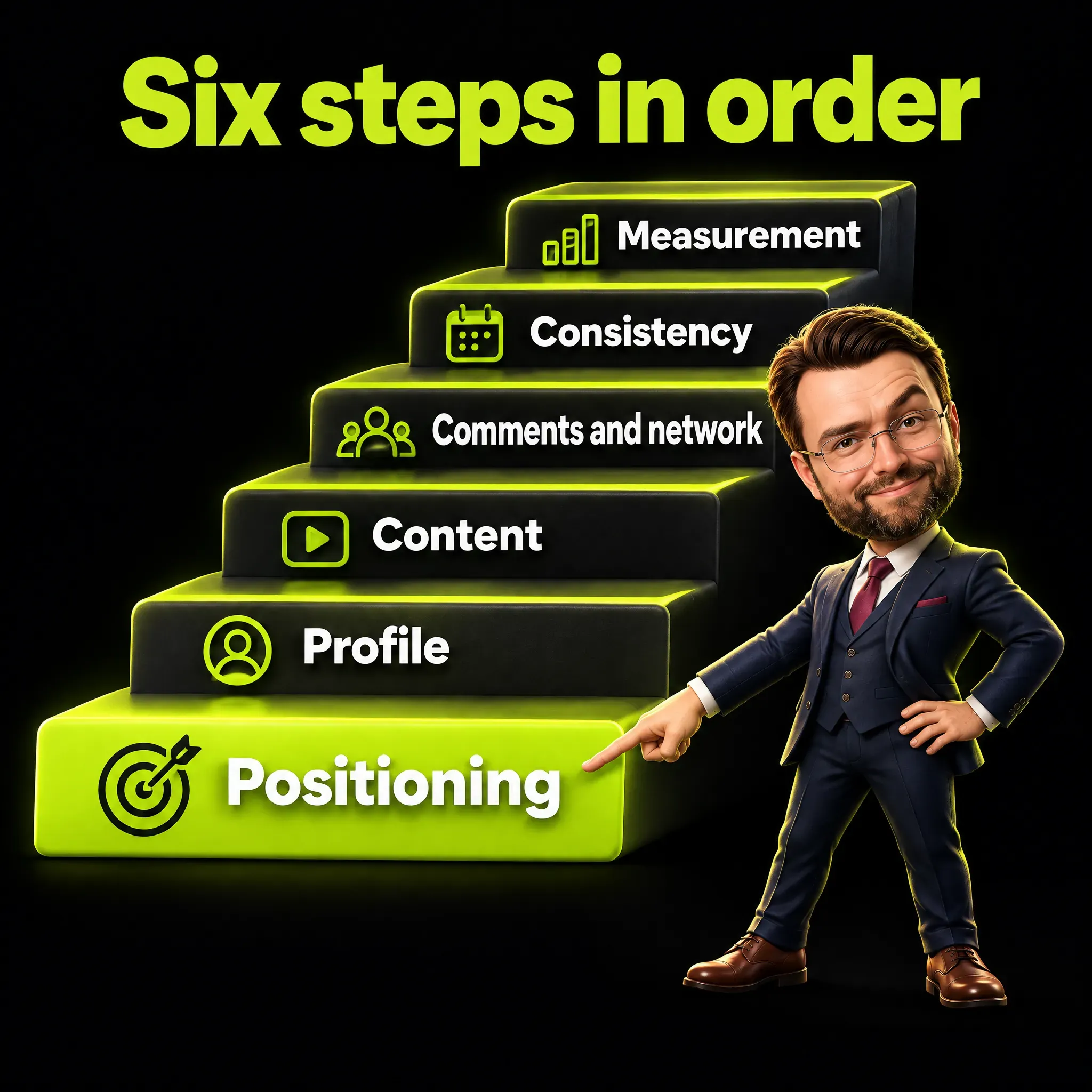
The table is my own working order, not a LinkedIn standard. Treat the right-hand column as an example of how to know a step is finished. The sections below follow that order, except that posting frequency comes before comments.
| Step | What you decide | Done when |
|---|---|---|
| 1. Positioning | Who you help and what they should call you about | It fits in one sentence |
| 2. Profile | Headline, About, Featured, optional verification | A stranger can repeat the sentence after one look |
| 3. Content | Two themes and one regular format | You can name next month’s topics today |
| 4. Comments and network | A short list of profiles worth answering | Each comment adds a fact or an example |
| 5. Consistency | A calendar you can hold for three months | No week depends on inspiration |
| 6. Measurement | Profile searches, conversations started, contact requests | Followers are the last line of the report |
How Do You Write a Positioning Sentence?
Write one sentence with three slots: who you help, with what, and how. If a line does not answer for whom and about what, it is not a positioning yet. A job title alone fails that test, because it says what you are and not why someone should call you.
Here are three invented examples. None describes a real person.
- I help marketing managers at B2B companies with 50 to 250 employees connect sales data to marketing decisions, with monthly reports a non-technical reader can follow.
- I help owners of small dental practices fill their calendar through local search and patient reviews.
- I help accounting software teams write product documentation that their customers read to the end.
A positioning is also a list of what you leave out. Before I prepared a single post for my own profile, I wrote down what I say about myself: Digital since 12, full Marketing since 20, Marketing Engineer. I also wrote down what I never say: client names, competitors, and numbers without a source.
A common worry is doing more than one thing. In the search preview of a Reddit post on personal branding, one member asks “how people here handle personal branding on LinkedIn when they’re involved in a few different things”. I would put in the headline the activity you want the next call to be about, and leave the rest to the About section.
A Real Comment: Positioning Before Posting
In a thread titled Personal branding DONE right, in a Reddit forum about LinkedIn, one member starts a numbered list of advice. The lines I quote come from the short preview that a search engine shows for the thread.
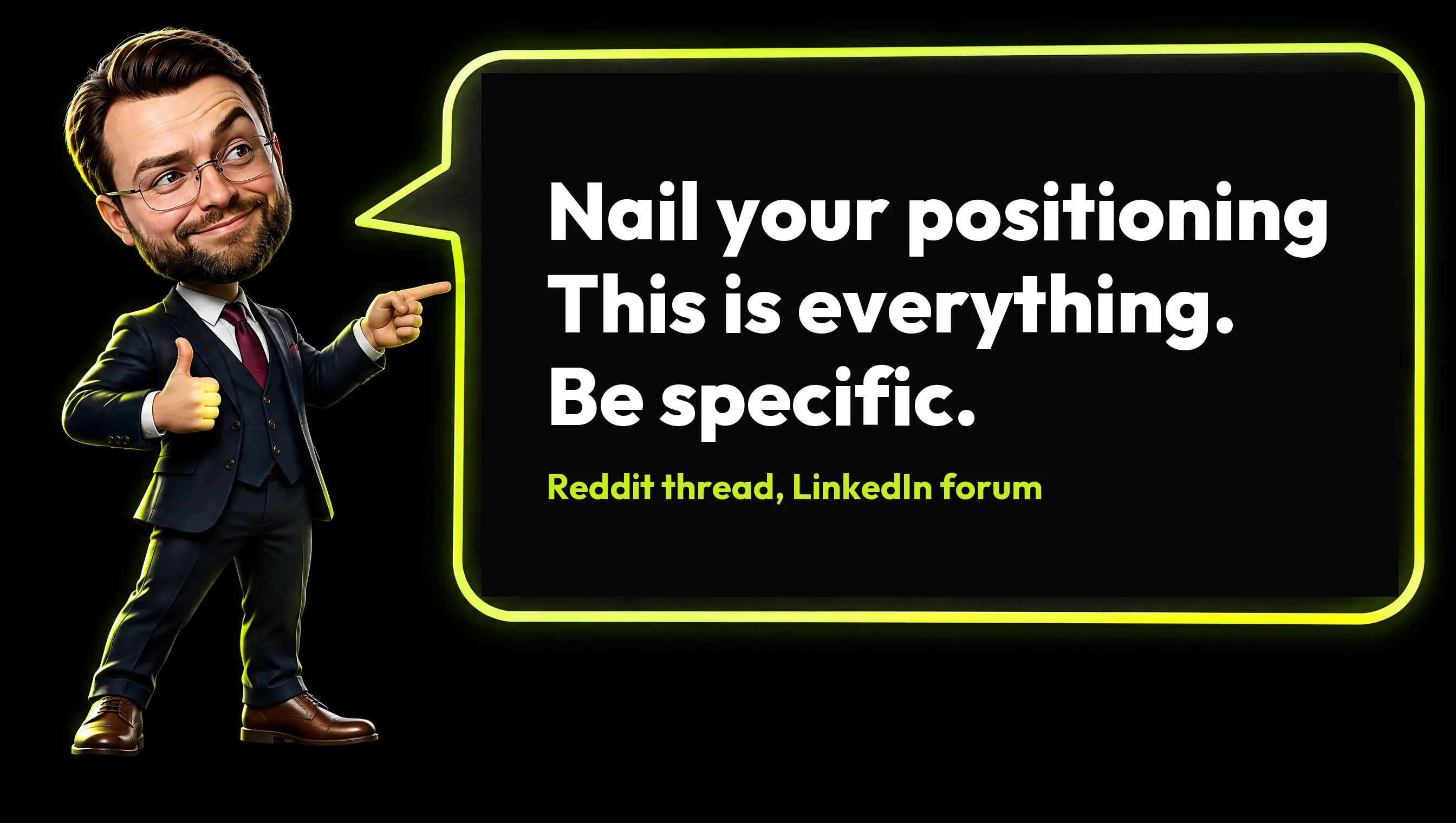
From the search preview of a Reddit thread in a forum about LinkedIn.
The preview mentions the habit of “posting selfies and random content every day” and then gives the first point. I copy it as the preview shows it, where a line break may be lost: “Nail your positioning This is everything. Be specific”.
I agree with putting positioning first and with the two-word test that follows it. Be specific is what separates a positioning from a job title. It is also the cheapest step, because it needs one sentence and no audience.
I would add one thing: a positioning that lives only in your head does not survive a busy month. Written down, together with the list of things you never say, it becomes a filter for every draft.
How Do You Turn Your Profile Into a Landing Page?
Make the top of the profile repeat your positioning sentence: photo, headline, About section and Featured. As of November 2026, LinkedIn’s help page on creating a good profile gives short advice for each part.
On the photo, the help page states: “Members with a profile photo on LinkedIn receive up to 2X more profile views”. That is LinkedIn’s own figure, with no method published. The words up to mark a ceiling, not an average.
On the headline, the page says “you can re-write it to either promote an area of expertise or to let your personality shine through”. On the About section it is specific: “Ideally, you should limit the text to one or two paragraphs while filling this section”. I would use the first of those paragraphs for the positioning sentence and the proof behind it.
For each section step by step, see my guide to LinkedIn profile optimization. For the line under your name, see my collection of LinkedIn headline examples.
What Belongs in the Featured Section?
Featured is the profile section where you pin samples of your work. I would put there the two or three pieces that prove your positioning sentence, such as a post that explains your method or a link to your own site.
The help page on the Featured section accepts posts you created or re-shared, articles you published on LinkedIn, and uploaded media such as documents or videos. The fourth type is the one I find most useful: “Links to external websites, for example your personal blog or portfolio”.
One more line deserves care: “Once you remove a work sample from the Featured section, it can’t be restored”. I would keep the original file or link somewhere safe before tidying up.
Is Creator Mode Still There, and Should You Switch to Follow?
No: creator mode, a profile setting LinkedIn launched in 2021, was removed in 2024. Any guide that tells you to turn it on is out of date. What remains, as of November 2026, is a separate setting that makes Follow the main button on your profile instead of Connect.
The LinkedIn pages in the sources for this guide give no exact date, so I rely on two secondary sources. A National Law Review article dated February 7, 2024 reports that “LinkedIn recently announced that it will discontinue its Creator Mode, which was initially launched in 2021”. Guiding Tech’s explainer on Creator Mode, updated in December 2024, writes that “LinkedIn shuttered Creator Mode in February 2024”.

The Follow setting is documented in LinkedIn’s help page on who can follow you. The path is Settings & Privacy, then Visibility, then Followers, then the switch named Make follow primary. With the switch on, visitors see Follow first, and with it off they see Connect first.
The same page explains that “anyone can follow you, even if they’re not in your network”, while your connections follow your posts automatically. I would switch to Follow if most of your readers are strangers, and keep Connect if your work depends on a small circle you know by name. LinkedIn adds that “Changes can take up to 24 hours to take effect”.
Once Follow is the main button, a second help page describes a Follow link you can share on your website or by email. You find it in Contact info, under Sharing on socials. LinkedIn lists conditions for it, among them a clean record with its community policies and a location outside mainland China.
Does Verification Help a Personal Brand on LinkedIn?
It costs nothing and it removes one doubt, so I would do it. A verification badge shows that LinkedIn or a partner has checked your identity, your workplace or your school. What I would not do is expect the numbers LinkedIn attaches to it.
LinkedIn’s help page on profile verifications states: “Our data shows that verified members naturally see 60% more profile views and 50% more engagement on average”. Engagement here means the reactions, comments and shares a post collects, and LinkedIn publishes no method behind that average. Members who take the trouble to verify may already be the more active ones, so the badge may not be the cause.
The same page is clear on the terms: “Verifications are optional and are not required to complete your profile”. It adds that a verification “is available with no additional cost”. As of November 2026, identity checks run through partner services that differ by country.
What Should You Post About?
I would start with two themes that come straight from the positioning sentence, and one format you can repeat every week. Two are enough to be recognized, and you can grow to three or four once the rhythm holds.
I suggest writing in your own words instead of sharing a ready-made company post unchanged. The clearest number on this comes from DSMN8, which sells an employee advocacy tool. That is software that helps staff share posts about their company.
DSMN8 studied 517,374 posts shared through its platform in the first half of 2026. In its comparison of company pages and employee posts, it reports: “Original posts created by employees earned 9.2x more engagement than unedited shares of curated posts”. That is one vendor’s data from its own customers, so I take the direction and not the multiplier.
My own drafts start with help from AI, but the idea and the final check stay with me. For that check I suggest a short written list like this one.
- Every date and figure has a source, or it stays out.
- No client names and no competitors.
- The post serves one of the two themes.
If you are employed, I would add your employer’s limits to that list before the first post. For choosing themes and planning them across weeks, see my guides to LinkedIn content strategy and LinkedIn post ideas.
How Many Posts a Week Does a Personal Brand Need?
Two to five posts a week is the range that LinkedIn’s page for creators advises and that one large vendor study recommends as sustainable. A second study names three a week as its threshold. None of these is a platform rule.
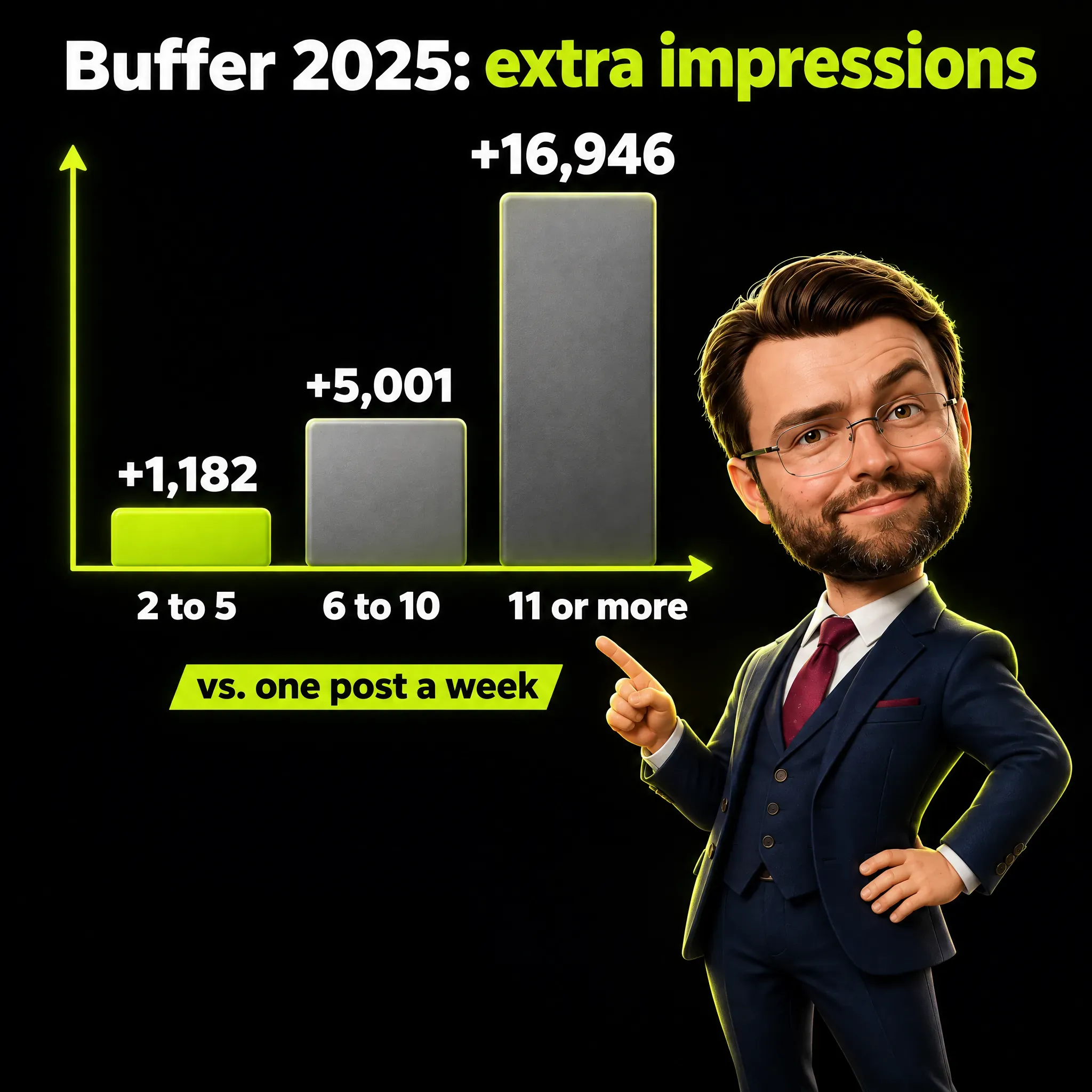
Source: Buffer, August 2025, over 2 million posts. Extra impressions per post, compared with one post a week.
Buffer, which sells a tool for publishing posts, released its analysis of LinkedIn posting frequency on August 28, 2025. It covers “over 2 million posts from 94,000+ LinkedIn accounts” and compares each account with its own average, not small accounts with large ones. That design makes it more careful than most studies of this kind.
The table shows Buffer’s results for each band, compared with one post a week. An impression is one display of a post on a screen, and I explain the metric in my guide to LinkedIn impressions. A percentage point is the plain difference between two percentages: from 4% to 5% is one point.
| Posts per week | Extra impressions per post | Engagement rate |
|---|---|---|
| 2 to 5 | +1,182 | +0.23 percentage points |
| 6 to 10 | +5,001 | +0.76 percentage points |
| 11 or more | +16,946 | +1.40 percentage points |
Buffer’s own numbers keep rising with frequency, and its answer to whether you can post too much is no. It still notes that “the marginal payoff decreases as you climb higher”.
For most accounts it recommends the lowest band: “posting 2 to 5 times weekly on LinkedIn is the sweet spot for improving reach and engagement”. I read that as a recommendation about what people can sustain, not as the point of best results.
A second reading of the same Buffer data, by Buffer’s own data scientist, finds that reach per post tends to fall as frequency rises, while total reach still grows. I set the two readings side by side in my guide to LinkedIn content strategy.
Vulse, which sells an employee advocacy tool, published its analysis of posting consistency in August 2026. It “analysed LinkedIn accounts connected to its platform over the 12 months to August 2026, covering 263,900 posts”. Its finding on frequency: “Accounts posting at least three times a week grew their impressions by 32% over the past 12 months”.
The page gives no comparison with accounts that post less. So the 32% describes those accounts and proves no effect of the frequency itself.
The two thresholds fit together, since three sits inside two to five. But both samples come from accounts connected to the vendors’ own tools, so I would not promise anyone growth from a number of posts.
Consistency is the part I would plan first. Vulse puts it this way: “Three posts a week is the point in our data where a profile becomes a reliable presence, for the audience and for LinkedIn alike”. My version is more modest: choose a calendar you can hold for three months, even at one post a week, and judge it at the end.
Does a Personal Profile Reach More People Than a Company Page?
In the one study that divides by audience size, yes. The other two vendor datasets point the same way without that adjustment: one counts the share of all impressions, the other compares engagement for one CEO and one Page.
All three come from companies that sell services around employee posting, and none is independent. I read them as a direction, with no multiplier I would repeat.
The table sets the three studies side by side, each with its limit.
| Who measured | What they looked at | Result | Limit |
|---|---|---|---|
| Refine Labs, B2B agency, February 2026 | Three employee profiles and its own Page, over 10 months | Impressions per 1,000 followers in the third quarter of 2025: 70,651, 9,269 and 12,769 for the profiles, 980 for the Page | One company, three people, one profile far above the others |
| Vulse, advocacy tool, August 2026 | 263,900 posts from accounts on its platform | 90% of impressions from employee profiles, 10% from company pages | Only companies that run an advocacy program on Vulse |
| DSMN8, advocacy tool, page dated August 2026, citing an older DSMN8 study with no year given on the page (its link points to a 2023 report) | 11,107 posts from one civil engineering firm | A CEO with 5,000 followers got the same level of engagement as a Page with 300,000 | One client, one case, an older study I did not read, and engagement instead of reach |
Refine Labs’ comparison of employee profiles and its brand page describes its method as “normalizing all results per 1,000 followers to remove the scale advantage”. Normalizing means dividing by audience size, so a small account and a large one can be compared. The agency also warns that “One viral post can distort quarterly data”.
The DSMN8 row is a single client from an older study, and it measures engagement, so it illustrates the idea and does not prove it. Other multipliers circulate, such as 2.75, 5 or 14 times the reach of Pages, but their sources do not show how they were calculated.
None of this makes a company Page useless, and Refine Labs says so itself: “Company pages still serve an important role”.
How Do Comments and Your Network Build a Personal Brand?
A comment is a small public sample of how you think, placed where your future clients already read. I would choose a short list of people in your field and answer their posts with substance, such as a fact or a counterexample. A comment that only agrees adds nothing to your brand.
The sources for this guide hold no measured data on comments. The closest is advice in Buffer’s study: “Spend 10 to 15 minutes a day leaving meaningful comments on posts from your network, industry voices, or potential collaborators”. Treat it as a habit suggested by a vendor, not as a finding.
LinkedIn’s help page on followers says that “your 1st-degree connections automatically follow your posts and articles”. A 1st-degree connection is a person you are directly connected to, so each relevant connection is also a possible reader.
I would connect with people in the market named in your positioning sentence, not with everyone. How posts and comments then travel through the feed is a separate topic, covered in my guide to how the LinkedIn algorithm works.
What Should You Measure Instead of Followers?
Measure whether the right people find you and talk to you. LinkedIn gives you a tool for the first half: Search Appearances, which counts how many people found your profile through search and shows their companies and job titles. The second half you count by hand.

LinkedIn’s help page on Search Appearances describes it this way: “The Search Appearances profile feature displays statistics on how many people found you through a search on LinkedIn”. You open it from the Analytics section of your own profile. The filters include the top companies your searchers work at and the job titles you were found for.
That last filter is a direct test of your positioning. If your sentence is about marketing reports and you are found for unrelated titles, the profile is not saying what you think it says.
The same screen has a part called Profile engagement, with total impressions, total clicks, average viewing time and impressions per section. The help pages I read list no engagement rate (interactions divided by impressions) for a personal profile.
Here is what a monthly note could look like for a consultant. The numbers are invented to show the format.
| What to count | Example month | What it tells you |
|---|---|---|
| Profile searches | 140, up from 95 | Whether you are found at all |
| Contact requests from the chosen market | 6 | Whether the right people act |
| Conversations that began in comments | 3 | Whether comments open doors |
| New followers | 40 | Secondary, read it last |
I would write these four lines once a month and compare them after three months.
Which LinkedIn Personal Branding Rules Are Not Platform Rules?
Several rules that circulate in guides are not platform rules. The 4-1-1 rule and the seven pillars of personal branding are two that people ask Google about.
The first is a tip that an August 2024 article on LinkedIn’s marketing blog gives to company Pages, with no data behind it. The second appears on no LinkedIn page I read for this guide. The table sets each claim next to what a source says.
| Widespread claim | What the sources say |
|---|---|
| Follow the 4-1-1 rule: four shares of other people’s content, one post of your own, one promotional post | A content-mix habit from content marketing. LinkedIn’s marketing blog repeats it as a tip for company Pages (August 2024), in a different mix: for each post about yourself, one update from another source and four pieces written by others. No data comes with it, and it is a tip, not a platform rule |
| Personal branding has 7 pillars | A scheme from third-party blogs, not a standard. No LinkedIn page I read lists it |
| Turn on creator mode | Removed in 2024, according to National Law Review and Guiding Tech |
| Verification gives you 60% more profile views | LinkedIn states an average for verified members and publishes no method |
| Post three times a week and you will grow | A pattern in data published by Vulse and Buffer, two tool vendors, not a platform rule |
| Profiles get a fixed multiple of Page reach | Vendor figures with different definitions. The one detailed study covers three profiles |
| The Follow button grows your audience by itself | It is a setting that changes which button comes first |
Frequently Asked Questions
How can I use LinkedIn to build my personal brand?
Decide who you help and what they should call you about, write it into your profile, then post and comment on a regular schedule. Measure profile searches and conversations before followers.
What are the 7 pillars of personal branding?
It is a scheme from third-party blogs, not a LinkedIn standard, and none of the LinkedIn pages I read lists it. I would use a working order instead, starting from positioning.
What is the 4-1-1 rule on LinkedIn?
It is a content-mix habit from content marketing. One common version is four shares of other people’s content, one post of your own and one promotional post. LinkedIn’s marketing blog repeats a similar mix as a tip for company Pages, with no data behind it, so it is no platform rule.
Is personal branding on LinkedIn worth it for a consultant?
Surveys by Edelman and LinkedIn say business buyers read expert content before choosing a vendor. The 2026 edition questioned 1,135 executives, as reported by O’Dwyer’s. They are opinion surveys co-signed by LinkedIn, so I read them as a reason to be findable, not as a promised return.
Is creator mode still available on LinkedIn?
No. It was removed in 2024, according to National Law Review and Guiding Tech. Its main tools, such as the Follow button and the Featured section, are available without it.
Do I need to turn on Follow as the main button?
No. It is an optional setting called Make follow primary, and with it off visitors see Connect first. LinkedIn says a change can take up to 24 hours to appear.
How often should I post on LinkedIn for a personal brand?
LinkedIn’s page for creators advises two to five posts a week, as does Buffer’s 2025 analysis of over 2 million posts. Vulse’s 2026 data on 263,900 posts names at least three. Start low and raise the number only when the quality holds.
Does a personal profile or a company Page reach more people?
In the three vendor studies I found, from Refine Labs, Vulse and DSMN8, personal profiles come out ahead, but only Refine Labs compares per follower. None is independent, so treat the gap as a direction, not a multiplier.
Why are people getting rid of LinkedIn?
No source in this guide measures how many people leave LinkedIn. If staged self-promotion is what tires readers, I would answer it with a plain and specific profile.
LinkedIn Personal Branding in Short
LinkedIn personal branding is one sentence about who you help and what they should call you about. Your profile, posts and comments repeat it at a steady pace, and you count searches and conversations before followers.
I write about marketing, AI and the numbers behind them. If this was useful, follow me on LinkedIn.