Marketing Engineer: What It Is and How It Differs From a Marketer or a Developer
What is a marketing engineer? Three meanings share one name. Here is the job by the work it delivers, compared with a marketer, a technologist and a developer.

Take a newsletter that goes out every Thursday. The marketer writes it. A developer built the software that sends it. Someone still has to build the chain that prepares the content, checks the links and the numbers, and hands the result to the sender, and then keep that chain running when something changes.
In some companies, that someone is called a marketing engineer. This is an invented example, but it holds the whole job in one sentence: a marketing engineer does not do the marketing for you. They build, own and check the systems your marketing team works through.
The title is new, contested and used for at least three different things. Below I separate them, describe the job by the work it delivers, and compare it with a marketer, a marketing technologist and a developer.
I started building websites at 12, for gaming clans, and I have done full-scope marketing since I was 20. I sell marketing consulting, so I have an interest in this topic.
Key Takeaways
- A marketing engineer does not do the marketing for you. They build, own and check the systems a marketing team runs its work through.
- The same name covers three different things: an academic method, an industrial sales-support job and the newer AI-era role. This article is about the third.
- Judge the work, not the title. Two real job ads for the same kind of work ask for different backgrounds.
- The difference is a center of gravity, not a fence. Marketer, marketing technologist, marketing engineer and developer overlap, and in a small company one person covers several.
- The title is contested. One consultant who went through LinkedIn listings found no evidence of a boom, and a practitioner says the job mostly turns up under other names.
- Ask to see what was delivered and how it is checked. Ownership after launch and a check inside the system are what separate a system from a demo.
Marketing Engineer: Three Things With the Same Name
Search for the title and you meet three different ideas at once. Here they are, apart.

The academic one. “Marketing engineering” is a method for deciding with data. It comes from the book Principles of Marketing Engineering by Lilien, Rangaswamy and De Bruyn (second edition, 2013), later published as Principles of Marketing Engineering and Analytics (third edition, 2017). Their abstract says that “the new marketing increasingly looks like engineering (that is, combining art and science to solve specific problems).”
In this meaning the term describes a way of deciding. It is not a job.
The industrial one. A recruiter’s listing for a “Product Marketing Engineer” in power electronics describes “a hybrid technical + commercial role designed for an engineer who enjoys customer interaction, communication, and business development”. This is an engineer who talks to customers and supports the sale of a technical product. It is a separate use of the same title, found in industrial recruiting.
The AI-era one. Someone inside a marketing team who builds the agents, automations and data flows that the team works through. It is what the recent articles and job ads I read for this piece mean, and it is the subject of everything below.
What Is a Marketing Engineer? One Sentence, Then the Work
My sentence: a marketing engineer builds, owns and checks the systems that a marketing team works through.
The clearest definition I found comes from Nick Lafferty, founding marketing engineer at Profound, a software company for marketers. His post says it represents his personal views. He writes: “A Marketing Engineer doesn’t do the marketing. They build the machine that does.” A little further on he adds that they “sit inside a marketing team and build the AI agents, automations, and data infrastructure”.
Two other sources, from different angles. The agency JAC Growth Marketing proposes: “A marketing engineer connects a defined marketing task to the tools and records needed to run it.” The newsletter Marketing Machine sees the role “Not as a new job title, but as a realization that there’s an emergent set of sub-specialties which fit under an engineering umbrella.”
Build, then own. Lafferty is firm on the second one: “A Marketing Engineer owns the system after it ships.” That separates a system from a one-off script, because someone answers for it when it breaks. In practice it means owning the marketing tech stack as a working set of parts, not as a list of subscriptions.
I add a third verb, check. It comes from a sentence of Lafferty’s that I find more useful than his definition: “Technical ability can multiply your judgment. It can also multiply a bad idea.” He names the base skill as “marketing judgment”. A check inside the system is how you find out which of the two got multiplied.
The systems are the kind I describe in my guide to an AI marketing system: not a tool you open, but a chain that keeps running, with a person who answers for it.
Marketer, Marketing Technologist, Marketing Engineer, Developer: An Honest Grid
The boundaries are blurry, and the sources say so. In 2015 the site chiefmartec reported a 2014 study of marketing technologists, made among attendees of a marketing-technology conference and readers of the blog. Of the participants: “half of the participants skewed more heavily to the marketing side of the spectrum (52%), and the other half skewed towards technology (48%)”.
Here is what that number means, in three steps. It comes from a 2014 survey of people working in marketing technology: conference attendees and readers of one blog. It says that even in that group, about half lean toward marketing and half toward technology. So a title alone does not tell you what the person does.
Built In calls the marketing technologist a “catchall term” that “changes its shape based on the size and type of company”. The grid below describes the center of gravity of each profile, not a fence.
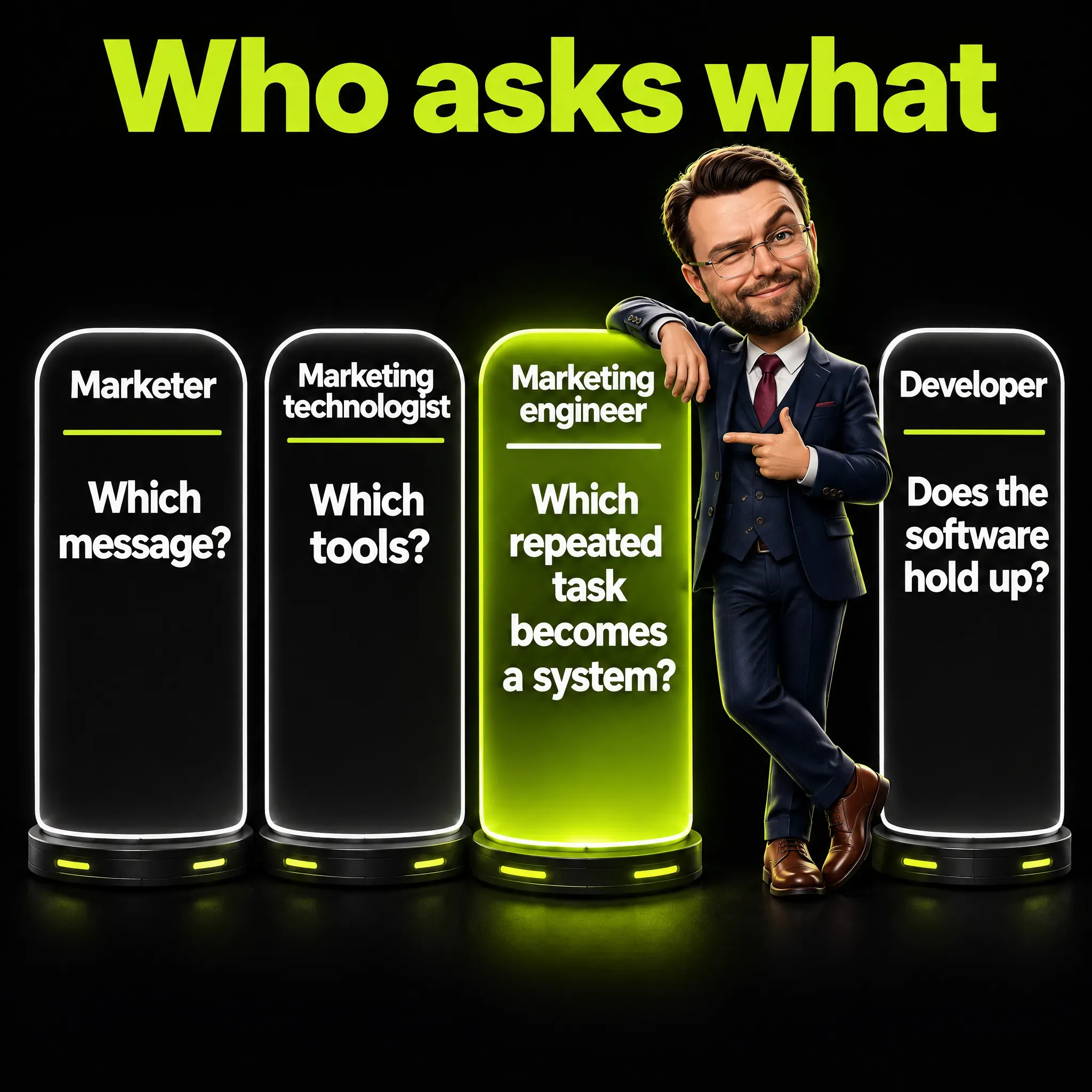
This grid is my synthesis of the sources linked in this article and of the job ads below.
| Marketer | Marketing technologist | Marketing engineer | Developer | |
|---|---|---|---|---|
| Asks | What message, to whom, on which channel? | Which tools does marketing need, and how do they connect to the company? | Which repeated task of the team can I turn into a system that runs and that I can check? | How do I build software that works, holds up and can be maintained? |
| Owns | Campaigns, channels, messages, budget | The choice and connection of the stack, the relationship with IT | The systems the team works through, after they ship | The product and its code |
| Produces | Commercial results | A chosen stack, integrations, requirements | Automations, agents, data pipelines, tests and checks | Software |
| Judged by | Leads, sales, return | Tools adopted that talk to each other | Time and errors removed from the team, data quality, delivered work | A product that works |
| Stops at | Usually does not build the systems | Selects and coordinates more than it builds | Stays inside marketing, does not build the product for the end user | Does not decide marketing message and priorities |
For the technologist column, the source I used is LXA: the main focus is making sure marketing strategies stick to the business goals, “selecting the best tech vendors, and cooperating with IT”.
Two neighbors deserve a name. Marketing operations, in Lafferty’s words: “Good ops people create the governance and deployment rules that make shared systems trustworthy.” Growth engineers, he says, are different: “Growth engineers usually work closer to the product.” And he admits what every small team knows: “At a smaller company, one person may cover both jobs.” For one person who is the whole department, I wrote about marketing operations for a team of one.
Back to the Thursday newsletter. The marketer writes it. The marketing engineer builds the chain that prepares, checks and sends it. The developer builds the sending software the chain uses. In a company of three people, one person may do all three jobs on different days; they stay three different jobs.
A Task That Falls Between Two Roles: The Test That Could Not See
Here is a real task that belongs to nobody on an organization chart.

A client site had recently moved its measurement to a server of its own. That is server-side tracking: the site’s measurements travel through a server you control, instead of leaving directly from the visitor’s browser. My automated tests said that after a visitor clicked “accept all”, the measurements seemed to vanish.
A marketer, reading that, might conclude that lead measurement is broken and call a developer. A developer might find the requests missing from the network log and start digging into the server. Either could spend days on a problem that did not exist.
The measurements had not vanished. After the click, the browser hands the sending to a service worker, a small program it keeps alive in the background. Its requests do not appear in the log of the page, which is the log my tests read. But they reached the real server and Google Analytics 4: 33 test events of mine showed up in the Realtime report. They were test events, not real contacts.
The test did not see this traffic, so I changed the test. It now serves the service worker from local files and blocks the real server with a browser rule, so no test traffic touches real data. Then it fires an event with a unique name and looks for that name in the Realtime report of Google Analytics 4. For the consent side of such a setup, see the Swiss tracking consent checklist.
Why is this a marketing engineer’s task? It needs three kinds of knowledge at once. Marketing knowledge: which events are real leads, and what consent changes. Technical knowledge: how a browser sends data in the background. And the design of a check that cannot be fooled.
A marketer alone may never think of a service worker. A developer alone may not know which events count as leads, or why a unique event name in the Realtime report is the right proof.
What Job Ads Say, and Where They Contradict Each Other
Two real ads for the same kind of work, found while I was researching this piece, ask for different backgrounds.

Energy Aspects (Athens, hybrid, posted on 8 September 2026) is hiring a Marketing Engineer. The ad asks for 3-4 years as a software engineer or in an equivalent engineering role, plus SQL and Python, which are a database language and a programming language, and the tools Git and Salesforce. One of its opening paragraphs says: “You are the engine room of the marketing function.” The work: “Build, configure, and maintain the automated workflows and AI agents that run our marketing operation.”
Gwi (London, posted on 24 July 2026, no longer accepting applications) used the official title “Growth Marketing Automation Engineer”. It says: “You won’t run a channel or own a campaign, you build the systems, agents and tools that let everyone else operate at a scale they couldn’t reach independently.” And, on the background: “You don’t need a computer science degree or a software engineering background, but you’re comfortable in low/no-code platforms”. It adds that you could be “a growth or performance marketer who has gone all-in on AI”.
Read them together. The core of the work is the same: build the workflows and agents the marketing team runs on. The entry ticket is different: 3-4 years of software engineering in one ad, no computer science degree or software engineering background needed in the other.
The most useful line of the second ad sits in its list of bonus points, not its requirements: “A portfolio of things you’ve built”. The ad wants to see “what you’ve shipped”, not to read about it.
That is the thread I follow. The role is defined by what a person builds and delivers, so a portfolio of delivered work is the first thing I would ask to see. My own work is marketing, with technical competence built on top of it.
The Title Is Contested
The title has critics, and they make fair points.
Richard Baxter, who takes client briefs for this kind of work, writes at Houtini that “The title may or may not stick, but the job is certainly real”. He is plain about who is pushing the name: “the title is being pushed by people with something to sell, but, the job is turning up anyway, mostly under other names.”
Vincent Grippi, at Grippi Media, is more direct: “I dug through LinkedIn’s job listings myself and found no evidence that marketing engineer roles are booming. Most were contract gigs with wildly inconsistent descriptions, and many didn’t even mention AI.” And his conclusion: “Marketing will never be an engineering job because that’s not what marketing is about.”
Nothing I read proves a boom, and I do not claim one. I describe a kind of work, and I would give the same description if the title disappeared tomorrow.
Grippi’s conclusion and the ESSEC abstract are less far apart than they look. Marketing is about deciding what to say, to whom, and whether it worked. Engineering is about making something that runs and can be trusted. The marketing engineer sits where the first needs the second, and Lafferty’s rule applies: the most important skill is marketing judgment.
Grippi also worries that AI agents are fragile and that AI-made content can cost a brand its audience. Those are the reasons for my third verb, check.
A contested title also has a practical side on a profile. LinkedIn says standard job titles are what other members search for, so I looked at how to write the line under the name in LinkedIn headline examples.
What a Marketing Engineer Does in a Normal Week
Examples from my own work beat definitions. Three systems, each with a check inside.

An agent that learns from corrections. I built an agent that writes drafts of my LinkedIn posts. It keeps an archive of everything it proposes and of every correction I make, and it turns corrections into written rules. As I write this, the archive holds 41 post drafts and 215 corrections, and the corrections have produced 36 written rules, 10 of them active today.
What do those numbers mean? Each of the 215 is a reply of mine to a draft. So the rules come from real cases, not from a theoretical list. Every active rule has a mistake behind it that I have already seen.
Before I see a draft, it passes a mechanical check of 12 points, scored out of 100: a short first line, one concrete figure, plain hyphens, short paragraphs and so on. The score says what to fix, not whether the post is good. That judgment stays mine, and the agent never publishes on its own.
The corrections pushed it in one direction: write for people outside the trade, use one technical term per post, explain every number. I try to write this article the same way. More on how I keep agents on a short leash in my guide to AI marketing agents.
A method that got cheaper once it was tested. I have a tested recipe for writing and checking a blog article with AI helpers that each do one part: reading sources, drafting, reviewing. My first attempt used about 31 million subagent tokens. A token is a small piece of text that the AI reads or writes, and you pay per piece. The recipe uses about 1.8 million, roughly 17 times fewer (31 divided by 1.8).
The method has two basic rules. Each helper has an effort level chosen on purpose, low for reading and high only for the skeptical reviewer, and every quotation must be literal. Build the method once and reuse it. A working example of the same idea, applied to a mailing, is my newsletter automation pipeline.
A check on another AI’s work. I asked an AI to review a video that another AI had generated, and it called the video fine. The video had a huge third forearm in the foreground. Since then, my check of generated video zooms into the area of the arms to count forearms, compares the first frame with the last frame of the previous clip, and has an independent reviewer compare the prompt against the frames. The bottleneck has moved from producing to reviewing, which I wrote about in AI slop and the review bottleneck.
What the three have in common: each takes a task a person did by hand, turns it into a system, and puts a check inside. For a longer treatment of that last part, see human-in-the-loop AI verification. You can also see the kind of things a marketing engineer builds in my piece on AI marketing automation.
How to Recognize a Marketing Engineer: Ask for the Work
The JAC Growth Marketing page has a line I agree with: “Assess the work, not the title.” It matters because the title changes from one company to the next, as the two ads above show.
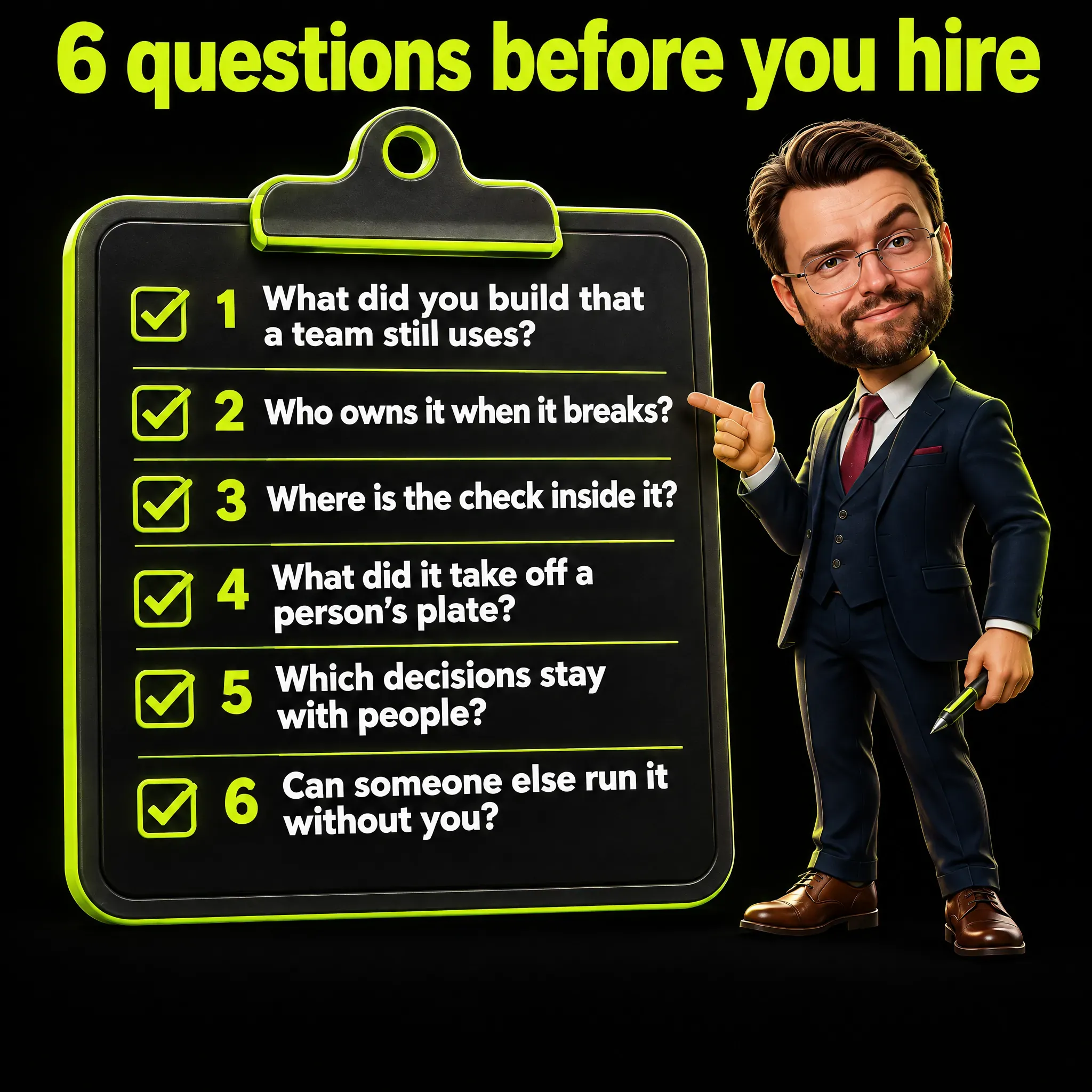
Six questions to ask anyone who claims the title, whether you are hiring or being hired:
- What have you built that a team still uses? Delivered work counts more than the label.
- Who owns it today, and what happens when it breaks? Ownership after the launch is the dividing line between a system and a demo.
- Where is the check inside it? A system without a check is a guess that runs on its own.
- What did it take off a person’s plate, in hours or in errors? The job is judged by time and errors removed.
- Which decisions did you leave to people, and why? The honest answer shows the marketing judgment.
- Can someone else run it without you? If not, it is not yet a system.
Good answers have names, dates and things you can open and look at. If the answers are a list of tools, you learned what the person uses. If the answers are about owners, checks and time saved, you learned what the person delivers.
So, what is a marketing engineer? Someone inside marketing who builds the systems the team works through, stays responsible for them after they ship, and puts a check inside each one. The title may or may not last. The work, a repeated task turned into a system you can trust, is already being done under several names.
If you hire for it, read the work. If you want to become one, build something a team uses, and show it.
Frequently Asked Questions
Who is a marketing engineer? A person inside a marketing team who builds, owns and checks the systems (agents, automations, data flows) that the team works through. In Lafferty’s account the base skill is marketing judgment. The title also has an academic meaning and an industrial one, described at the top of this article.
What exactly is a job in marketing? A job in which you decide what to say, to whom and where, and then measure whether it worked. The marketing engineer is the role that builds the tools the rest of the team does that with.
What is the difference between a marketing engineer and a marketing technologist? The center of gravity. A marketing technologist chooses and connects the tools and works with IT, and the title is a catchall that changes with the company. A marketing engineer builds the systems and owns them, staying inside marketing. In small companies one person may do both.
Do I need a computer science degree to become a marketing engineer? It depends on the ad. Lafferty writes that “You can start without a computer science degree”, and Gwi says the same. Energy Aspects asks for 3-4 years of software engineering. The common thread is work you can show.
My own path is digital from 12 and full marketing from 20. If you are starting out, my guide on vibe coding for marketers shows a first step.
How much does a marketing engineer earn? It depends on the company, the country and which of the three meanings the employer has in mind, so a single figure from me would mislead. Read the range that the employer publishes in the job ad.
Does a small company need a marketing engineer? I suggest a practical test. Is there a task, based on data and tools, that someone does by hand every week? If yes, it is worth turning into a system you can check, and that is the job. In Lafferty’s words, “At a smaller company, one person may cover both jobs.”
What does a marketing engineer do in a normal week? Builds, repairs and checks systems: an agent that writes drafts and learns from corrections, a chain that prepares and verifies an article, a test that confirms the tracking tells the truth. Each one has a check inside it.