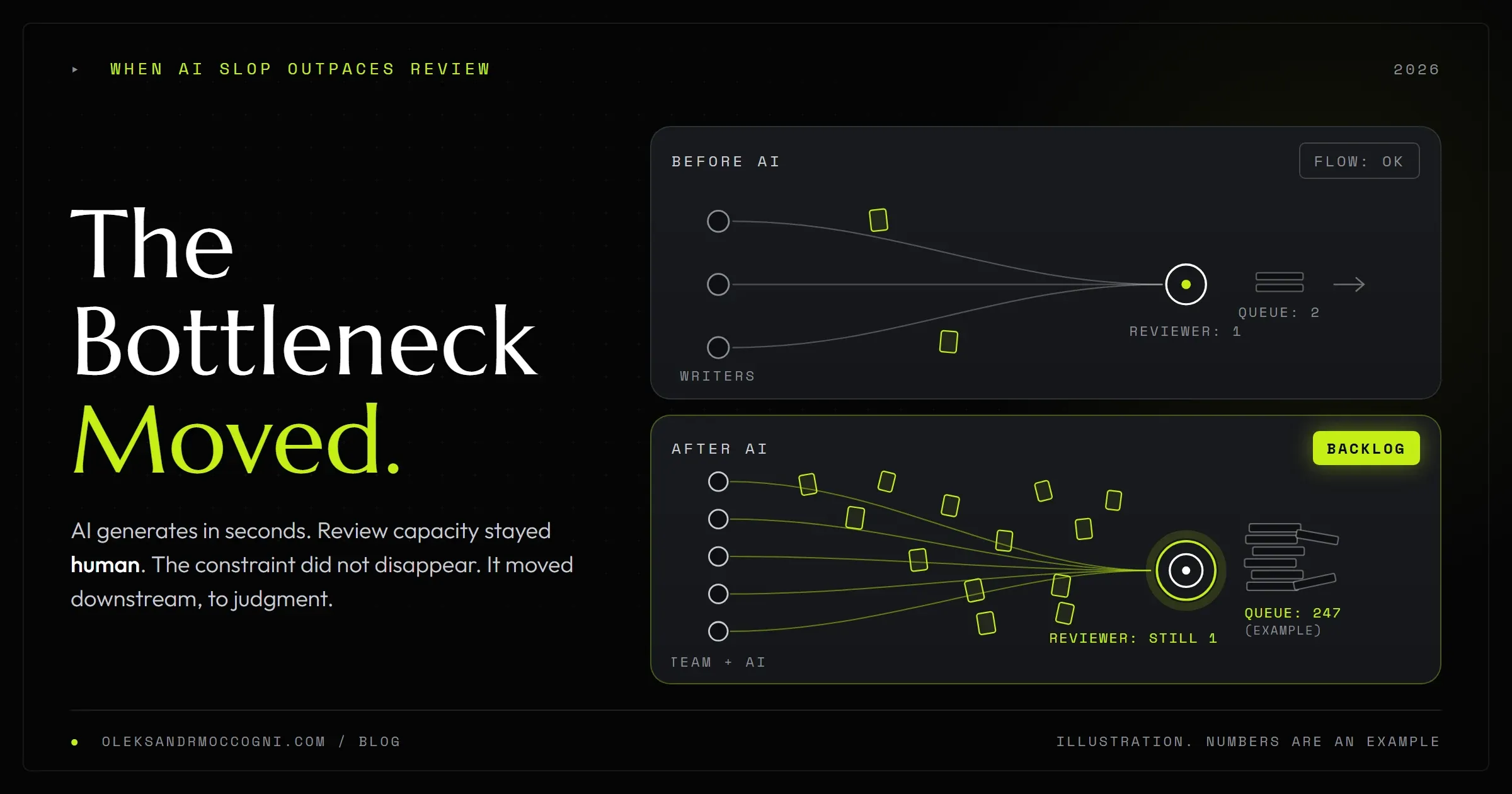
The Bottleneck Moved: AI Slop vs. Human Review Capacity
AI slop is cheap to make and expensive to check. Why the bottleneck moved from creating to reviewing, with real numbers, my own mistakes and a review budget.
Practical, opinionated writing on AI, search and growth. No fluff. Just takeaways you can use on Monday.
AI slop is cheap to make and expensive to check. Why the bottleneck moved from creating to reviewing, with real numbers, my own mistakes and a review budget.
Human in the loop AI is theater unless the check can say no. What OpenAI's math release and its corrections teach marketers about verifying AI work.
GPT Image 2 vs Nano Banana 2.1 for marketers: Google's per-image prices, what Flow's free credits cover, my credit costs and a 3-prompt test to pick your tool.
ChatGPT Intelligent UI turns answers into tools. What OpenAI confirms, what it leaves open about data sources, and the checklist I would run to stay visible.
Claude Haiku vs Sonnet vs Opus for marketing: real API prices, what shrinks the gap, and one job priced on all three. Pick the cheapest model that passes.
Email tracking pixel rules in Europe: Italy's consent deadline is October 29, France's has passed. What the Garante, CNIL and EDPB say, and what I would change.
CLAUDE.md best practices after Claude 5: Anthropic deleted over 80% of Claude Code's prompt. Here is what I cut, moved and kept in my own setup, and why.
PhotoCraft is an open source Photoshop alternative built in 9 days with AI. I audited the repos: what is real, what is hype, what Adobe costs in CHF.
AI lead generation without the tool listicle. How I use AI to qualify leads, shorten forms, classify first touch, and follow up faster, with receipts from live builds and one channel I refused.
AI marketing automation without the tool list: what to automate first, in what order, and the human gates that keep it from breaking. Receipts included.
An AI marketing strategy built on 2.5 years of daily practice: map your processes by volume and judgment, automate in payoff order, measure against a baseline, and keep a no-list. Not another tool list.
AI seo tools do not have to mean another SaaS subscription. Here is the pipeline I run instead: raw APIs, Python scripts, my own SEO database, and AI only where it earns its place.
A B2B marketing strategy for the hard version of the problem: long sales cycles, small budgets, skeptical committees. What I run in-house and for consulting clients.
A brand positioning framework you can fill in one afternoon: one sentence of position, a counter-frame, a receipt nobody can copy, and consistency on every touchpoint.
Customer acquisition cost is easy to define and hard to measure. A working marketer's guide to first-touch attribution, honest windows, and the mistakes that turn your CAC into a guess.
Generative engine optimization explained by a marketer who runs it on a 900-page directory and a five-language blog: what you control, what you don't, and the workflow that makes content citable.
How to build a marketing budget in 2026 when AI made production nearly free and review expensive. Phased allocation, what to cut first, and the paid guardrails I refuse to break.
Marketing operations without a department: task states, decision logs, review gates and near-zero-cost automations that let one marketer run like an ops team. With receipts.
Marketing ROI is a measurement problem before it is a formula problem. First-touch attribution you can build yourself, blended vs paid-only numbers, the day a channel vanished overnight, and where AI actually fits.
Marketing strategy 2026 from a practitioner with skin in the game: what actually changed, which hyped channels to skip, what to prepare, and the four bets I am making on a small budget.
How to vibe code as a marketer. I shipped real internal marketing tools with no dev team. Here is the stack, the real cost, and the limits I refuse to cross.
Newsletter automation at enterprise scale: how I rebuilt drafting, translation, QA, and scheduling into one AI pipeline. Real numbers, honest failures.
How I built a second brain AI that actually retrieves: the exact Obsidian structure that makes Claude read real answers instead of inventing them every time.
ChatGPT for marketing: seven ugly truths from 2.5 years of daily use. The hallucinations, the generic slop, the hidden bill, and where the tool truly pays off.
Using AI for marketing, honestly: what 2.5 years of daily use changed, what AI still gets wrong, what it really costs, and how to test who can drive it.
My marketing tech stack for 2026: one small server, one database, four API pipes, and a lot of scripts. What each layer does, what it costs, and what I cut.
GLM 5.3 is the best open source LLM right now. Z.ai shipped it without touching the architecture: same 744B model, longer post-training. What it means for you.
Most AI marketing implementations fail for boring, predictable reasons. The real numbers, the four failure patterns, and how the winning 20 percent do it.
Omarchy review: the opinionated Arch Linux distro that made me want to switch. AI agents, a mouseless workflow, real privacy, and a 60 second install.
OpenAI paused its biggest training run and put safety over speed. What the August 2026 slowdown means for the GPT-6 release date and the AI race.
What two years of real AI marketing campaigns taught me: predictive lead scoring, personalization at scale, and the tools that turned out to be vapor.
A Head of Marketing shares real experience using predictive analytics at SSI SCHÄFER Switzerland. What actually changed, what didn't, and what you should know.
AI marketing is not a tool you buy. It is a system you build. Here is the architecture I use, with real cases and real numbers.
What does an SEO consultant cost, and when is one worth it? An honest guide to SEO consulting pricing models, the process, and consultant vs agency.
This blog covers how marketing teams use AI in daily work, how search is changing with answer engines, and which tools and processes hold up in production. Every article is written by Oleksandr Moccogni.
About me ↗We use cookies and similar technologies. Necessary technologies make the website work. We always count visits in aggregate and without cookies: you are not recognized on later visits. With your consent we also use statistics (Google Analytics, Microsoft Clarity with session recording). You can change or withdraw your choice at any time via the cookie icon at the bottom left or "Cookie settings" in the footer.Necessary technologies make the website work. Statistics with Google Analytics and cookies are on from the start; you can switch them off at any time in the settings. With your consent we also use Microsoft Clarity with session recording. You can change or withdraw your choice at any time via the cookie icon at the bottom left or "Cookie settings" in the footer.
Here you decide which technologies we may use. Your choice is valid for 12 months. Details on every provider are in the cookie policy.
So the website works and your choice stays saved. These technologies cannot be switched off and contain no measurement.
om_consent Stores your choice in the cookie banner (statistics yes/no, time). Cloudflare Turnstile Spam protection of the contact form. The script loads when you open a page with the form and checks that you are not a bot; Cloudflare receives technical data of the request such as the IP address. It sets no cookie on this website. Cal.com booking calendar Loads when you open the contact page: the booking calendar is shown from our own Cal.com server. The server receives the technical data of the request such as the IP address. __Secure-next-auth.csrf-token, __Secure-next-auth.callback-url Set by the Cal.com booking calendar when it loads. They protect the booking system against forged requests (CSRF) and keep the sign-in redirect; they are not used for statistics or advertising. timeOption.is24hClock, embed-theme-*, nextauth.message Kept by the Cal.com booking calendar on its own domain: whether you see 12 or 24 hours, the calendar theme and a sign-in message. Not used for statistics or advertising. om-academy-joined Carries your sign-up to the Academy waiting list (email and chosen trade) from the form to the thank-you page. It stays in this browser tab, is never sent anywhere from here, and disappears when you close the tab. YouTube video (youtube-nocookie.com) Loads only when you press play on a video in an article, and the video says so before it loads. Until then nothing is requested from YouTube. Once the video loads, YouTube receives the technical data of the request such as the IP address and may store cookies or similar data of its own; we do not control that. Always on: we count visits in aggregate with Google Analytics, without cookies. You are not recognized on later visits. Google still receives technical request data such as the IP address. With the switch on, Google Analytics sets cookies that recognize returning visitors and show where visits come from. Microsoft Clarity also records clicks, mouse movement and scrolling of individual sessions (session recordings and heatmaps).In Switzerland on from the start, and you can switch it off: Google Analytics sets cookies that recognize returning visitors and show where visits come from. Google receives technical request data such as the IP address. Switched off, we only count visits in aggregate and without cookies: you are not recognized on later visits. Microsoft Clarity records clicks, mouse movement and scrolling of individual sessions (session recordings and heatmaps) and runs only if you choose "Accept all".
Google Analytics 4 (cookieless count) Counts page views and events in aggregate without a cookie or stored visitor ID, so returning visits are not recognized. Google receives the technical data of the request, such as the IP address and browser. _ga Tells visitors apart so that returning visits can be counted. _ga_S3SJGYRC3L Stores the session state of our website measurement. _clck Stores the Clarity user ID and preferences so recordings are attributed to the same visitor. _clsk Connects several page views into one session recording. CLID, ANONCHK, MR, MUID, SM Microsoft cookies on the clarity.ms domain that Clarity can set when it loads (recognizing the same browser across Clarity sites, synchronization).