AI Marketing Automation: What to Automate First, and Where It Bites
AI marketing automation without the tool list: what to automate first, in what order, and the human gates that keep it from breaking. Receipts included.

Search for AI marketing automation and you will find two kinds of pages. Definitions from enterprise software vendors, and lists of twenty tools with affiliate links. Neither answers the question you actually have: what do I automate first, and what breaks when I do?
I run marketing for a Swiss enterprise in intralogistics, SSI Schäfer, and I build my own systems around the work. Over two and a half years I have moved drafting, translation, asset preparation, monitoring, and notifications onto pipelines where AI does the volume and I do the verification. Some of it runs in production every week. Some of it failed loudly before it got there.
This is the map I wish someone had handed me at the start. Not a tool list. An ordered answer to what to automate and in what sequence, with receipts from systems that run today, and a clear picture of where automation bites.
Key Takeaways
- Automate the mechanical before the impressive. Asset preparation, scheduling, and notifications pay back within a week. Generative work pays back slower and needs gates around it.
- The order matters more than the tools. Start where failure is cheap and the payoff is instant, then climb toward the work that writes.
- Failures happen at the joints. Every automation that broke on me broke at a handoff between two stages, never inside one stage. Spend your paranoia on the seams.
- Automate the volume, keep the verification human. Numbers, links, and claims get checked by a person before anything ships. That split is the entire system.
- Receipts beat tool lists. A newsletter draft in under two hours, a dashboard with 34 tests that caught 3 real bugs, an ingestion service with 161 green tests, alerts that reach me in seconds.
- Judgment never automates. Strategy, claim verification, the send decision. The machine is cheap and unaccountable. You are the accountable part.
What AI Marketing Automation Actually Means
Marketing automation is old. Triggers, drip sequences, welcome flows. Every email platform on the market solved that twenty years ago, and none of it needs AI.
AI marketing automation is a different thing. The machine is not just firing emails on a timer. It is doing volume work that used to require a person: drafting from structured notes, translating against a glossary, cleaning RSS feeds into readable articles, watching dashboards and telling you when something moves. The trigger logic stays boring. The volume moves to the machine.
The definition I work with: AI marketing automation is a production line where the machine handles volume and a human keeps judgment. Notice what that excludes. It excludes full autopilot. It excludes publishing without review. It excludes the fantasy where you set it up once and marketing runs itself. Everything below sits inside that boundary, because everything I ever broke sat outside it.
The Map: Three Tiers, Bottom Up
Everything you could automate in marketing sorts into three tiers, and the order you climb them decides whether this works.

Tier one is mechanical work with immediate payoff. Image compression before a send. Scheduling. Notifications when something deploys or a lead arrives. Monitoring that watches a dashboard and pings you. This tier is boring, low risk, and pays for itself in the first week. Automate it first.
Tier two is volume cognition. Drafting from structured notes. Translation with a pinned glossary. Ingesting feeds and turning them into clean articles. This is where AI earns its keep, and where it hallucinates. It needs a human gate on the way out, every single time.
Tier three is judgment. Strategy. The decision to send or hold. Verifying a claim. The brand call on tone. This tier never automates. Not because the models are bad at it, but because the cost of a wrong call lands on your reputation, and reputation has no undo.
Most teams invert the pyramid. They automate the writing first because it is the exciting demo, leave asset preparation manual, and then wonder why send day still panics. I learned the boring order the hard way: mechanical first, generative second, judgment never.
The Receipts: What Runs My Week
Here is the part a tool list cannot copy. Systems in production, and what each one does.

The newsletter pipeline. The company newsletter for SSI Schäfer ships in German and French on a fixed date. Drafting used to eat the better part of a day. It now lands in under two hours, my review included. Translation runs in under an hour per language against a pinned glossary. Images get compressed to a hard ceiling before every send, every link gets opened, every number gets checked against source. I tore the whole pipeline down here.
The Nexus. A task dashboard in Python with zero dependencies. Five views, seven alert rules, live updates, atomic writes so a crash never corrupts state. It shipped with 34 tests, and those tests caught 3 real bugs before they reached production. This is the tool that killed my twenty-minute dashboard ritual.
Corpus. An ingestion service that pulls RSS feeds and turns them into clean articles. It runs 161 tests, all green. The first version failed silently on malformed feeds, and I only noticed a week later. The test suite is the scar tissue from that week.
The nervous system. Deploy notifications and lead alerts land in a Mattermost channel within seconds. A cron job rebuilds everything every two minutes. When something moves, I know before I think to check.
One pattern runs through all four. Each automation attacked a specific volume problem, and each one carries its own monitoring. None of them began as a tool purchase. I built them myself, the way I build everything now.
Where Automation Bites: The Joints Between Stages
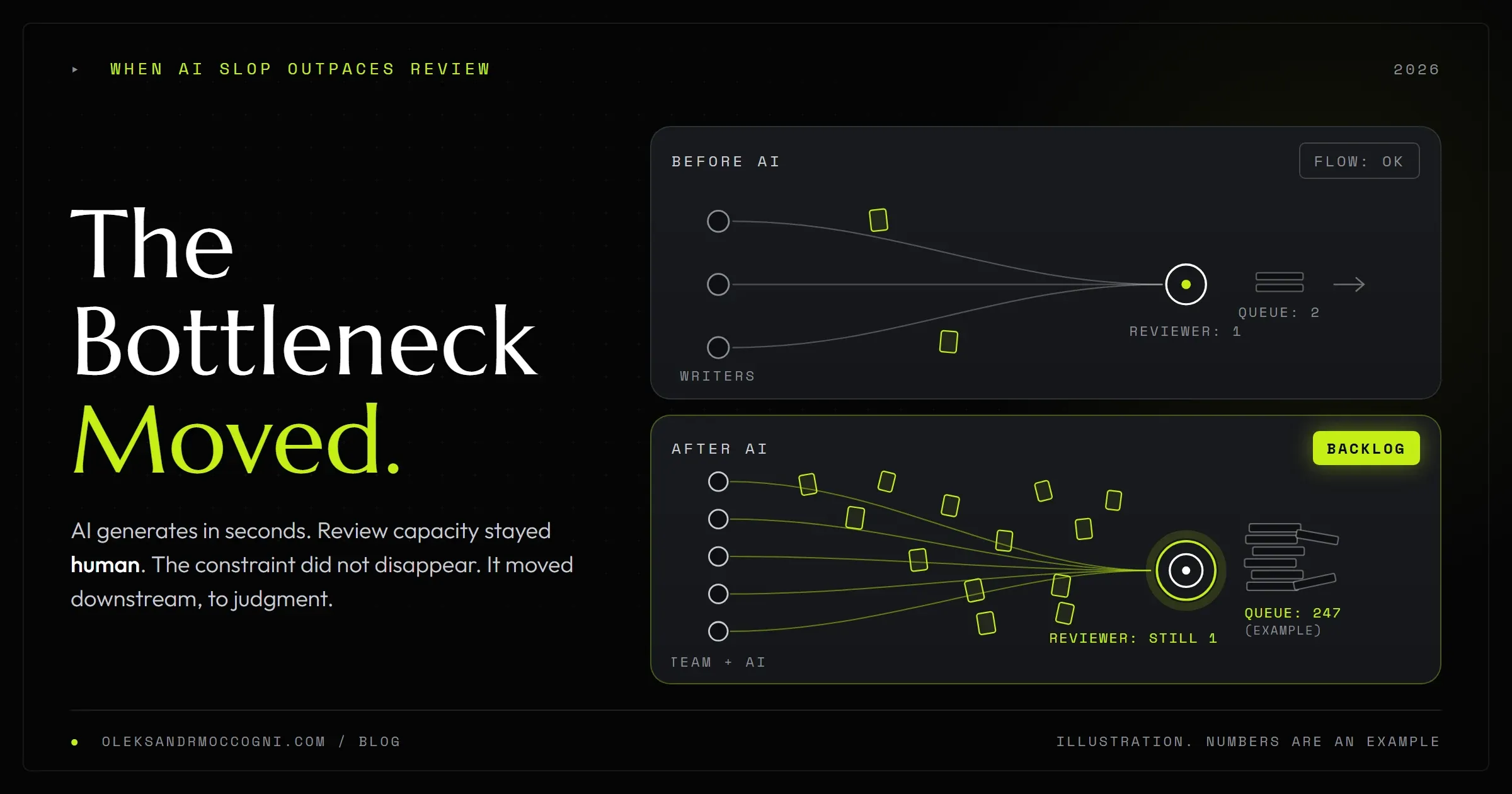
Here is the finding I would tattoo on the inside of every marketer’s eyelids. In two and a half years, not one of my failures happened inside a stage. Every single one happened at the joint where one stage hands off to the next.
Corpus is the clean example. The ingestion logic worked. The failure lived in the handoff between fetching and processing. A malformed feed made the stage exit quietly, nothing downstream complained, and the gap sat open for a week. The fix was not better logic. The fix was making the failure loud.

The newsletter taught the same lesson from the other side. A link that was healthy at draft time can be dead by send time. Nothing inside either stage is broken. The joint between them rotted. The fix is a gate at the seam: every link gets opened before every send, no exceptions.
So when you design a pipeline, spend your paranoia on the handoffs. Ask what happens when stage two receives nothing from stage one. Ask what happens when stage three succeeds on garbage from stage two. The stages are the easy part. The seams are where implementations die.
The Human Gates I Refuse to Remove
Three gates stay human in every pipeline I run, and I will defend each one.
The numbers gate. Every figure in anything that ships gets checked word for word against its source. A model can generate a chart in seconds and quietly swap a label while looking confident. Reading every number against the source costs ten minutes. Being wrong in front of thousands of readers does not have a price you want to pay.
The links gate. Every link gets opened before send. Trivial, boring, non negotiable. It is the only defense against the rotting joint.
The claims gate. Before anything publishes, a human answers one question: is every claim in this true, and would we stand behind it in a sales call? Models are fast typists with no accountability. Accountability stays on this side of the gate.

People ask whether AI can run these gates itself. Partially, and I use automated pre-flight checks everywhere. But an automated gate checks only what it was told to check, and the expensive mistakes are always the ones nobody thought to check for. The machine narrows the field. A human closes it. After two and a half years of daily AI use, that is the one line that has never moved.
Tools Are the Smallest Decision You Will Make
None of the systems above started with a tool choice. They started with a bottleneck, and the tools followed. Python, cron, a chat webhook, an email platform we already paid for. Boring on purpose, because boring is what runs unattended.

The tool lists get this backwards because the tool is the thing they are selling. When you evaluate any AI marketing automation platform, ask two questions. Does it let you inspect what the machine produced before it ships? And does it fail loudly when a stage breaks? If either answer is no, you are not buying automation. You are buying a liability with a nice interface.
The durable asset is not the stack. It is the sequence and the gates. Those survive every tool migration, and they are what turns automation from a one-off project into an operations discipline.
A Sequence You Can Start This Month
If you are starting from zero, here is the order I would climb again, one stage per week.
Week one: notifications. Wire up alerts for the things you check manually. Deploys, leads, form submissions. Zero risk, instant payoff, and it teaches you the pattern: something happens, a machine tells you.
Week two: asset preparation. Compression with a hard size ceiling, resizing, formatting. The least glamorous automation and the one that prevents the most send-day panic.
Week three: drafting. Feed the model structured notes, not a blank page, and keep the human edit. This is the stage everyone wants to start with. It works far better as stage three, sitting on top of notifications and asset prep that already run.
Week four: translation, if you ship in more than one language. Build the glossary before the workflow. The glossary is the moat, not the model.

After that, monitoring dashboards, then lead routing, then whatever your actual bottleneck turns out to be. One rule holds across every stage: run it manually first, automate it second, and add the gate before you need it, not after. The dashboard that watches all of it is the same second brain my agents read from.
What I Will Never Automate
Short list, hard edges. The send decision. Claim verification. Strategy. Anything where the failure would be public and the apology would be automated too.
This is not technophobia. I push AI into more of my work every quarter. It is arithmetic. The machine is cheap, fast, and unaccountable. I am expensive, slow, and the person whose name is on the send. Automating the volume multiplies what I can produce. Automating the judgment would multiply what I can break.
Done right, this work does not make the marketer redundant. It makes the marketer the scarce part: the one who decides what is true, what is worth saying, and what never goes out the door.
Frequently Asked Questions
What is AI marketing automation?
It is a production line where AI does the volume work in marketing, such as drafting, translation, asset preparation, monitoring, and notifications, while a human keeps the judgment. It is not the same as classic marketing automation, which fires preset emails on triggers and has existed for twenty years. The AI version generates volume at each stage, and the gates between stages stay human.
What should I automate first in marketing?
The mechanical tier: notifications, asset preparation, scheduling, and monitoring. It is low risk, the payoff lands within a week, and it teaches you the failure modes on cheap ground. Move to generative stages like drafting and translation only when the boring layers already run without you.
Does AI marketing automation still need human review?
Always. Every system I run keeps human gates on numbers, links, and claims, because failures concentrate at the joints between stages and an automated gate only checks what it was told to check. AI marketing automation works when the machine handles the volume and a person keeps the verification. Drop the review and you have not built a pipeline. You have built a liability with a send button.