ChatGPT Ads: What OpenAI's Official Pages Say as of November 2026 and What Is Still Open
ChatGPT ads are a beta paid channel: labeled units below answers for Free and Go users. Countries, costs, context hints and measurement as of November 2026.
ChatGPT ads are paid placements that OpenAI shows below an answer, labeled as sponsored and kept apart from the answer itself. As of November 2026 the product is in beta, and OpenAI’s Ads FAQ says so in plain words. People on the Free and Go plans may see the ads, and companies buy them through a partner or a self-serve Ads Manager.
Two things get mixed up around this channel. One is the weight of the source: a dated OpenAI page, a trade article and a forum post are not the same kind of evidence. The other is the model: there are no exact keywords to buy.
I work as a Marketing Engineer: Digital since 12, full Marketing since 20. This guide reads OpenAI’s own pages as I found them on November 18, 2026, and marks what they leave open.
Key Takeaways
- Ads sit below the answer. OpenAI labels them as sponsored and says they run on systems separate from the chat model.
- Only some users see them. As of November 2026, ads may appear on the Free and Go plans. OpenAI’s Help page for users lists Plus, Pro, Business, Enterprise and Edu without ads.
- The product is in beta. The self-serve Ads Manager was announced on May 5, 2026, and OpenAI says it has no performance benchmarks yet.
- You do not buy keywords. You write context hints, which OpenAI says inform relevance and are not exact-match keywords.
- You pay for impressions or valid clicks. As of November 2026 the minimum daily budget is USD 25, EUR 15 or CHF 20, depending on the billing currency.
- Several facts are still open. No official page states pilot prices, results by industry or a full list of countries where users see ads.
What Are ChatGPT Ads, and Why Is OpenAI Adding Them?
ChatGPT ads are paid placements inside the ChatGPT product: a company pays OpenAI, and its message can appear under an answer on a related topic. OpenAI’s stated reason is cost. Its Help page for users says: “Keeping the Free and Go plans fast and reliable requires significant infrastructure and ongoing investment”.
The principles came before the product. On January 16, 2026, OpenAI published its approach to advertising. Its second principle, answer independence, reads: “Ads do not influence the answers ChatGPT gives you”.
The Help page for users adds: “Ads run on separate systems from our chat model, and advertisers have no ability to shape, rank, or alter ChatGPT’s responses”. I report both as statements by the seller: neither can be checked from outside.
The same caution applies to results. In an update dated March 26, 2026 to its test announcement, OpenAI wrote of “low dismissal rates of ads”. It published no figure with those words, so I read them as a description and not as a measurement.
As for status, the Ads FAQ puts it this way: “ChatGPT Ads is currently in beta and in the early stages of scaling”. This article covers the paid side only, and I wrote about the unpaid side in what OpenAI confirms about ChatGPT’s interface.
Where Do Ads in ChatGPT Appear, and What Does One Look Like?
The basics page for advertisers answers in one line: “Ads appear below ChatGPT responses”. The test announcement of February 9, 2026 adds that “they are always clearly labeled as sponsored and visually separated from the organic answer”. So the ad is a separate block under the reply, not a sentence inside it.
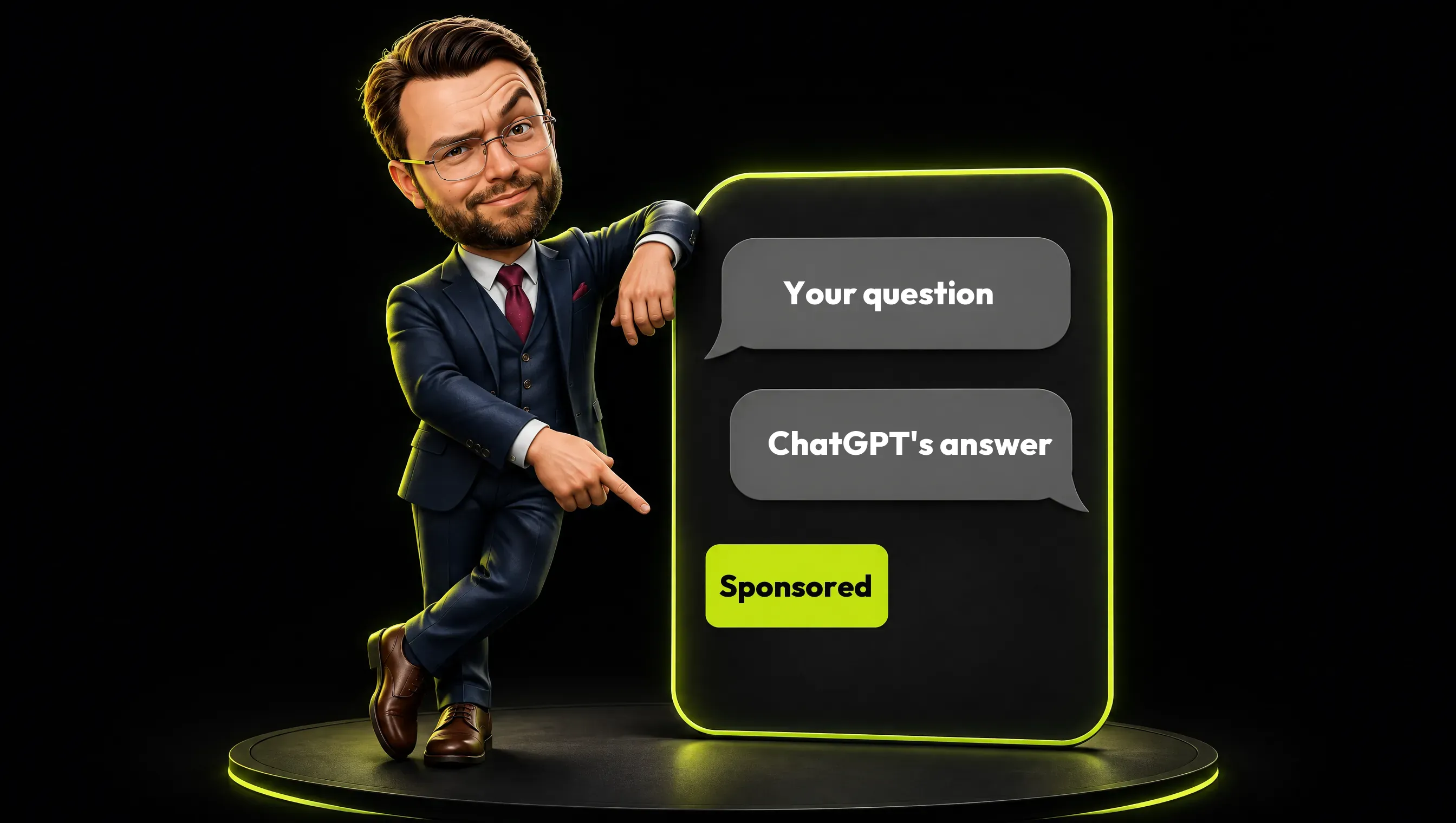
One ad has six parts according to the basics page: advertiser name, favicon, title, copy, landing page and image. The favicon is the advertiser’s small logo, the copy is the short text, and the landing page is the page that opens after the click.
OpenAI’s page on creating ads says: “Starting Monday, October 26, 2026, we’re introducing the multi-image ad format in Ads Manager as an open beta”. That second format takes four to six square images in place of one.
The Help page for users names one more place: “We are also testing a multi-image visual ad format during image generation in ChatGPT”. Below the answer is the main position, and it is no longer the only one.
For users, the Help page describes a menu on each ad with four controls: Hide ad, Report ad, About this ad and Ask ChatGPT. The last one exists because, in OpenAI’s words, “By default, ChatGPT can’t see the ads shown to you”.
Who Sees ChatGPT Ads?
Adults on the Free and Go plans may see ads, as of November 2026. The Help page for users says: “Ads may appear for users on the Free and Go plans”. Go is what the January post calls a low-cost subscription tier, and the plans above it are listed as plans without ads.
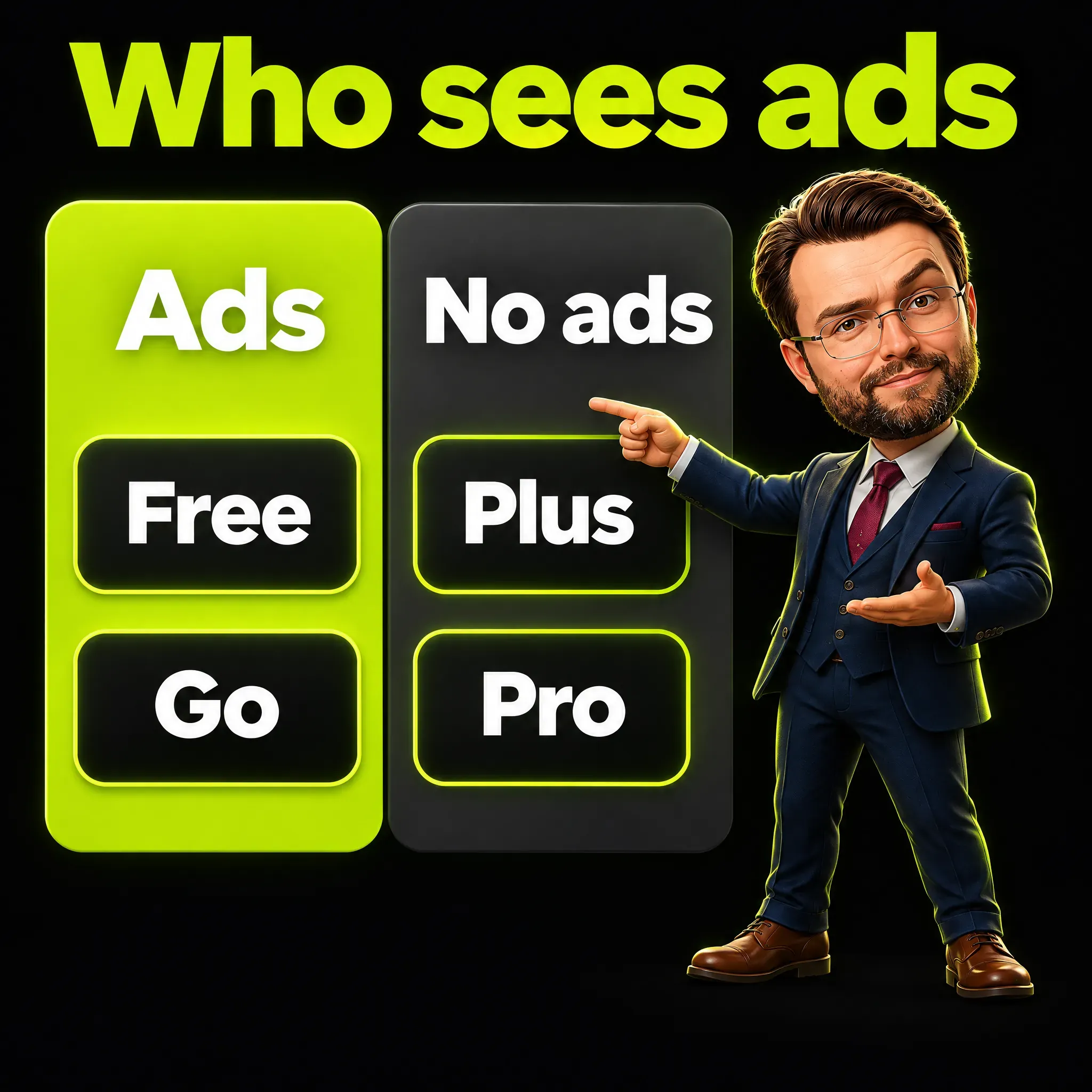
The lists of plans without ads are not identical from page to page, so I show them as written.
| Page | Plans listed without ads |
|---|---|
| Approach post, January 16, 2026 | Plus, Pro, Business, Enterprise |
| Test announcement, February 9, 2026 | Plus, Pro, Business, Enterprise, Education |
| Help page for users | Plus, Pro, Business, Enterprise, Edu |
| Basics page for advertisers | Plus, Pro, any Business plan |
Plus, Pro and Business are on every list. Enterprise and Education (Edu) are missing from some, and no page explains the differences.
Two filters apply on top of the plan. The basics page says ads are not shown to “any accounts identified as belonging to users under 18”. The Help page for users adds: “Temporary Chats will not show ads”.
The topic matters too. The February 9 announcement said that “ads are not eligible to appear near sensitive or regulated topics like health, mental health or politics”. Since version 1.1 of the ad policies, dated April 2026, medical, legal and financial advice contexts are no longer blocked by default, while sensitive conversations remain ineligible.
There is also a way out that costs nothing: the Help page for users describes “a free, no-ads option with additional limits”.
The same page also mentions “Ads shown in logged-out experiences”, with no date and no country. The test announcement covered logged-in adults only, so the point stays open.
What Happened When? The ChatGPT Ads Timeline
Ten months separate the first announcement from today. I built the table from dated lines on OpenAI’s own pages, mainly the test announcement, its later updates and the post titled New ways to buy ChatGPT ads. Every row is an announcement by the company.
| Date | What happened | Where it is written |
|---|---|---|
| January 16, 2026 | Advertising principles published, tests promised within weeks | Approach post |
| February 9, 2026 | Test starts in the United States for logged-in adults on Free and Go | Test announcement |
| March 26, 2026 | First self-reported results, pilots announced for Canada, Australia and New Zealand | Update to the test announcement |
| May 5, 2026 | Self-serve Ads Manager in beta, agency and technology partners, cost-per-click bidding | New ways to buy ChatGPT ads |
| May 7, 2026 | Plan to expand the pilot to the United Kingdom, Mexico, Brazil, Japan and South Korea | Update to the test announcement |
| August 11, 2026 | Launch confirmed in those five countries | Update to the test announcement |
| September 10, 2026 | Ad policies updated, changelog at version 1.6 | Ad policies |
| October 26, 2026 | Multi-image format opens as a beta | Page on creating ads |
One gap is visible. Canada, Australia and New Zealand were announced as pilots in March 2026, and no later official line confirms a launch there.
Which Countries Have ChatGPT Ads as of November 2026?
OpenAI has dated statements for six countries where users see ads. The test began in the United States on February 9, 2026. An update dated August 11, 2026 reports the launch in the United Kingdom, Mexico, Brazil, Japan and South Korea.
The list of countries where a company can buy through self-service is much longer, and it answers a different question.

The August update reads: “ChatGPT Ads has now launched in the United Kingdom, Mexico, Brazil, Japan, and South Korea”.
For buyers, the Ads Manager availability page sets the rule: “the legal entity that will advertise and be billed must be based in a country listed as available below”. When I read it on November 18, 2026, the table listed 89 countries as available. Switzerland, Italy, Germany and the United Kingdom were among them.
That table tells you where the buyer sits, not where the ads run. The same page says advertisers “in the new European markets” can start through the OpenAI Ads Solutions team or through partners, and it does not list those markets.
Two more limits come before the first campaign. The Ads FAQ warns: “Creating an account does not give you access before your country is supported”. The page on creating campaigns notes that “Some new self-serve ad accounts can initially advertise only in their home country”.
Personalized ads are a third limit: the Help page for users says they “are not initially available in the European Economic Area (EEA) or Switzerland”. For a reader in Switzerland, Italy or Germany, the country is on the buyer list, and no dated official line covers users there.
How to Advertise on ChatGPT: Partner or Self-Serve
There are two doors. The May 5 post says: “Advertisers can now create ChatGPT ads through partners or a new beta self-serve Ads Manager”. Partners are agencies and ad technology companies that support the purchase, while self-serve means you open the account and build the campaign yourself.
On the partner side, OpenAI names agency groups “including Dentsu, Omnicom, Publicis, and WPP” and several technology partners. A partner can help with budget, bids and creative, while “OpenAI’s ads system controls all delivery decisions”.
The self-serve route starts at ads.openai.com. The Ads Manager quickstart lists these steps:
- Sign in with an OpenAI account tied to your work email, or create one.
- Add your brand logo in the settings.
- Set up a billing profile and a payment method.
- Complete the account verification.
- Invite the team members who need access.
- Create the first campaign with the guided flow or a bulk upload.
Before step three I would slow down. The billing page states: “An existing ad account’s country/region, billing currency and time zone cannot be changed”.
A campaign sets the goal, budget, dates and targeting. Inside it, an ad group collects ads around one theme and carries the context hints. After you publish, the quickstart says: “Your ads will go live once they pass review”.
How Does ChatGPT Advertising Choose an Ad? Context Hints, Not Keywords
You do not pick search terms. You describe your offer, and OpenAI’s system decides when it is relevant. The page on ad groups calls these descriptions context hints and says they “are not exact-match keywords or targeting rules”.
OpenAI’s own example makes the difference clear: the hint “cushioned everyday running shoes for beginners training for their first 5K” says more than the two words running shoes. The page asks for “clear, specific phrases that describe what you offer, who it helps, or when it may be useful”.
On the order, the Help page for users says: “we consider a combination of factors, including relevance and advertiser bids when deciding which ad to show first”. The test announcement lists the signals used for matching: “the topic of your conversation, your past chats, and past interactions with ads”.
Custom audiences are optional. As of November 2026, the page on creating campaigns sets a floor: “Inclusion targeting requires at least 25,000 matched users; exclusions can use smaller audiences”. For campaigns aimed at the EEA or Switzerland, the same page advises against them while ad personalization is unavailable there.
Exclusions are limited. The basics page says: “Qualifying advertisers can use Negative Phrases for narrow placement requirements specific to their brand’s own policies”.
How Much Do ChatGPT Ads Cost?
There is no price list. You set a budget and a maximum bid, and you pay either per 1,000 impressions or per valid click. An impression is one display of your ad, and the amounts in this section are those on OpenAI’s pages as of November 2026.

The page on creating campaigns offers three goals, and the way you pay follows from the goal.
| Goal in Ads Manager | What the page says about payment |
|---|---|
| Views (CPM) | “You pay per 1,000 impressions served.” |
| Clicks (CPC) | “You pay per valid click.” |
| Conversions | ”You do not pay per conversion.” |
CPM means cost per 1,000 impressions, and CPC means cost per click. A conversion is the action you want after the click, such as a purchase or a contact request. I explained what an impression counts and what it misses in what LinkedIn impressions measure.
On bids, the basics page says: “Advertisers set a maximum bid at the ad-group level”. For click campaigns it recommends “starting with a maximum bid of $3-$5 USD per click”, as of November 2026. I pass that on as the seller’s starting suggestion, not as a price and not as my advice.
The minimum daily budget depends on the billing currency, according to the page on creating campaigns.
| Billing currency | Minimum daily budget, as of November 2026 |
|---|---|
| USD | 25 |
| EUR | 15 |
| GBP | 15 |
| CHF | 20 |
| JPY | 2,500 |
A daily budget is an average over seven days, not a ceiling for the day. The billing page says: “It is not a same-day spending limit”. One day can reach twice the daily budget, while one budget week, from Sunday to Saturday, cannot exceed seven times that budget.
My own example: with an unchanged daily budget of CHF 20, one day can cost up to CHF 40 and one budget week up to CHF 140.
Two billing details are easy to miss. OpenAI bills after delivery, with what the billing page calls “a postpay billing model that charges advertisers after ads have been delivered”. And after a pause, in some cases “ads may continue to appear for up to 24 hours”, and those costs remain billable.
Press reports have mentioned large minimum spends for the early pilot. No OpenAI page states those figures, so this guide leaves them out.
On November 18, 2026, the ads.openai.com page also showed a promotional ad credit with an end date of December 31. I note it with its date and do not treat it as a price.
What Can You Measure, and What Stays Hidden From Advertisers?
You get campaign numbers, not conversations. The basics page lists them: “Ads Manager Beta reporting currently includes impressions, clicks, spend, click-through rate (CTR), average CPC, average CPM, and conversions”. The click-through rate is the share of impressions that turned into a click.
Conversions reach OpenAI in two ways. The Measurement Pixel is, in the documentation’s words, “a browser SDK for measuring website events that can be attributed to ads in ChatGPT”. An SDK is a ready-made piece of code, in this case a script you place on your site.
The second way is the Conversions API, which “sends conversion events directly from your server to OpenAI”. I described that kind of setup in my guide to server-side tracking.
For the links, the page on creating ads says “you may add UTM tags to each ad’s destination URL”. UTM tags are short labels at the end of a link that tell your analytics tool where a visit came from.
Attribution has fixed rules. The pixel documentation says: “View-through conversions use a fixed one-day window after an eligible ad impression”. A view-through conversion follows a display of the ad without a click.
I would not read the dashboard as live. According to the basics page, impressions, clicks and CTR “refresh approximately every 15 minutes”. Spend is slower: it “may be delayed 7-8 hours, so a displayed spend of zero does not necessarily mean no charges have accrued”.
What advertisers do not get is your chat with ChatGPT. The Help page for users says: “We do not share your conversations with ChatGPT with advertisers, and we never sell your data to advertisers”. Advertisers receive “aggregated, non-identifying information about how their ads perform, such as total views or clicks”.
One exception is on the same page: if you message an advertiser through an ad, that advertiser sees the messages you send it directly.
So the platform numbers alone do not tell you what a customer cost. For that you need your own data after the click, the subject of my article on customer acquisition cost.
ChatGPT Ads vs Google Ads: What Carries Over
The measurement habits carry over, and the keyword habits do not. I use Google Ads as the reference because many readers know it. The left column is how I work there, and the right column is what OpenAI’s pages say as of November 2026.
Google’s own Help pages describe the left column: keyword match types and negative keywords, the search terms report and cost-per-click bidding. The last row is my own setup.

| Topic | Google Ads, as I use it | ChatGPT ads, per OpenAI’s pages |
|---|---|---|
| What you write | Keywords with a match type: exact, phrase or broad | Context hints that describe the offer |
| What you can exclude | Negative keywords | Negative Phrases, for qualifying advertisers only |
| What you pay for | The click, in the search campaigns I run | 1,000 impressions or a valid click, never the conversion |
| What you can inspect | A search terms report | Aggregated figures, no conversations |
| How you measure | Browser tag, server send, UTM tags | Measurement Pixel, Conversions API, UTM tags |
The fourth row is the one I would miss most. The reporting list on the basics page names no equivalent of a search terms report. You judge an ad group by its aggregated numbers and by what you measure on your own site.
Which Industries Are Excluded From OpenAI Ads?
Most regulated sectors, as of November 2026. The ad policies were last updated on September 10, 2026. In the test period, ads are “primarily limited to consumer verticals such as lifestyle and household goods, local services, travel and experiences, and digital products or education”.
The same text adds: “These categories may expand over time”. The table sums up the main exclusions as the policies word them.
| Category | What the ad policies say |
|---|---|
| Financial services | ”Ads for financial services outside the US are generally prohibited.” |
| Health services | ”Ads for health services outside the US are generally prohibited.” |
| Legal services | ”Ads for legal services outside of the US are currently prohibited.” |
| Jobs and housing | ”Ads for individual job listings or housing rentals or sales are prohibited.” |
| Adult content | ”Ads for adult content or services are currently disallowed.” |
| Politics | Ads for or against political actors, elections, public policy or contested social issues are disallowed |
| Gambling | Ads for products or services that involve wagering money are disallowed |
| Alcohol and tobacco | Ads that promote their sale, use or consumption are disallowed |
For a company outside the United States, the first three rows matter most. The case-by-case approvals the policies describe for finance and health apply in the US.
Review is mostly automatic: “Most reviews are conducted through automated systems with human oversight and calibration”. It covers the landing page as well as the ad. One more rule protects the reader: “Ads must be clearly distinguishable from the ChatGPT product experience”.
What Is Still Not Confirmed?
Six points, by my count: pilot prices, average results, the countries for users, Europe, logged-out users and stability. As of November 2026, no official page confirms any of them, so treat figures you read elsewhere with care.
- Pilot prices. Minimum spends for the early pilot circulate in the press, and no OpenAI page states them.
- Average results. The Ads FAQ says the platform “does not yet have performance benchmarks across advertisers, industries, or campaign types”.
- Countries for users. Six countries have a dated statement, and the three announced in March 2026 have no later official confirmation.
- Europe. The availability page mentions new European markets without listing them.
- Logged-out users. One Help line mentions ads in logged-out experiences, with no date and no country.
- Stability. The Ads FAQ warns that delivery and spend can “fluctuate during the beta”.
The trade press says the same thing in fewer words. The Search Engine Journal report of May 5, 2026 put it this way: “This platform is still early. Benchmarks are limited”.
Which assistant to use for your own work is a different question. I cover it in Claude vs ChatGPT.
How I Would Prepare Before a First Test
Measurement first, money second. Before I activate any new channel I check that tracking works: the pixel is installed, a test event arrives, and the UTM tags are readable in GA4. GA4 is Google Analytics 4, the analytics tool many sites already use.
The reason is an old lesson from paid search: a low cost per click says nothing until the click is linked to a conversion.
For a new beta channel my method is one precise goal, a fixed end date and then a decision. On the amount, the seller’s Ads FAQ says: “Choose budgets that balance testing a new platform with giving campaigns enough room to deliver and generate meaningful signals”.
This is how I would structure a first test for a company that already runs Google Ads. It is an example, not a real campaign.
- Goal. One conversion event that is already tracked, for example a contact request.
- Ad group. One theme per group, described as a problem such as how to choose X, not as a list of keywords.
- UTM tags.
utm_source=chatgptandutm_medium=paid, read in GA4 with the same standard used for the other paid channels. - Budget. An amount fixed before the start, with the date on which I stop and read the numbers. As of November 2026, if each click cost OpenAI’s suggested starting bid of $3-$5 USD, the USD 25 daily minimum would pay for five to eight clicks.
Where a test like this sits in the plan for the year is a separate question, which I treat in how to allocate a marketing budget.
One thing I would not do is promise a result. OpenAI publishes no benchmarks, so a first test produces information, and I would judge it as information.
A Real Comment: Problems, Not Keywords
One caveat first. What follows is the preview text that a search result showed for a Reddit thread titled “Has anyone tried ChatGPT ads and has any experience?”. The preview names no author.
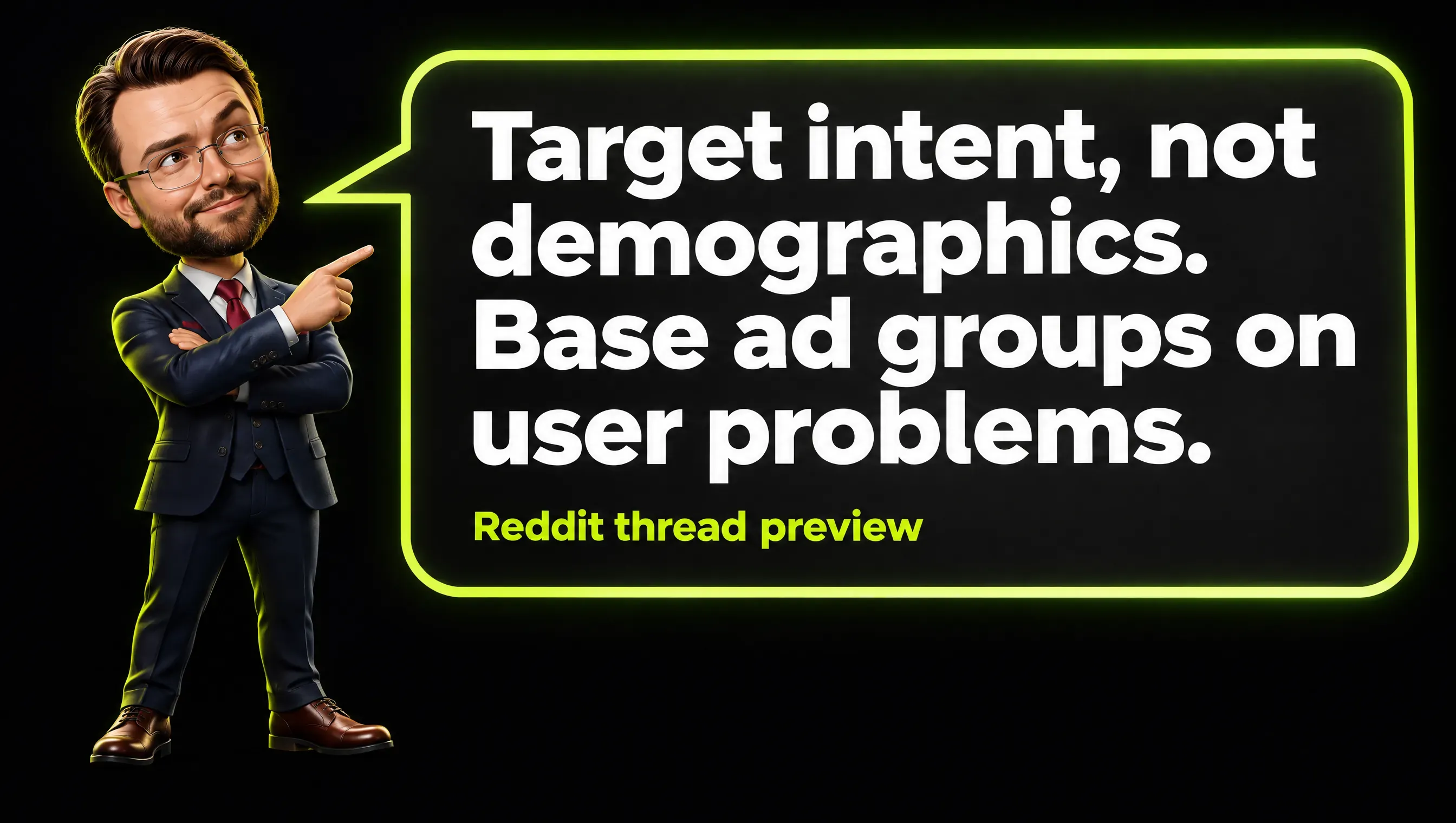
Text from the search preview of a Reddit thread on ChatGPT ads, not from the thread itself.
The preview reads: “Target intent, not demographics. Base ad groups on user problems”.
It continues: “Ditch single keywords. Use context hints”.
I agree with the direction, and it matches what the official pages say about hints. In Google Ads I have spent years choosing match types and reading the search terms report to exclude noise. In ChatGPT ads that routine has no object, because the hints are not exact keywords.
I would add two cautions. The preview shows a few lines from one thread, with no numbers, no author and no account of the experience behind them. And hints remain hints: by OpenAI’s own wording on the basics page, they “do not guarantee delivery in specific conversations”.
Frequently Asked Questions
How does ChatGPT show ads?
Ads appear below the answer, labeled as sponsored and visually separated from it.
Who sees ads in ChatGPT?
As of November 2026, ads may appear for adults on the Free and Go plans. OpenAI’s Help page for users lists Plus, Pro, Business, Enterprise and Edu as plans without ads.
How do I advertise on ChatGPT?
There are two routes: an agency or technology partner, or the self-serve Ads Manager at ads.openai.com. For self-service, the company that pays must be based in a country on OpenAI’s availability list.
How much do ChatGPT ads cost?
You pay per 1,000 impressions or per valid click, within a budget and a maximum bid that you set. As of November 2026 the minimum daily budget is USD 25, EUR 15, GBP 15 or CHF 20, depending on the billing currency.
Is ChatGPT advertising available in my country?
As of November 2026, OpenAI has dated statements about ads for users in the United States, the United Kingdom, Mexico, Brazil, Japan and South Korea. The self-service buyer list is longer, with 89 countries on November 18, 2026.
Can I use keywords in ChatGPT ads?
Not as exact-match keywords. You write context hints, which can describe conversations, topics or keywords, and OpenAI says they guide matching and do not guarantee delivery in a specific conversation.
Can I measure conversions from ChatGPT ads?
Yes, with the Measurement Pixel in the browser, the Conversions API from your server and UTM tags on the destination URL. Reporting shows aggregated figures only, never the conversations.
Do ads change the answers ChatGPT gives?
OpenAI says they do not, and that ads run on systems separate from the chat model. I report that as the company’s statement, because it cannot be verified from outside.
Can I use ChatGPT without ads?
Yes, by OpenAI’s account, as of November 2026. Its Help page for users lists Plus, Pro, Business, Enterprise and Edu without ads. It also describes a free option without ads and with lower limits.
Is it worth testing ChatGPT ads?
Only your own numbers can answer that. Three conditions come first: your category is allowed, your company is based in a country on the buyer list, and your tracking works. As of November 2026 the product is in beta and OpenAI publishes no benchmarks, so nobody can promise a result.
ChatGPT Ads in Short
ChatGPT ads are a beta channel: a labeled unit below the answer, matched by context and paid per impression or valid click. As of November 2026 the official pages confirm the format, the plans and six countries for users, and leave pilot prices and results by industry open.
I write about marketing, AI and the numbers behind them. If this was useful, follow me on LinkedIn.