Claude vs ChatGPT in November 2026: No Universal Winner, Four Questions to Choose
Claude vs ChatGPT as of November 2026: same $20 entry price, top scores three points apart on one index. Four questions and a job map split fact from opinion.
Claude vs ChatGPT has no universal winner as of November 2026. Each company says it leads on its own tests, and the one independent index cited here puts the top models three points apart. The useful answer depends on four things: your task, your files and apps, your daily volume, and how your data is treated.
Most comparisons hand you a scorecard with a winner on each row. That scorecard ages in weeks. On the day I wrote this, OpenAI’s official pages named two model families for the free plan, and Anthropic’s pages had mismatches of their own.
I work as a Marketing Engineer: Digital since 12, full Marketing since 20. I use both tools in my daily work, so this guide links each fact to its official page with a date and marks each opinion as mine.
Key Takeaways
- No one wins everywhere. On the Artificial Analysis index one Claude setting scores 65 and the next four rows tie at 62 across both makers. Each maker leads on its own tests, and the two tables compare different pairs of models.
- The entry price is the same. Claude Pro and ChatGPT Plus both cost $20 per month when billed monthly, as of November 2026.
- The limits are counted differently. Claude draws chat and coding from one pool, while ChatGPT keeps one shared Work and Codex allowance apart from Chat.
- Both can train on personal chats. Both give you a setting that controls it, and both say training is off by default on work plans.
- Pick by job, then test. Run the same real task on both tools for three days and note how long the corrections take.
What Are Claude and ChatGPT, as of November 2026?
Claude is the AI assistant made by Anthropic, and ChatGPT is the one made by OpenAI. Both answer questions, write, read files and search the web. Each runs on a family of models, and a model is the engine that produces the answer, the way two cars of one brand can carry different engines.

As of November 2026, the Anthropic models overview lists four current models: Fable 5.2, Opus 5.5, Sonnet 5.5 and Haiku 5.5. OpenAI names its tiers Astra, Sol, Terra and Luna. The ChatGPT release notes of October 7, 2026 say: “Plus, Pro, Business, and Enterprise use GPT-6 Sol; Free and Go use GPT-6 Luna.”
Astra powers Pro reasoning. OpenAI’s help page on its models calls Luna “the fastest and lowest-cost model in the GPT-5.6 family”, with no such line for GPT-6 Luna.
Names like these change often, which is why every fact below carries a date. I read each page on November 18, 2026, and I suggest you open the linked page before you pay for anything.
Is Claude Better Than ChatGPT? What Each Company Claims
Claude is not better than ChatGPT in a way anyone has proven for all work, and the reverse is equally unproven. Each company publishes tests where its own model comes first. The one independent index cited here puts the leaders three points apart, so treat every claim below as a statement from an interested party.
A benchmark is a fixed set of tasks used to score models, the way a standard exam scores students. Anthropic’s Fable 5.2 announcement of November 9, 2026 includes a table of benchmark results. On a coding benchmark called FrontierSWE v2, it shows Fable 5.2 at 69.9% and GPT-6 Astra at 65.5%.
The same table shows that the publisher does not win every row. On AutomationBench, a test of business workflows, Gemini 4 Carbon, a model from neither company, scores 53.9%. Fable 5.2 is at 51.4% and GPT-6 Astra at 41.4%.
OpenAI’s GPT-6.2 announcement of November 17, 2026 makes the opposite claim. On a benchmark called Agents’ Last Exam, it says GPT-6.2 Astra is “5.5 points ahead of Claude Fable 5.2” at 5% of the cost. A footnote adds: “Its leaderboard results for Fable 5.2 exclude nine tasks that used a fallback model.”
The two tables do not add up to a verdict. Anthropic compares Fable 5.2 with GPT-6 Astra, while OpenAI compares the newer GPT-6.2 Astra with Fable 5.2. Each maker also chooses which benchmarks to show.
The independent figure comes from the Artificial Analysis leaderboard, which scores 115 models on what it calls an Intelligence Index. When I read it, the first row was Claude Fable 5.2 at 65, with the settings Max and Default Fallback. The next four rows all scored 62: two more settings of Fable 5.2 and two settings of GPT-6.2 Astra.
Default Fallback is the page’s own label, and the page does not explain it. The page also tracks cost and time per task, so read each score next to them.
The leaderboard page shows no update date, and the gap changes with the reasoning setting you pick. I read it as one measurement on one day.
Claude or ChatGPT? Four Questions Instead of a Scorecard
Claude or ChatGPT is a choice I would make with four questions about my own work, because the scores are too close. The questions cover the task, the files and apps, the daily volume and the data.
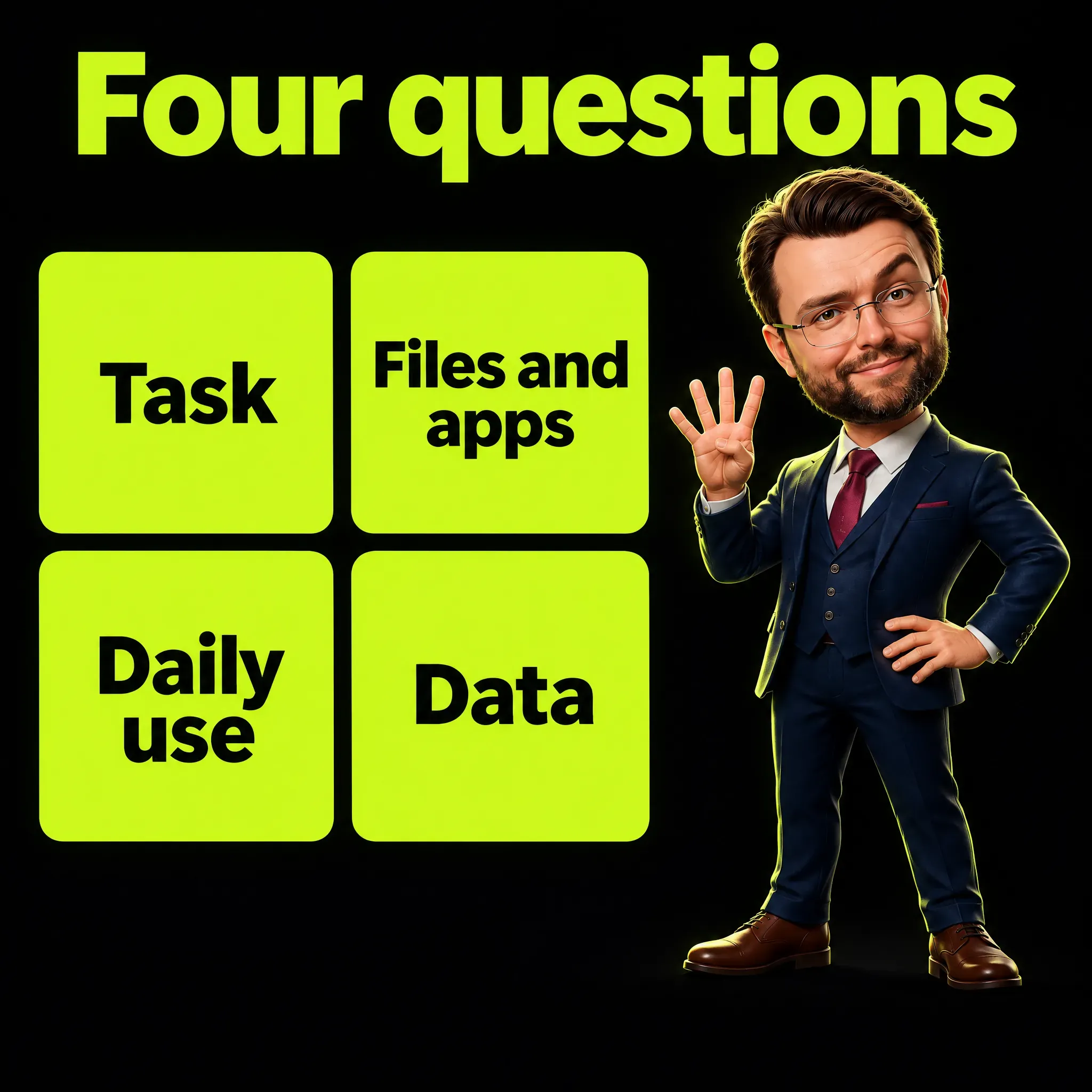
A note on my own position, so you can discount it. In my daily work I use Claude for long work with files and code, and ChatGPT with Codex as the alternative on code and for images. That habit is a bias, so the next sections lean on the official pages and label my opinion as opinion.
Question 1: What Kind of Task Do You Do Most?
Both products cover the common tasks, so start from the one that fills most of your hours each week. Quick questions, long documents, finished files, code and images are different jobs.
The Work and Codex help page describes how ChatGPT splits them: “Chat is for fast, conversational assistance and everyday questions. Work is an agent designed for longer, multi-step work and finished deliverables.” The same page says Codex stays dedicated to software development and technical work.
An agent, in this context, is a mode where the tool carries out several steps on its own, such as reading files and producing a finished report. Claude has agent features too. The Claude pricing page lists web search, file creation and code execution on the Free plan, then Claude Code and task scheduling from Pro.
Question 2: Which Files and Apps Do You Work In?
Check two things here: how much text the tool can hold at once, and whether it connects to the apps where your files live. The published figures are split by plan and model in different ways, so read them as rough.
The context window is the amount of text a model can keep in view in one conversation, like the size of the desk you spread papers on. It is measured in tokens, which are pieces of words, and a million tokens is roughly 750,000 English words, as a rule of thumb.
Claude’s usage and length limits page says that on paid plans “the newest models support up to a 1M token context window” and that others support 500K or 200K.
ChatGPT separates instant models, which answer at once, from reasoning models, which take more time on harder problems. The ChatGPT pricing page lists 256K tokens for reasoning models on Go and Plus and 400K on Pro. Instant models get 27K on Free, 54K on Go and Plus, and 128K on Pro.
ChatGPT’s Work and Codex areas have their own figure: the help page gives GPT-6.1 Sol a default window of 500,000 tokens there. These are each company’s own numbers, so I would test with my own longest file.
For apps, the Claude pricing page lists Claude in Chrome and Microsoft 365 from the Pro plan. The ChatGPT pricing page lists extensions for Excel, Word, PowerPoint and Google Sheets, limited on Free and Go and included on Plus. Both pages also list projects and memory across conversations, with different limits per plan.
Question 3: How Much Will You Use It Each Day?
Neither company publishes a fixed number of messages per day, so nobody can tell you how far a plan will go for you. What the official pages do describe is how each product counts usage. The two designs differ, and the difference matters most if you chat and code on the same subscription.
ChatGPT’s help page on its models says: “Free and Go users have unlimited everyday text chats, subject to abuse-prevention safeguards.” Other tools have their own limits. The page names file uploads, image generation, voice and data analysis, and it says that usage rules in Work and Codex are separate from Chat.
That unlimited label covers everyday text chats only. OpenAI’s pricing table marks them “Unlimited” on Free, Go, Plus and Pro, with a footnote on reasonable use.
The ChatGPT Plus page adds that Plus may include usage limits such as message caps, especially during high demand. The models page states: “A Pro subscription does not include unlimited use of the GPT-6 Pro model.”
Claude counts differently. Its limits page describes “a session limit that resets every five hours, and weekly limits that reset once every week” on paid plans. The pricing page adds that “there’s no fixed message count” and that web, desktop, mobile and Claude Code draw from the same pool.
In my reading, neither design is better in itself. One pool is easy to follow, but a heavy coding day eats into your chats. A separate Work and Codex allowance keeps agent and coding work apart from chat limits, but those two share it, and you watch more than one meter.
Both companies keep room to change the limits. Anthropic writes: “We may adjust usage limits at our discretion to manage capacity and ensure fair access to all users.”
Question 4: What Happens to Your Data?
On personal accounts, both companies may use your chats to train their models, and both give you a setting that controls it. On work plans, both say training is off by default. The differences are in the wording, in how long data is kept, and in ads.
OpenAI’s data usage page says “we may use your content to train our models” when you use its services for individuals, meaning Free, Plus and Pro. The switch is called Improve the model for everyone, under Settings and then Data controls. For work, the page says that by default OpenAI does not use content from ChatGPT Business, Enterprise or Edu to improve its models.
Anthropic’s page on model training says training applies when “You choose to allow us to use your chats and coding sessions to improve Claude”. The switch is called Model Improvement, in Privacy Settings, and the page also names conversations flagged for safety review. For Team and Enterprise, the Claude pricing page says: “No model training on your content by default”.
Both pricing pages label training on personal plans with the same word: opt-out. Anthropic’s privacy page describes a choice you make, and its terms update of August 28, 2025 says a new user selects the preference during signup. Open the setting on the day you sign up.
Feedback is a separate channel: a thumbs up or down sends the whole conversation, and both pages say that feedback may be used to train models. Anthropic says it stores such a conversation for up to 5 years. OpenAI says the use applies even if you have opted out of training.
Both offer a chat mode that stays out of training. OpenAI says: “Temporary chats are not used to improve OpenAI models while they remain temporary”. Anthropic says: “Your Incognito chats are not used to improve Claude, even if you have enabled Model Improvement”.
On retention, meaning how long chats are kept, the sources are thinner. The same Anthropic terms update gives five years if you allow training and 30 days if you do not. That post is almost 15 months old, and the OpenAI training page states no period, so check both before you rely on either.
On ads, the OpenAI ads page says: “Ads may appear for users on the Free and Go plans. Plus, Pro, Business, Enterprise, and Edu accounts will not have ads.” It adds: “Ads do not influence ChatGPT’s answers.”
Anthropic’s pricing page does not mention ads. I read that as an absence on a page and not as a promise. I cover the advertiser side in my guide to ChatGPT ads.
Claude Pro vs ChatGPT Plus: What Do the Plans Cost?
Claude Pro and ChatGPT Plus cost the same when you pay monthly: $20 per month, as of November 2026. Claude Pro drops to $17 per month with annual billing, while OpenAI says Plus has no annual option. Both companies also have a free plan and higher plans that start at $100.
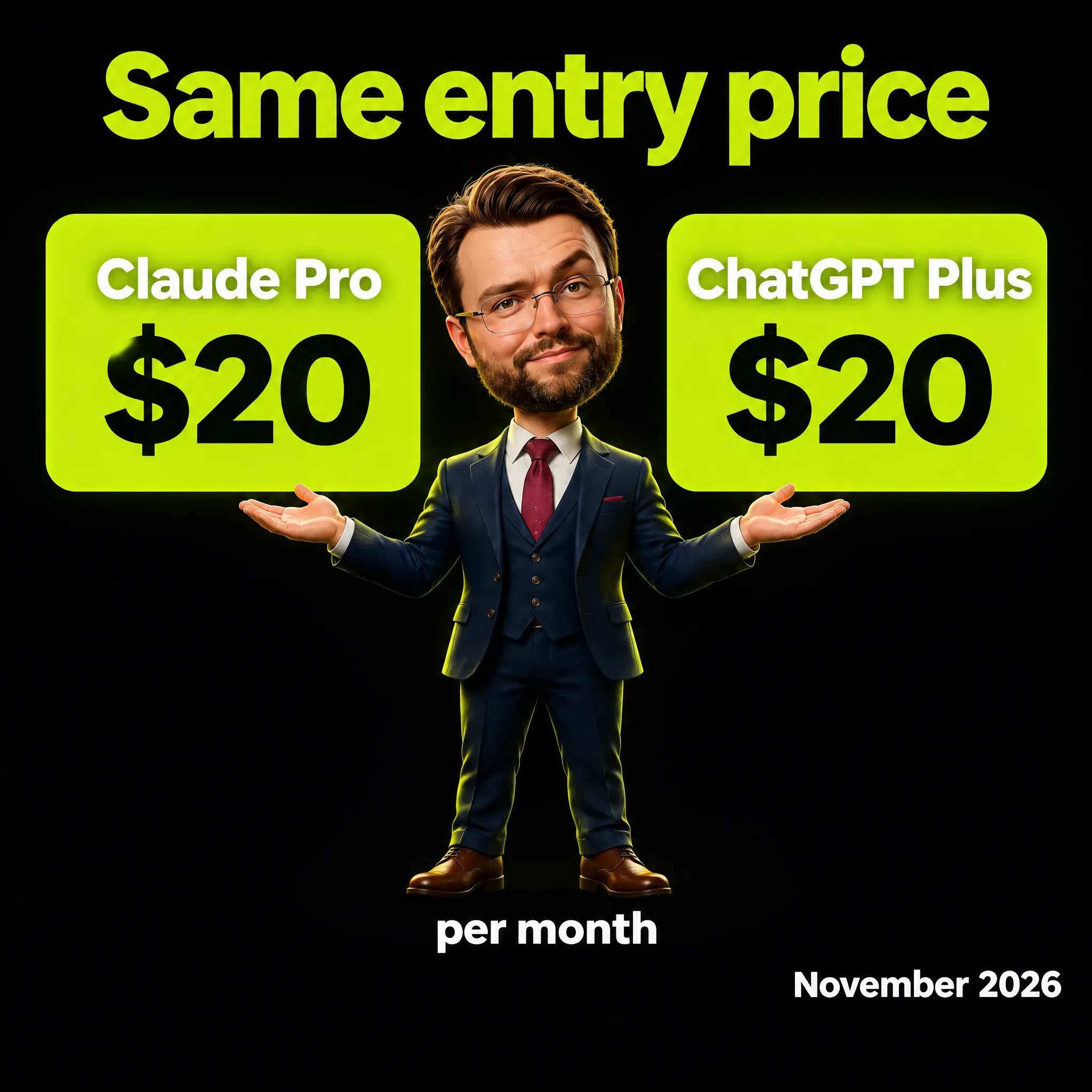
| Plan level | Claude, as of November 2026 | ChatGPT, as of November 2026 |
|---|---|---|
| Free | Free plan | Free plan |
| Entry paid plan | Pro: $20 monthly, or $17 per month billed annually ($200 up front) | Plus: $20 monthly, no annual billing |
| Higher personal plans | Max $100, Ultra $200 | Pro 100 $100, Pro 200 $200, Pro 500 $500 |
| Low-cost plan | None listed | Go: no price in the pricing page text |
| Teams | Team: 2 to 150 people, $20 per person billed annually, $25 monthly | Business: from 2 users, no price in the pricing page text |
The sources, all read on November 18, 2026, are the Claude pricing page, the ChatGPT pricing page, the ChatGPT Plus page and the ChatGPT Pro tiers page.
The higher plans mostly add usage. Anthropic describes Max as “5x Pro usage” and Ultra as “10x Pro usage”. OpenAI’s Pro comes in three tiers, billed monthly only, and its pricing page adds Pro reasoning with GPT-6 Astra.
Which Version of Claude Is the Best, and Which Version of ChatGPT?
The best version depends on the task, and Anthropic itself does not send everyone to its top model. For most coding and knowledge tasks, its announcement says “we recommend that users start with Claude Opus 5.5, our strongest daily driver”. Fable 5.2 sits above it for the most ambitious technical work, with Sonnet 5.5 and Haiku 5.5 below.
Plan access differs. On the Claude pricing page, the Free plan lists Sonnet and Haiku. Fable is paid with usage credits on Pro, and is included on Max and Ultra for up to half the weekly limit.
On the ChatGPT side, Sol is the model for paid plans in Chat, a Luna model serves Free and Go, and Astra powers Pro reasoning. OpenAI’s help page adds that Plus plans include GPT-6 Astra in ChatGPT Work and Codex.
If you build software on these models, you pay per token, and the list prices match at the top as of November 2026. Anthropic lists Fable 5.2 at $8 per million tokens of input and $40 per million of output, and OpenAI lists GPT-6.2 Astra at the same figures. I compare the smaller Claude models in Claude Haiku vs Sonnet for marketing.
Why Do Official Pages Disagree on Which Model You Get?
The most plausible reason is timing: models change within weeks, and pages are updated at different times. A release note of August 6, 2026 announced GPT-5.6 Luna as the default for Free and Go, and one of October 7, 2026 names GPT-6 Luna. On November 18, 2026, two OpenAI pages named GPT-6 Luna for the free plan and two help pages still named GPT-5.6 Luna.

OpenAI’s pricing page lists “Unlimited text chats with GPT-6” on Free, and its plan table marks GPT-6 Luna as included there and GPT-5.6 Luna as not included. The Free tier FAQ says Free users have access to GPT-5.6 Luna. The help page on models says: “GPT-5.6 Luna is becoming the default model for Free and Go users.”
None of the four pages says which statement is current. Anthropic’s pages need the same care. Its pricing page limits Free usage “every 5 hours and every week”, while its own FAQ says “paid plans add weekly limits on top”.
That page also carries no date, and the retention figures come from a post dated August 2025.
What I take from this: put the date next to every model name. For the background on OpenAI’s release pace, see my piece on the GPT-6 release date.
Claude Code or Codex: Which One for Coding and Automation?
Both companies offer a coding tool that works in the terminal, the text window where developers type commands. Anthropic’s is Claude Code and OpenAI’s is Codex. No independent test among the sources settles which one writes better code for your project, so the practical differences are access and limits.
Codex appears on every personal ChatGPT plan: limited on Free and Go, included on Plus and expanded on Pro, according to the pricing page. For Claude Code, Anthropic’s pricing page says it “is included in all paid plans.”
The limits follow Question 3. Claude Code shares one pool with your chats, and Codex draws on the Work and Codex allowance, apart from Chat. If you code all day, I think that detail weighs more than a benchmark.
In the summer of 2026 I spent about a month evaluating a move from my coding tool to the other maker’s. On my work the models were on par. What weighed on the decision was usage limits and the cost of switching, because skills, scripts and connections would have to be rebuilt.
Both pricing pages list skills, which are folders of instructions, and sometimes scripts, that a tool loads for a recurring job. I explain the Anthropic version in my guide to Claude Skills.
Your month could end the other way, so compare the tools on real work and count the cost of rebuilding your setup.
Claude vs ChatGPT for Writing: Is There Proof?
No. For writing and marketing copy, no source with a declared method settles which one writes better, so anything you read on that point, including from me, is opinion.
The check I trust is the three-day test from the takeaways, run on your own copy. Example: the same client brief and the same three files, given to both tools on Monday, Tuesday and Wednesday, with the correction minutes written next to each draft.
My article on ChatGPT for marketing covers that tool’s limits on the job, and in my experience most apply to any assistant.
Should You Use ChatGPT and Claude at the Same Time?
Yes, if each one covers a job the other does not cover for you. Two entry plans cost $40 per month as of November 2026, so the second tool should earn its place with a task you can name.

Images are the clearest example in my own work. The ChatGPT pricing page lists image creation on every personal plan, limited on Free, and the release notes announced ChatGPT Images 2.6 on November 4, 2026. Anthropic’s pages do not list image generation among the features, which is not proof that Claude cannot do it.
So I generate reference visuals for a page with ChatGPT’s image generator, and the building and checking happens in the other tool. If images are your main job, my comparison of GPT Image 2 vs Nano Banana 2.1 covers the price per image.
For a small business, I would start with one plan, write down the tasks where it falls short, and add the second tool only for those.
When to Choose Claude and When to Choose ChatGPT: A Job Map
Choose Claude or ChatGPT one job at a time. The official pages give Claude’s newest models the larger published window for long documents on paid plans. For ChatGPT they list image creation and unlimited everyday text chats on every personal plan.
The map below sorts common jobs by what the sources say, and its last column shows where each line comes from. No row names a winner for everyone, because the evidence supports none.
| Job | What the sources say, as of November 2026 | Kind of evidence |
|---|---|---|
| Everyday questions | Both free plans cover them. ChatGPT states unlimited everyday text chats on its personal plans, with safeguards. Claude publishes no fixed message count. | Official pages |
| Long documents | Claude: up to 1M tokens on paid plans for the newest models, 500K or 200K for others. ChatGPT: 256K on Go and Plus and 400K on Pro for reasoning models, 500,000 in Work and Codex with GPT-6.1 Sol. | Official pages |
| Images | ChatGPT lists image creation from the Free plan. Anthropic’s pages do not list image generation. | Official pages |
| Coding and automation | Claude Code on all paid plans, same pool as chat. Codex from the Free plan with limits, on the shared Work and Codex allowance. | Official pages |
| Client or sensitive data | Training off by default on the work plans of both. On personal plans, a setting on both. | Official pages |
| Overall model score | First row Claude Fable 5.2 at 65. Next four rows at 62, split between Fable 5.2 and GPT-6.2 Astra. No update date on the page. | Third party: Artificial Analysis |
| Marketing copy | No source with a declared method. I test both on the same brief. | My opinion |
| Tone and personality | Personal taste. Public comments point in both directions. | My opinion |
The test I suggest is small. Take one real task from your week, run it on both tools for three days, and note how long you spend correcting each result.
Whichever tool you pick, check its output before it reaches a client. In my experience both can state wrong things with confidence, and I describe my checking routine in human in the loop AI.
A Real Comment: Benchmarks Do Not Settle Which Is Better
The search preview of a public Reddit thread that compares the two tools shows a comment about benchmarks. The preview is all I quote: it was marked as eight months old and shows no username.
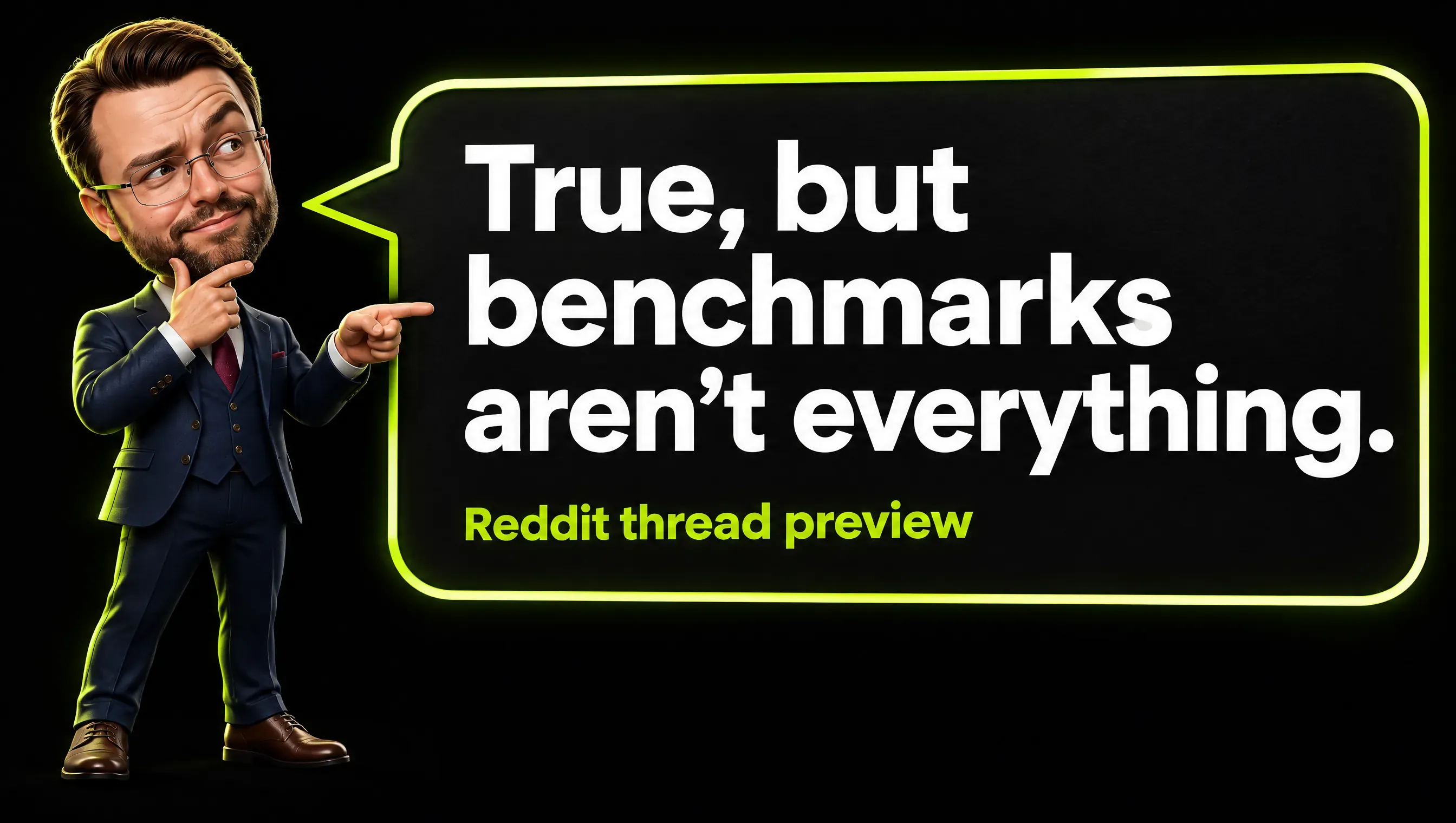
Real comment, as shown in the search preview of a Reddit thread on ChatGPT and Claude.
The comment reads: “True, but benchmarks aren’t everything.” It goes on to say that real-world performance and use cases matter as much when you compare the two.
I agree, with one condition. Real use beats scores only if you measure it, and it is easy to replace the benchmark with a feeling.
Personal verdicts point in opposite directions too, and these two come from search previews as well, with no usernames shown. The preview of another Reddit thread, also marked as eight months old, shows “It depends on what you’re looking for.” and then “I like Claude’s personality a LOT more”.
A public Facebook group post, in a preview two days old, puts ChatGPT ahead: “I use both daily and it’s not ever a fair fight at this point”. The two writers disagree, and neither comment is a measurement, so the verdict that applies to you comes from your own test.
Frequently Asked Questions
Is Claude better than ChatGPT?
Not for everyone, and not provably. As of November 2026, the Artificial Analysis index has one Claude setting at 65 and four rows tied at 62 across both makers. Each company leads on its own tests, which compare different pairs of models, so choose by your task, files, daily use and data needs.
Claude or ChatGPT for marketing and writing?
No source with a declared method settles it. Give both the same brief and the same files, then compare how long you spend correcting each draft.
Is Claude AI totally free?
No, only in part. Claude has a Free plan with web search, file creation, code execution and memory, and its usage is limited every five hours and every week. Paid plans start at $20 per month, or $17 per month with annual billing, as of November 2026.
ChatGPT vs Claude: which one is cheaper?
At the entry level they cost the same: ChatGPT Plus and Claude Pro are both $20 per month when billed monthly. Claude Pro drops to $17 per month with annual billing, and OpenAI says Plus has no annual option.
Which version of Claude is the best?
Anthropic recommends starting with Claude Opus 5.5 for most work and keeps Fable 5.2 for the most ambitious tasks. Sonnet 5.5 and Haiku 5.5 cost less, and the Free plan lists Sonnet and Haiku.
Can Claude generate images like ChatGPT?
As of November 18, 2026, Anthropic’s pages do not list image generation among Claude’s features. ChatGPT lists image creation from its Free plan, and OpenAI announced ChatGPT Images 2.6 on November 4, 2026.
Does ChatGPT or Claude train on my chats?
On personal accounts both can, and both offer a setting that controls it. On work plans such as ChatGPT Business and Claude Team, both companies say training is off by default.
Is Claude better than ChatGPT for small business owners?
Neither is better by default for a small business. Start with one $20 plan, run the three-day test on real tasks, and look at a work plan if you handle client data.
Claude vs ChatGPT in Short
Claude vs ChatGPT has no single winner in November 2026, with equal entry prices and top scores three points apart. Answer the four questions, test both on one real task, and write the date next to your choice.
I write about marketing, AI and the numbers behind them. If this was useful, follow me on LinkedIn.