LinkedIn Algorithm: What LinkedIn Wrote, What Studies Measured, and What Is Only Repeated
The LinkedIn algorithm ranks posts from your interaction history, not from tricks. What LinkedIn wrote, what studies measured, and a table of widespread rules.

The LinkedIn algorithm is the system that decides which posts appear in each member’s feed, and in which order. As of November 2026, LinkedIn describes it as a model that reads your profile and your past interactions, then predicts what you will read next. LinkedIn has published less about it than most guides suggest.
Statements about the feed come in three kinds. Some were written by LinkedIn, some were measured by third parties on a sample of posts, and some are only repeated from guide to guide. On links in posts, the first two kinds point in different directions.
I work as a Marketing Engineer: Digital since 12, full Marketing since 20. In this guide every claim carries one of those three labels, with a link to its source.
Key Takeaways
- The feed reads your history. LinkedIn says its ranking model processes more than a thousand of your past interactions, together with profile details such as industry and skills.
- Reading time counts. Dwell time, the seconds a post stays on your screen, has been a documented signal since 2020.
- Links are an open question. A LinkedIn product director is reported to have said reach is not limited on purpose, while two studies measured 16% less reach and 36% fewer impressions.
- The first hour has no official source. A 2026 analysis of over 1.2 million posts found that 85% of a post’s reach arrives after its first two hours. Slow starters still rarely beat the author’s average.
- Some behavior is officially fought. LinkedIn names engagement pods, meaning groups that agree to like and comment on each other’s posts, and automated comments.
- Your own average is a useful reference. In the same newsletter, a creator’s past average explained 51% of the differences in reach between posts.
What Is the LinkedIn Algorithm?
The LinkedIn algorithm is the ranking system behind the feed, the stream of posts you see when you open LinkedIn. For every member it picks candidate posts and puts them in order. According to LinkedIn’s engineering blog, the feed serves more than 1.3 billion professionals.

In March 2026 LinkedIn announced a new generation of this system in its newsroom post on improving the feed. It wrote: “We’re upgrading how the Feed ranks content using larger sequence models, known as Generative Recommenders, augmented with large language models (LLMs)”.
A sequence model reads your actions in order, like a list of what you read, skipped and commented on. A large language model, or LLM, is the kind of AI behind chatbots, used here to understand what a post is about.
Many guides call the new system 360Brew. The name comes from the January 2025 research paper on 360Brew, which describes a model trained on LinkedIn’s data. The paper presents it as “our research pre-production model”, so it does not describe a system live for members.
The official feed pages I read for this guide do not use that name. As of November 2026, the name those pages use is Generative Recommenders, so I would not call the live feed 360Brew.
How Does the LinkedIn Algorithm Work in 2026?
It works in two steps. First a retrieval step picks candidate posts for you out of everything published, then a ranking model puts those candidates in order. LinkedIn’s engineering blog describes the ranking model as sequential, which means it reads your past actions in order, as one story.
The model starts from what you tell LinkedIn about yourself. The newsroom post says the models “look at signals you choose to share, like your industry, skills, experience, and geography, alongside how you engage with content over time”.
The second input is behavior. Instead of scoring each post in isolation, the engineering blog says the model processes “more than a thousand of your historical interactions”. It predicts two groups of actions: “passive tasks (click, skip, long-dwell) and active tasks (like, comment, share)”.
LinkedIn gives an example: you engage with a post about machine learning on Monday, with distributed systems content on Tuesday, and open LinkedIn again on Wednesday. The blog comments: “Traditional models see three independent decisions; a sequential model understands the trajectory”.
Many third-party guides describe three or four fixed stages, with a first test on a small audience. That sequence is not in the official texts I read, so I treat it as a description by outside authors.
A quality filter is official, and LinkedIn’s help page on feed relevance describes it. It says: “These algorithms also filter out or taper distribution of low-quality and unsafe content to enhance the value of what you see on your Feed”.
Which Signals Does LinkedIn Say It Uses?
LinkedIn’s help page says it “evaluates three main types of signals”: identity, content and activity. Identity is who you are on your profile, content is what a post is about, and activity is what you do in the feed. The page gives no weights for them.
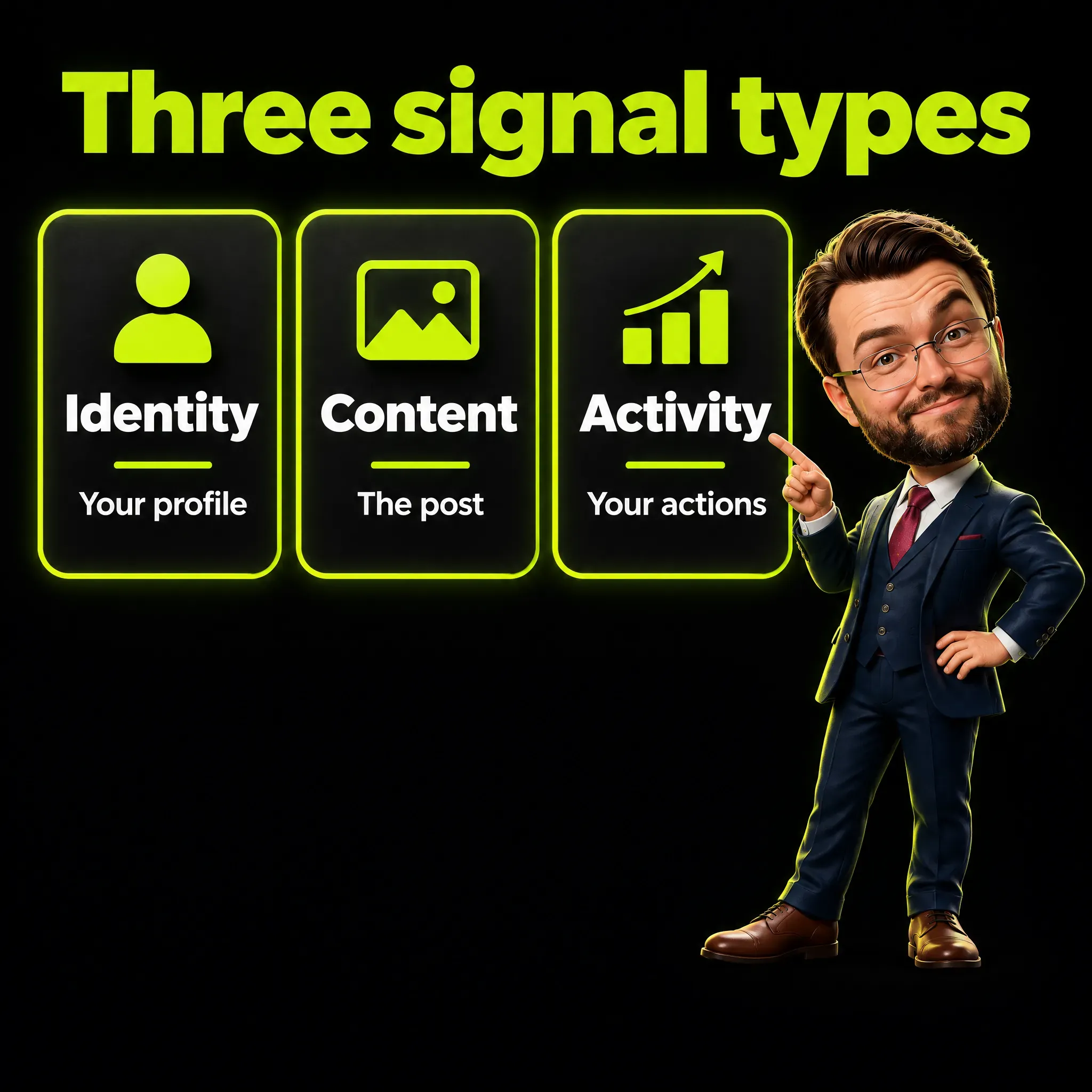
Content covers how often a post is viewed or engaged with, how recent it is, and “whether it provides knowledge or advice”. Activity covers the content you spend the most time viewing and the people you interact with often or recently.
The same texts say what stays out. The engineering blog says ranking relies on professional signals and engagement patterns, “never demographic attributes”.
The author’s side counts too. Tim Jurka, a vice president of engineering at LinkedIn, covers it in his August 2025 article on how the feed works. He writes that the system factors in the author’s professional identity, “such as experience, content shared on their profile, and skills”.
That is one reason I would fill in the profile before working on posts. My guide to LinkedIn profile optimization covers the steps.
Some guides put a percentage or a weight next to each ranking signal. Those figures are the authors’ estimates. LinkedIn published no weights for its signals in the texts I read.
What Is Dwell Time, and Why Does It Matter?
Dwell time is the time a post stays on your screen, measured in seconds. LinkedIn explained it in its 2020 engineering post on dwell time and still lists reading time among its signals. It matters because many members read without clicking or reacting.
The 2020 post gives the reason: “Click and viral actions can be rare, especially for passive consumers of the feed”.
The count on the feed “starts measuring when at least half of a feed update is visible”.
The newer model keeps this signal. The research paper on LinkedIn’s sequential feed ranker defines it as “Long Dwell: dwelling on a post longer than a specified threshold of time, depending on the post-type”. The paper does not state the threshold, so I would distrust any guide that names a number of seconds.
Reading time is one reason I give my own drafts room to explain what happened, show one number and say what it means. That is an editing habit, not a promise of reach.
What Changed in the LinkedIn Algorithm in 2026?
In March 2026 LinkedIn moved feed ranking to the Generative Recommenders described above, and wrote that the changes were already rolling out. It also said it was working to make engagement pods and automated comments ineffective, and to filter out posts built only to collect reactions over the following months. By October 2026 it had extended its automatic filters for low-quality AI content.
LinkedIn framed the goal in one line: “We want the Feed to be relevant to your interests, not a popularity contest”.
The system also keeps moving. Gyanda Sachdeva, a vice president of product management at LinkedIn, answered the question in her December 2025 list of top feed questions: “Yes, the algorithm is always changing”. She adds: “Not every change is noticeable right away, and some experiments don’t work, so we roll them back”.
Widespread Rules: Official, Measured or Only Repeated?
Rules about the feed come from three kinds of sources: LinkedIn itself, a third party that measured a sample, or guides that repeat each other. The table below shows eight rules, with what each source says and where each rule stands today. A study is a measurement on one sample in one period, not a rule of the platform.
| Widespread rule | What LinkedIn says | What studies measured | Status |
|---|---|---|---|
| Links in a post reduce reach | A product director reportedly said reach is not limited on purpose | 16% less reach in one study, 36% fewer impressions in another | Open question |
| Put the link in the first comment | Nothing in the official texts | One author reports hidden comments and fewer conversions; other tests reported by ContentIn found no difference or the opposite | Not official; figures disagree |
| The first hour decides everything | Nothing in the official texts | One author found 85% of reach after the first two hours, and only 8% of slow starters above the author’s average | Not official; one analysis points the other way |
| Engagement pods help | It works to make them ineffective | No sample in my sources | Officially fought |
| Hashtags increase reach | Hashtags do not impact distribution | No sample in my sources | Officially denied |
| Editing a post hurts it | Nothing in the official texts | One author advises editing at most 5%, with no method | Only repeated |
| More than one post a day hurts | It will not hurt total reach, though per-post engagement may fluctuate | Buffer measured more impressions per post in busier weeks; Ordinal cites a Linkboost figure of lower reach per post at two or more posts a day | Denied for total reach; per post, figures disagree |
| The feed model is called 360Brew | The feed pages name Generative Recommenders | A 2025 research paper uses the name for a pre-production model | Not confirmed for the live feed |
Do Links in Posts Reduce Reach?
A LinkedIn product director is reported to have said that reach is not limited on purpose, while two third-party studies measured lower numbers for posts with links. One found 16% less reach, the other 36% fewer impressions. Both statements can be true together, because a study shows what happened to a sample and not why.
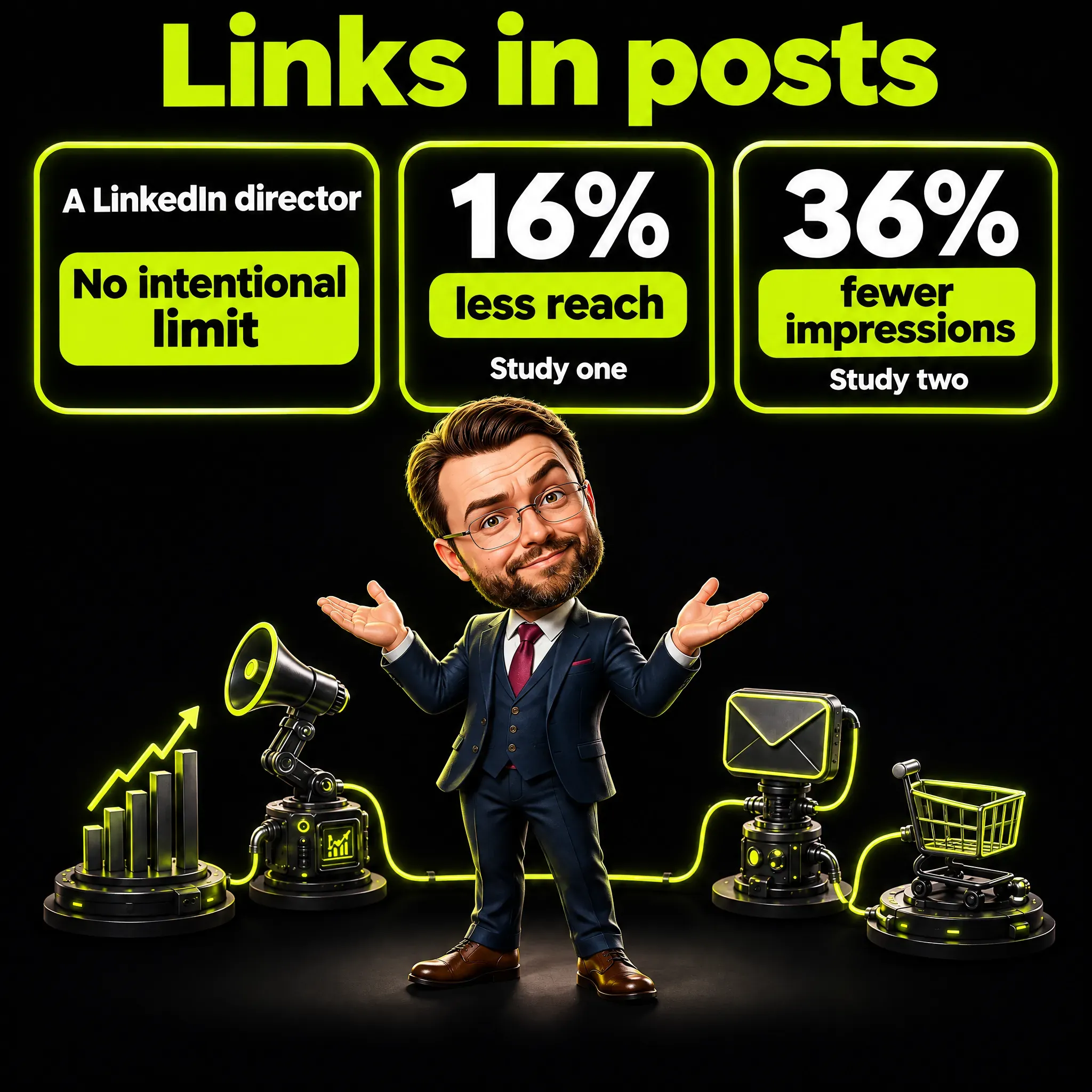
The official side comes second-hand. ContentIn’s article on links in posts reports a 2025 video answer by Rishi Jobanputra, a senior director of product management at LinkedIn. His words, as reported: “We don’t intentionally limit the reach of posts with links in it”.
The sentence reaches this guide through ContentIn’s article and not through the original video, so I pass it on as reported. Jack Appleby, who questioned LinkedIn executives in March 2026 for his Future Social newsletter, reports the same position. In his summary, the algorithm does not judge a post differently because it links to another site.
The first study is by Richard van der Blom, the author of a paid report on the LinkedIn algorithm. His July 2026 newsletter on links and reach is based on “close to 300,000 posts published between March and June 2026”. Its result: “A single external link now costs a post 16% of its reach”.
He adds that the figure was 18.8% in April. The detailed data sit in his paid report, so the method is not open to check.
The second number comes from LinkPost research, as reported in Ordinal’s article on the link study. It covers 358,000 posts published in 2026 from mixed account types. Posts with a link had a median of 448 impressions against 705 without one, a gap of 36%.
The median is the middle value, with half of the posts above it and half below. Ordinal adds two cautions.
The first is about account type. Ordinal says that in its own data company pages absorb the gap “while personal profiles show almost none”, but it publishes no figures for this split. A Metricool study reported by ContentIn found the opposite: fewer impressions for personal profiles with links, more for company pages.
The second caution is about cause. Ordinal calls the gap “an observed correlation across large samples”. A correlation means two things move together, without proof that one causes the other.
Van der Blom adds one exception: “LinkedIn Newsletters are not penalized for external links”. I cover that format in my guide to the LinkedIn newsletter.
Should the Link Go in the First Comment?
No official LinkedIn text recommends it. The link in the first comment is a habit that spread from guide to guide, on the idea that a post without a link travels further. The published figures do not agree with each other.
In the same July 2026 newsletter, van der Blom writes: “LinkedIn now actively hides comments that contain links, from everyone except the author”. He reports that in up to 80% of cases such a comment is not shown under the default relevance filter. No official text confirms this.
His second figure is about results: “A link placed in the original post now converts 5.2 times better than the same link dropped in the comments”. To convert means that the reader does what the link asks, for example opens the article or signs up.
Other figures point elsewhere, and I read them only as reported in ContentIn’s comparison of link studies. A MagicPost comparison across 1,824 creators found a 2% difference between the two placements. In older GrowthRocks tests, posts with the link in the comment reached 2.9 times more people, and 1.8 times in a 2021 rerun.
In my own drafting rules, link in the first comment is marked as a candidate: common practice, not proven. The rule I hold firmly is a different one: a post that points to an article is ready only once the article is online.
To check it on your own posts, alternate the two placements on similar posts for six to eight weeks, the length ContentIn suggests for a fair test. Then compare the medians, not single posts.
Does the First Hour Decide a Post’s Reach?
No official LinkedIn source says so. The golden hour, the idea that the first 60 minutes after posting decide everything, is a widespread claim with no LinkedIn source behind it. The one large measurement in the sources points the other way: most reach arrives later.

In his November 2026 newsletter on the first hour, van der Blom draws on “more than 1.2 million posts”. His main number: “In 2026, 85% of a post’s reach arrives after its first two hours”.
There is a nuance. He writes: “Of all posts that get no substantial engagement in their first 120 minutes, only 8% end up above the creator’s average”. Both numbers hold together: most reach arrives late, and a post with a silent start still rarely beats the author’s average.
This is one author’s analysis of his own data set, and the full method is not public. Several blogs by companies that sell LinkedIn tools still advise chasing comments in the first hour or two, without publishing a sample. I would not plan my day around either claim.
Do Hashtags Still Help?
Not for reach, according to LinkedIn. Sachdeva’s December 2025 answer is direct: “Hashtags do not impact distribution so no need to include them”. She adds that you can keep them for your own tracking, or to help members who search, because hashtags are clickable.
Appleby’s report from March 2026 uses a softer image: “Think of hashtags like a steering wheel, not a gas pedal”. In his summary, hashtags can help content reach the right audience without increasing reach.
Does Posting More Often Hurt Reach?
LinkedIn’s own advice is two to five posts a week. The sentence stands on its page for creators and in Sachdeva’s list: “Aim to publish between 2-5 posts per week”. More than one post a day is fine by her account: “posting more than once a day won’t hurt your total reach”.
She adds a limit: “If you share several posts close together, members will likely see the one that is most relevant to them”. She also notes that “your per post engagement may fluctuate”. The help page on posting sets the outer limit: LinkedIn may limit the visibility of posts when it detects excessive posting or an automation tool.
Third-party data points in the same direction. Buffer’s analysis of posting frequency, published in August 2025, covers “over 2 million posts from 94,000+ LinkedIn accounts”.
Buffer compared busier and quieter weeks of the same accounts. Two to five posts a week meant 1,182 more impressions per post than one post a week. The engagement rate, the share of viewers who interact with a post, was 0.23 percentage points higher.
Buffer’s article sums it up: “The more often you post, the further each post travels”. Buffer’s data scientist read the same data a second way and reported lower reach per post, and I compare the two in my guide to LinkedIn content strategy.
One company that sells LinkedIn tools disagrees on the detail. Ordinal’s guide to posting frequency says: “Engagement rate stays roughly flat whether you post once or six times a week”. It also tells readers to “Space posts at least 24 hours apart”, and it publishes no sample of its own for either line.
For two or more posts a day, the same guide cites a Linkboost figure: a median reach drop of over 40% per post.
I would pick a pace that survives a busy month and judge it against your own average. Days and hours are in my guide to the best time to post on LinkedIn.
What Does the LinkedIn Algorithm Penalize?
LinkedIn names four things it limits: engagement pods, automated comments, engagement bait and low-quality content. Engagement bait means posts built only to collect reactions, such as prompts to comment a word to agree. Each of the four appears in an official text from 2025 or 2026.

On pods, Social Media Today quoted a LinkedIn post by Sachdeva in November 2025: “Our goal is to make engagement pods entirely ineffective”. For content flagged as artificially boosted, her post says “we are limiting the reach of this content”. The same article notes that pod activity violates LinkedIn’s Terms of Service.
Automation is covered too. Jurka’s article on the March 2026 feed updates names comment automation, “including the use of third party software or browser extensions, which are not allowed on LinkedIn”. Sachdeva’s list says the same: “automating comments by using a third party program is against our community policies”.
On engagement bait, the March 2026 newsroom post promises fewer posts “that are designed purely to game distribution”. Low-quality content is the topic of the next section.
Editing is a different case: no official text sets a rule for it. Van der Blom advises to “never edit more than 5% of your original copy”, which is one author’s advice with no published method.
How Does LinkedIn Treat AI-Generated Content?
LinkedIn does not forbid writing with AI. It limits what is often called AI slop, in Jurka’s words “the generic, repetitive content”. Posts that its classifiers flag are shown to fewer people, and a classifier here is a model that sorts posts into categories.
In his October 2026 article on AI slop, Jurka writes that the classifiers were expanded “to cover all posts that are distributed beyond your immediate network”. He reports “94% precision at detecting AI-slop”. Precision means that out of 100 posts flagged, about 94 are flagged correctly.
The effect LinkedIn reports is its own figure: “as of August 2026 members are experiencing 40% fewer views on what we classify as AI-slop”. The comparison is with a few weeks earlier, and no outside party checks the number in my sources.
I wrote about the review side of this problem in my article on AI slop and the review bottleneck.
Which Formats Does the Algorithm Favor?
No official text ranks one format above another. LinkedIn gives advice on how to write and film, and says that reach moves with the content itself. Rankings of formats by average reach come from third-party samples, so I read them as measurements.
Sachdeva’s writing advice is short: “A strong first sentence, a clear point of view and a simple narrative”. She also explains the swings every author sees: “Distribution and reach naturally fluctuate based on what you’re posting”.
For one format in detail, my guide to the LinkedIn carousel covers the document post.
A Real Post: The Link Rule LinkedIn Never Confirmed
A member of the Skool community Scale Camp summed up the link rule in a few lines. The post is from March 16, 2026.
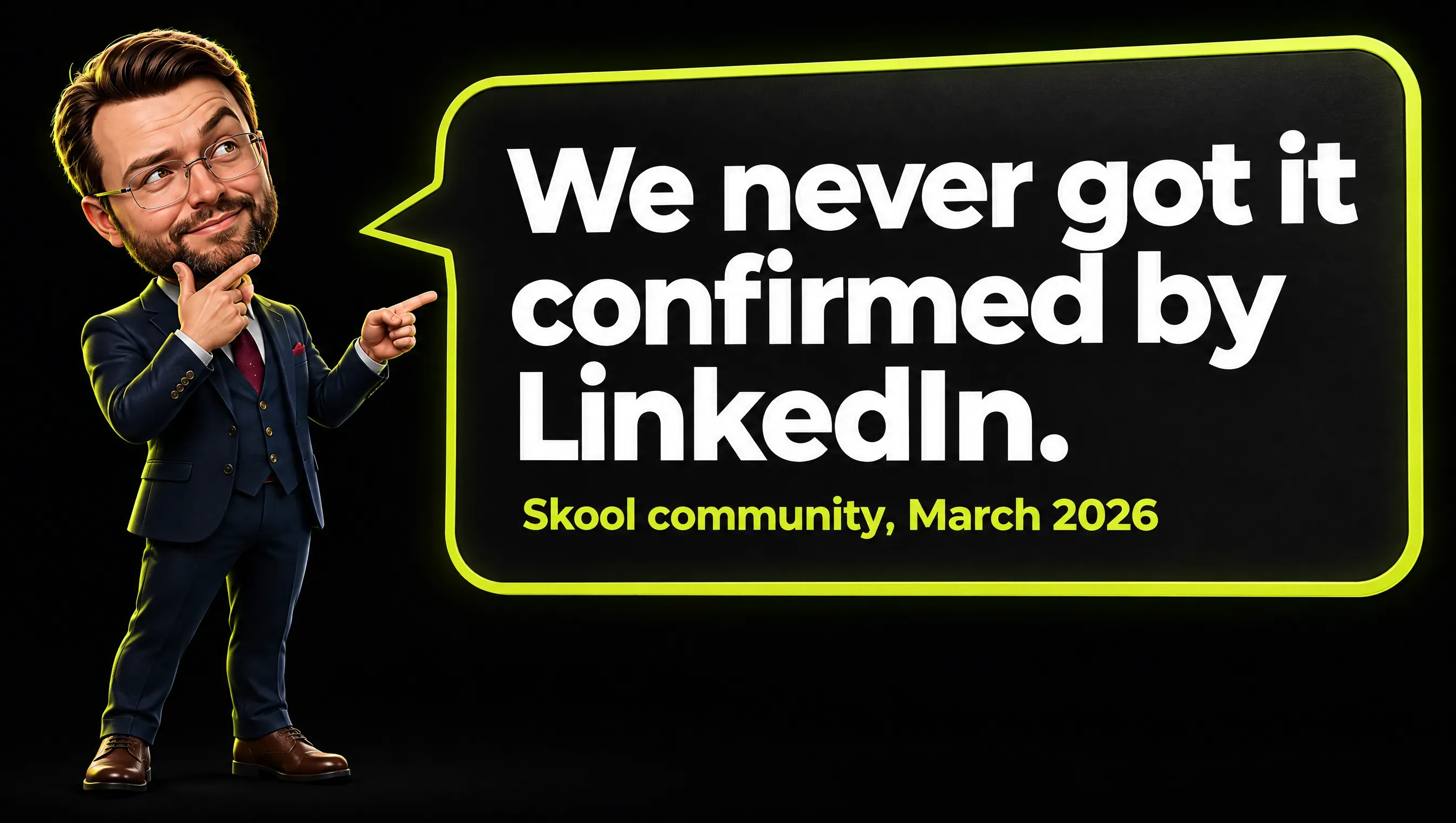
Real post from the Skool community Scale Camp.
The post opens with a question: “Myth or fact? Adding a link to your LinkedIn post decreases reach.”
The answer follows: “It used to, at least that’s what we all believed. We never got it confirmed by LinkedIn.”
I like this post because it separates belief from confirmation in two lines. The link rule was passed on as a fact, and what stood behind it was shared experience. Shared experience can be right, and it is still no statement by the platform.
Van der Blom’s own line explains why the topic never closes: “LinkedIn will never give you the clean confession everyone wants”. When a rule has no written source, I would treat it as a hypothesis and test it before building a habit on it.
Ordinal’s article says it well: “Two credible sources pointing different directions is a reason to keep measuring instead of a reason to pick a side”.
What I Would Do With These Facts
Start from your own numbers instead of a universal rule. Van der Blom used each creator’s average from March to June to predict the posts of July and August. His result: “That one number explained 51% of the differences in reach between posts”.
Jurka gives similar advice: “I always suggest that people look at their posting patterns by topic, format, and timing”. Van der Blom’s advice on patience is short: “Give it a week before you decide”.
With the facts in this guide, this is the order I would follow:
- Complete the profile, because identity is one of the three signal types LinkedIn names.
- Write posts worth the reading time, since dwell time is a documented signal.
- Put the link where it serves the reader.
- Stay away from pods and comment automation, which LinkedIn works to make ineffective.
- Judge each post after a week, against your own average.
For reading your own numbers, my guide to LinkedIn impressions explains what the counts mean and how to compare posts fairly.
Frequently Asked Questions
How does the LinkedIn algorithm work?
It picks candidate posts for each member, then a ranking model orders them. As of November 2026, LinkedIn says the model uses profile details and your history of interactions, including how long you stay on a post.
LinkedIn algorithm 2026: what changed?
In March 2026 LinkedIn announced a ranking system based on Generative Recommenders, models that read your past actions as a sequence. It also said it was acting against engagement pods, automated comments and engagement bait.
Is the LinkedIn algorithm called 360Brew?
Not in the official feed pages I read. 360Brew is the name of a research model from a January 2025 paper, while the feed pages name Generative Recommenders as of November 2026.
Do links in LinkedIn posts hurt reach?
A LinkedIn product director is reported to have said that the reach of posts with links is not limited on purpose. Two third-party studies measured 16% less reach and 36% fewer impressions on their samples, so the question is open.
Is the first hour after posting decisive?
No official LinkedIn source says so. A 2026 analysis of more than 1.2 million posts found that 85% of a post’s reach arrives after its first two hours. The same newsletter adds that only 8% of posts with a silent first two hours end above the author’s average.
How many times a week should I post on LinkedIn?
LinkedIn’s product team suggests two to five posts a week. It also says that posting more than once a day will not hurt your total reach.
Are engagement pods allowed on LinkedIn?
No. LinkedIn says it is working to make pods ineffective, and reporting from November 2025 notes that pod activity violates its Terms of Service.
Do hashtags increase reach on LinkedIn?
No. A LinkedIn vice president wrote in December 2025 that hashtags do not impact distribution. They can still help members who search, because they are clickable.
Can I change what LinkedIn shows me in the feed?
Yes. LinkedIn’s help page lists the options: mark a post as Not interested, unfollow or mute an author, and hide or report a post. You can also sort the feed by most recent or most relevant.
LinkedIn Algorithm in Short
The LinkedIn algorithm ranks posts for each member from profile details and past behavior, including reading time. Most popular rules about it are third-party measurements on one sample or claims with no source, so check who says what before changing how you post.
I write about marketing, AI and the numbers behind them. If this was useful, follow me on LinkedIn.