Best Time to Post on LinkedIn: Seven Studies, Seven Answers, and How to Find Yours
The best time to post on LinkedIn depends on who measured it. Seven studies compared, what LinkedIn says, time zones and a four-week test to find your own slot.

Ask seven studies for the best time to post on LinkedIn and you get seven answers. The one that counts the most LinkedIn posts, 4.8 million, says late afternoon on Wednesday. Another, built on 63,108 accounts, says morning, early in the week.
They are not wrong so much as different. Most measure engagement, one measures when people publish, one has no data set at all, and they do not treat time zones the same way.
My background in one line: digital since 12, full marketing since 20. As a Marketing Engineer I ask every study the same three questions: what was measured, on whom, and in which time zone. This article puts those questions to the timing studies and then gives you a test for your own audience.
Key Takeaways
- There is no single best time. Seven recent analyses point to different days and to hours that range from early morning to evening.
- LinkedIn says substance beats timing. Its own marketing blog writes that “the timing is often less important than the substance” and that nothing replaces testing.
- Averages can hide your profile. An independent analysis found almost no best day on average, while half of the profiles had a gap of two times or more between their best and worst day. Part of that gap may be noise from small samples.
- A time is always somebody’s time. LinkedIn schedules a post in the time zone of your device, not in the time zone of your reader.
- Four posts prove nothing. One lucky post can make a weekday look like a winner, so ten posts per slot is the minimum, and a win is worth a second test.
- Start from the studies, then measure. Pick two slots, alternate them for four weeks, and compare medians at the same post age.
When Is the Best Time to Post on LinkedIn? The Short Answer
If you need a starting point today, start with Wednesday: it is the only day that all five tool studies with a data set list among their best. For the hour there is no such agreement. The recommendations run from early morning to evening, so pick a time inside your reader’s working day.
Treat that as a first guess. The studies disagree on the day and even more on the hour, and most of them rank the weekend last. LinkedIn’s own marketing blog names no best time and points to testing.

What Seven Studies Say, Side by Side
Here are the seven analyses I read for this article, with what each one measured. All were consulted on November 13, 2026.
| Study | Sample | What it measures | Best days | Best hours |
|---|---|---|---|---|
| Buffer, Sept 2026 | 4.8 million posts sent with Buffer | Engagement, local time | Wed, then Thu and Fri | 3 p.m. to 8 p.m., peak Wed 4 p.m. |
| Sprout Social, March 2026 | Nearly 2 billion engagements, 307,000 profiles, six networks | Engagement, local time | Tue, Wed, Thu | Tue 11 a.m. to 5 p.m., Thu 1 to 5 p.m. |
| Hootsuite, Nov 2025 (data from Q4 2024) | Over 1 million social posts | Engagement, 118 countries | Tue and Wed | 8 to 9 a.m. in the summary, 4 to 6 a.m. in the body |
| Metricool, May 2026 | 673,658 posts, 63,108 accounts | When connected accounts publish | Mon, Tue, Wed | 10 a.m. to noon |
| Social Champ, Aug 2026 | 2.6 million posts | Engagement, method not described | Tue, then Wed | 1 to 4 p.m. |
| Later, May 2025 | No data set, team experience | Opinion | Weekdays | 8 a.m. and 1 p.m. Eastern |
| Trevor Fox, June 2026 | 7,913 posts, 63 profiles | Engagement against each profile’s own median | None on average | Not analyzed |
Where they agree. Most studies put Saturday and Sunday at the bottom, and almost every one ends by telling you to test on your own data.
Where they split. Buffer lists Monday and Tuesday among the weakest days, while Metricool, Sprout Social, Hootsuite and Social Champ list Tuesday among the best. The hours run from four in the morning to eight in the evening.
Buffer states its result this way: “Wednesday is the best day to post, closely followed by Thursday and Friday.” Metricool writes: “Mondays, Tuesdays, and Wednesdays are the best days to post on LinkedIn.” Both sentences were published in 2026.
Why the Studies Contradict Each Other
The studies measure different things on different customers. Reading the method lines does not make them agree, but it explains why you should not expect them to.

Different metrics. Most studies count engagement, and Metricool describes something else: “we also analyzed LinkedIn post frequency from accounts connected to Metricool to give you the best times to post on the platform.” When many people publish and when readers respond are two separate questions.
Mixed networks. Sprout Social describes a sample of “nearly 2 billion engagements across 307,000 social profiles across Facebook, Instagram, LinkedIn, Pinterest, TikTok and X (Twitter)”. The page does not say how much of that is LinkedIn, and Hootsuite describes its sample only as over 1 million social posts, without a LinkedIn share.
Each tool sees its own customers. A scheduling tool studies the posts sent through that tool. Those are companies and creators who plan content in advance, which is not the whole of LinkedIn.
One page, two answers. One of the studies names eight to nine in the morning on Tuesdays and Wednesdays in its summary, and four to six in the morning on the same days in its body. It shows how fragile a single best hour is.
One tool, two years. Buffer reports that its own result moved: its 2025 data showed engagement concentrated in working hours, with a sharp drop after five in the afternoon. In 2026 the best window runs into the evening, and Buffer admits: “Our data can’t tell us why the change is happening, though, only that later posting times performed particularly well in this analysis.”
This is the same caution I apply to predictive analytics in marketing: a number is only as good as the description of how it was collected.
What LinkedIn Itself Says About Posting Time
LinkedIn addressed the question on its marketing blog in July 2024, in an article titled What’s the Best Time to Post Content on LinkedIn?. It reviews third-party studies and reaches a careful conclusion.
About the studies it writes: “As you’ll see there are some common themes but also some inconsistencies and conflicting data points, serving to illustrate that this is not a black-and-white science.”
About priorities: “When it comes to getting your content seen on LinkedIn, the timing is often less important than the substance.” And about method: “In our own experience, there’s no substitute for testing when it comes to finding the sweet spot that best suits your audience.”
That is the platform telling you that the answer is in your own numbers. The rest of this article follows that advice.
And substance depends on decisions made long before you pick the hour. My guide to a content strategy for LinkedIn goes through them: one goal, one reader, three or four themes, a rhythm you can keep and a date to read the numbers.
Is the First Hour After Posting Decisive?
No official source says so: in the LinkedIn pages I read there is no 60- or 90-minute window. Early reactions do count, and the golden hour you will often read about is a rule of thumb.
Buffer says it plainly: “LinkedIn hasn’t confirmed an official 60- or 90-minute window, so treat it as a general concept”
What LinkedIn’s engineers describe is a feed that reacts to engagement as it arrives. In a March 2026 post, Engineering the next generation of LinkedIn’s Feed, they write: “For existing posts gaining engagement, we dynamically refresh embeddings, ensuring popularity signals stay current.” An embedding is the system’s numeric summary of a post, so the feed updates its picture of the post as reactions arrive.
The same post says that when relevant posts start getting traction, “you see them within minutes, not hours.” My reading, which LinkedIn does not state: a post published while its readers are online has a better chance of an early start. That is a reason to care about timing, and it stops short of a 60-minute rule.
The signals themselves are not about the clock. A 2020 LinkedIn engineering article on feed dwell time lists reactions, comments and re-shares as “viral actions” and explains that the feed also measures how long a member stays on an update.
How Long Does a LinkedIn Post Stay Alive?
There is no official lifetime for a post. The claim that a post is dead after 24 hours has no LinkedIn source, but a short life is the starting point LinkedIn itself described.
In a February 2024 interview with Entrepreneur, Tim Jurka, a senior director of engineering at LinkedIn, said: “Right now, content lives and dies on the newsfeed very quickly”. The article presents suggested posts as LinkedIn’s answer, surfacing relevant posts “regardless of when they were created.”
The feature was being tested at the time, and this is a secondary source reporting an executive’s words. I read it as a possibility, not a guarantee: a useful post can keep finding readers after its first day.
Time Zones: Ten O’Clock for Whom?
I live in Switzerland and I write in English. When a guide tells me to post on Tuesday at ten, my first question is: ten o’clock for whom?
LinkedIn’s blog describes the problem in one line: “Lunchtime in New York is dinnertime in London.” It also notes that the platform’s members “are logging in around the clock, from every time zone.”

Three facts help you read any recommended hour.
Studies in local time refer to the reader. Buffer explains that its data scientist normalized posting times by local time zone, and adds: “So if the recommended time is 4 p.m., you can treat that as 4 p.m. in the time zone you’re targeting.”
The scheduler uses your clock. LinkedIn’s help page on scheduling posts states: “Scheduled times are converted to UTC based on your device’s time zone settings.” If I schedule from Zurich, I pick Zurich time.
The same study gives different hours by region. Hootsuite publishes tables by time zone, and for Central European Time it says: “In CET, the best time to post on LinkedIn is 7 PM on Thursdays.” For the US East Coast the same page lists other slots, among them 5 AM on Tuesdays and 6 AM and 5 PM on Thursdays.
London is always one hour behind Zurich. New York is six hours behind for most of the year and five hours behind for two or three weeks in March and about one week between late October and early November, because the US and Europe change their clocks on different dates. This small table shows the six-hour case.
| Zurich | London | New York |
|---|---|---|
| 08:30 | 07:30 | 02:30 |
| 15:00 | 14:00 | 09:00 |
| 19:00 | 18:00 | 13:00 |
Converted, Hootsuite’s Thursday evening slot for Central Europe is 1 p.m. on the US East Coast, which is not one of the slots the same page lists for that region. A slot at three in the afternoon in Zurich opens the working day in New York while Europe is still at work.
Does the Day of the Week Matter? An Analysis That Compares Each Profile With Itself
On average, no; for a single profile, possibly. That is the result of the one analysis here that compares each profile with itself instead of pooling all accounts. In a pooled average, a large account that posts on Wednesdays can pull the whole Wednesday up.
Trevor Fox, who builds a LinkedIn analytics tool, took another route in June 2026. He writes: “I analyzed 7,913 LinkedIn posts from 63 profiles over the last year”. Each post was compared with its own author: “Every metric is normalized per-profile”.
On average, the day made almost no difference. Every day of the week, weekend included, landed between 0.99 and 1.02 times the profile’s baseline, which means within 2% of what that profile usually gets. The days are counted in US Eastern Time.
The individual picture looked different. In his words, “half of profiles have a 2x+ gap between their best and worst day”. Among the 55 profiles with at least 10 posts, the best day was spread over the whole week: Friday for 20%, Tuesday for 18%, Saturday for 15%, and Sunday and Monday for 13% each.
Read those shares with care. If the day had no effect at all, chance alone would give each of the seven days about 14% of the profiles. The author gives the same warning: the gap “is highest among infrequent posters and lowest among frequent ones”.
The sample is small, 63 profiles that use the same tool, and the author sells that tool. Even so, the method asks the question a single person has: what works for my profile, which can differ from what works on average.
A Real Case: The Team Lead Who Found Her Slot by Forgetting
One real story from the Hootsuite article shows how personal the answer is. Trish Riswick, Hootsuite’s Social Media Team Lead, describes an accident in her posting schedule.
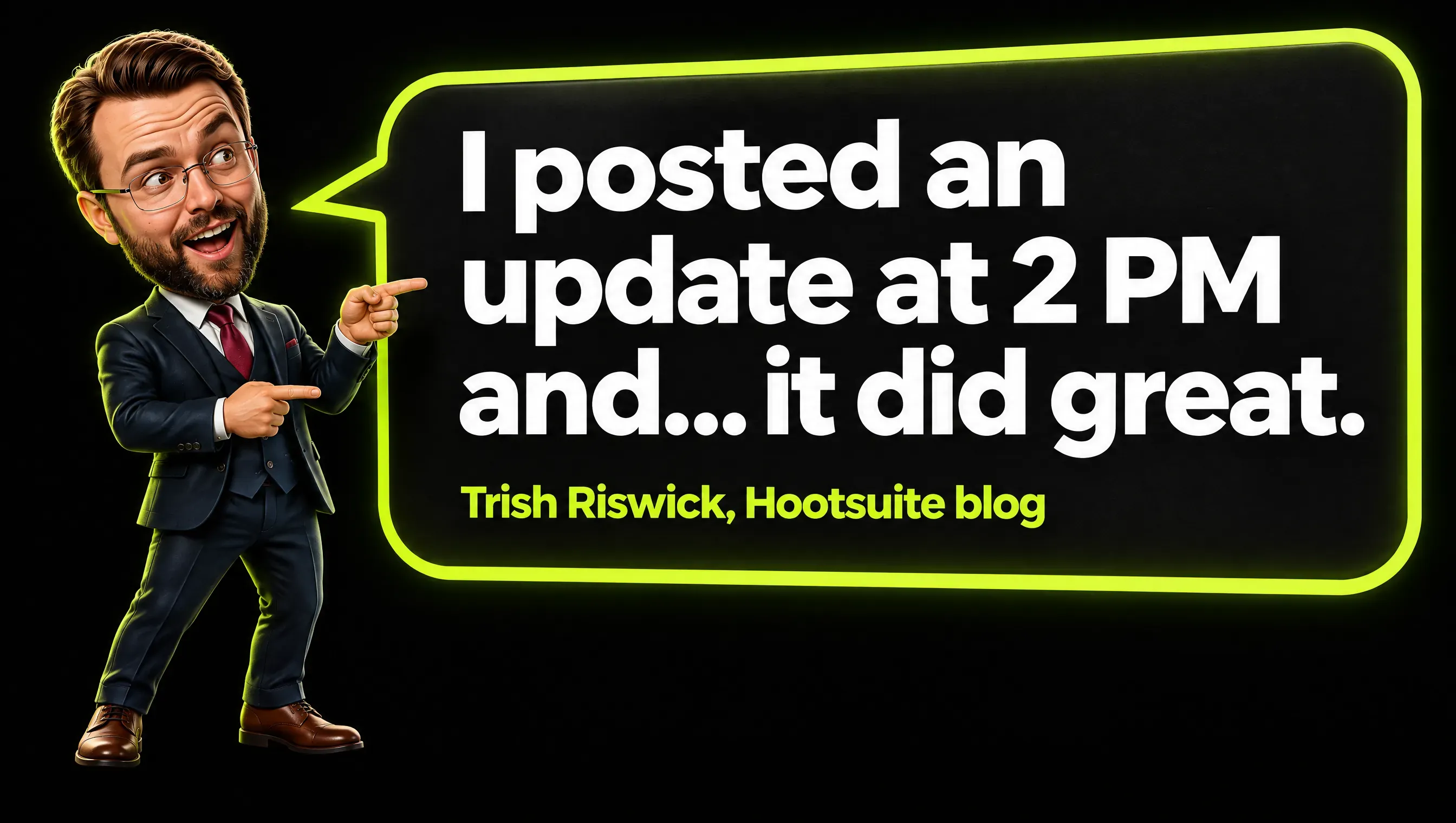
Real quote from the Hootsuite blog.
She says: “One time, after forgetting to get something out at noon, I posted an update at 2 PM and… it did great. Since then, I’ve noticed a positive increase in engagements at that time throughout the week.”
About the company account she adds a second observation: “posting to the Hootsuite LinkedIn account on Mondays and Fridays generates the best performance.” Those are different days from the ones in the study published on the same page.
It is one anecdote, without numbers, and I present it as one. The useful part is the second sentence: one good post was only the prompt, and she kept watching the same slot afterwards.
Why Four Posts Cannot Tell You Your Best Day
A best day found in a handful of posts is often luck. Trevor Fox warns about his own result: “If you’ve only posted 4 times on a Friday and one of them happened to go viral, Friday looks like your best day for reasons that have nothing to do with Friday.”
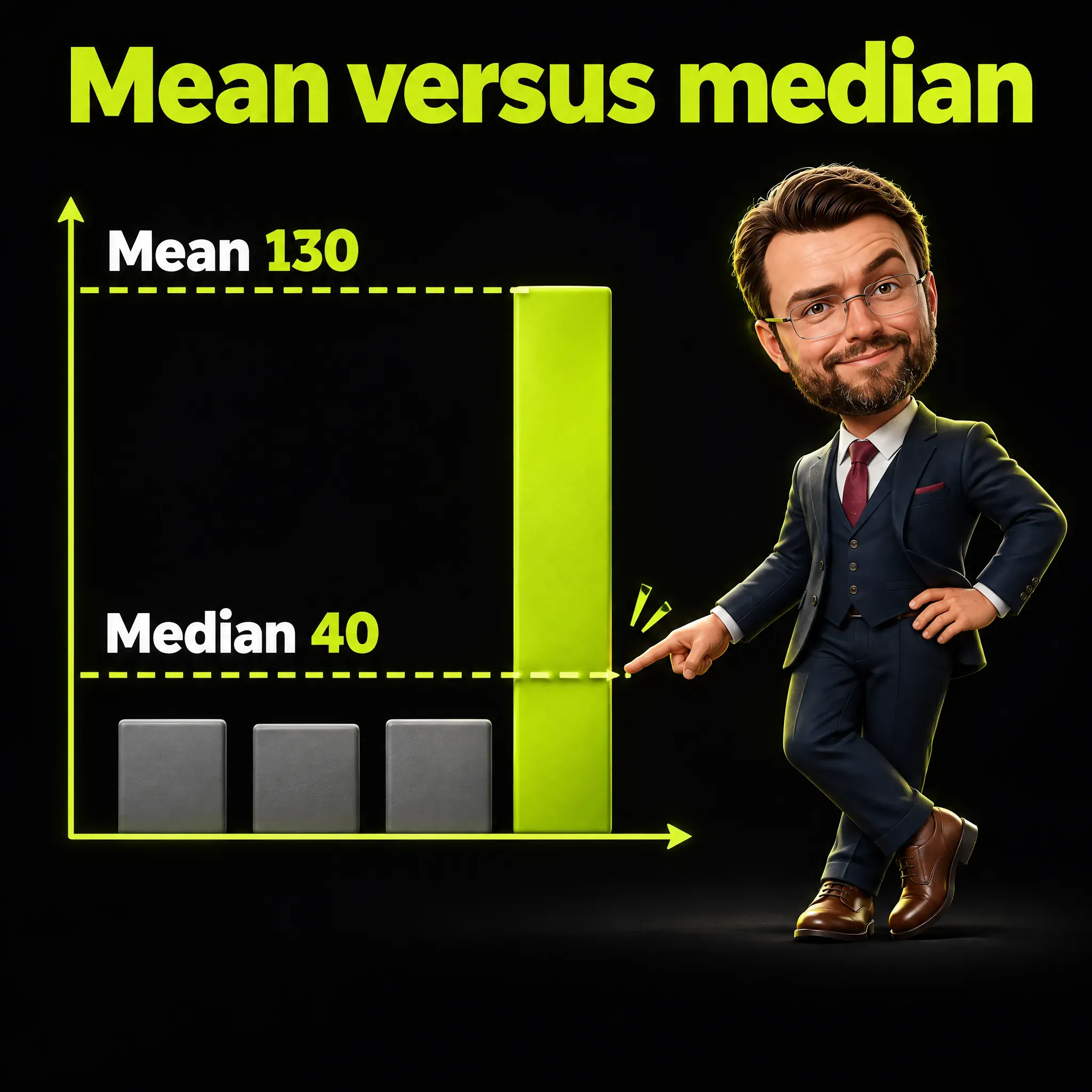
An invented example shows the mechanism. Take four Friday posts: three with 40 interactions and one with 400.
The mean, the plain average, is 130, so Friday looks like a star. The median, the middle value when you sort the posts from weakest to strongest, is 40, so Friday is an ordinary day. One post moved the average and told you nothing about Fridays.
That is why the test below uses medians and at least ten posts per slot. The same reasoning applies to any marketing report: a single outlier should never write the headline.
How to Find Your Own Best Time to Post on LinkedIn in Four Weeks
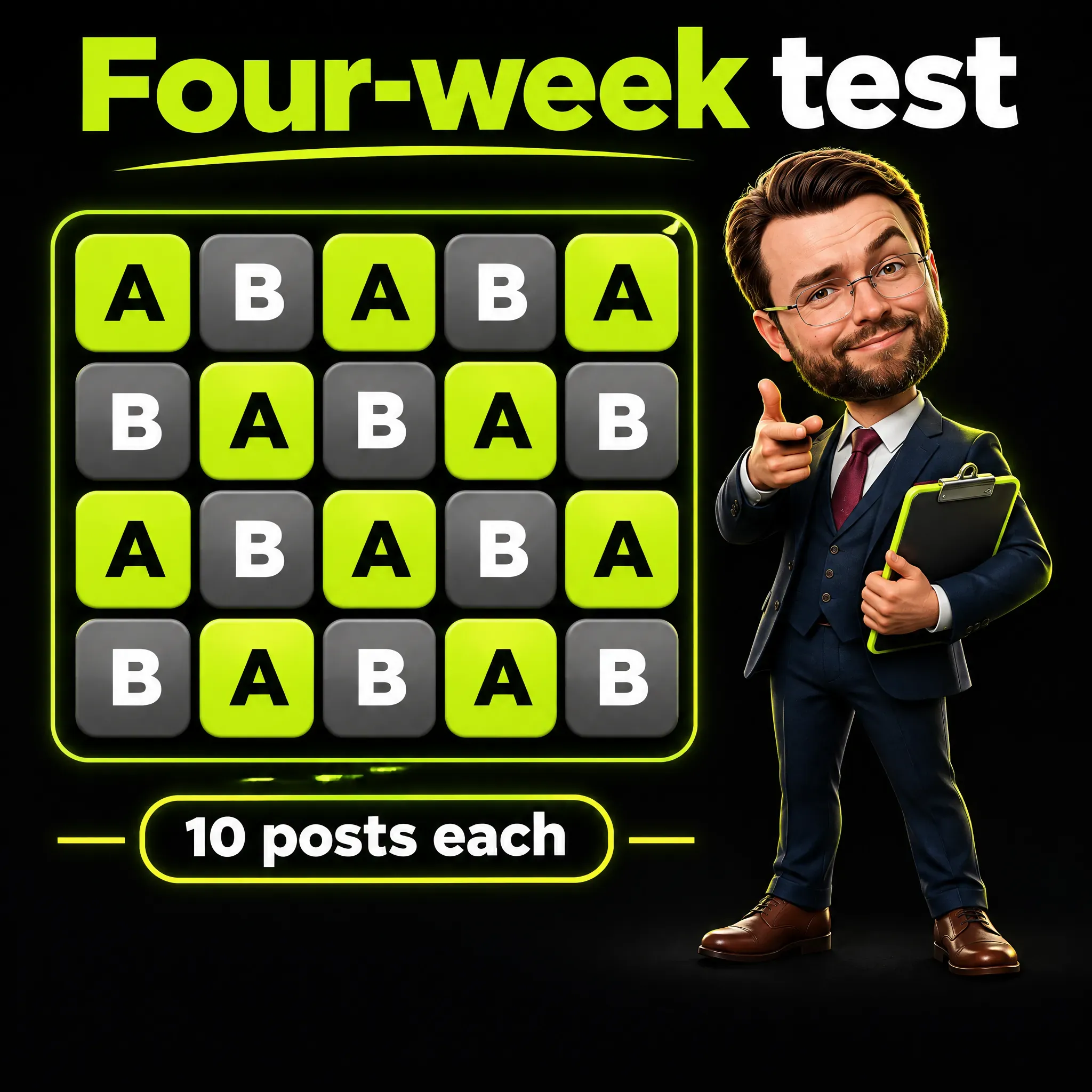
The test compares two time slots over 20 posts. All the hours and thresholds below are examples, not results.
- Check where your audience lives. Open your analytics, go to the audience section and look at the top demographics by Location. If the first countries sit on two continents, one slot should fall inside working hours for both.
- Choose two slots, not five. With five slots and one post per day you get four posts per slot in a month, which is too few. Example: slot A at 08:30 and slot B at 15:00, Zurich time.
- Post once per weekday for four weeks. That gives 20 posts, 10 per slot, and the last reading comes a week later. If you post twice a week, run the same test over ten weeks: keep two fixed days and swap the slots every week.
- Alternate so that days and slots do not mix. In weeks one and three, use A on Monday, Wednesday and Friday and B on Tuesday and Thursday. In weeks two and four, swap them. Every weekday then gets each slot twice.
- Keep the rest similar. Use the same format and a similar length inside each pair. In the per-profile analysis, format and length moved results more than the day did.
- Write down the exact publishing time. Use the native scheduler, which accepts a specific time, and keep a sheet. Buffer notes that the timestamp on an older post only shows something like “3h” or “2d”.
- Read every post at the same age. Example: seven days after publishing. Note impressions and interactions.
- Compare medians of one number. Choose interactions or impressions before you start. Look at the median of slot A and the median of slot B, and count how many posts of each slot beat the overall median.
- Decide with a rule you set before starting. Example: I keep the winning slot only if its median is at least 30% higher and at least 7 of its 10 posts sit above the overall median. By my calculation, two identical slots would pass the 7-of-10 part by luck about one time in six, so a win is a reason to repeat the test.
If no slot wins, that is a result too: choose the hour that suits your day. Keep in mind what this test answers: it compares two hours and cancels out the weekday on purpose, so each weekday ends with only four posts, the sample the previous section warns about. To compare days, keep one slot fixed and continue until each weekday has at least ten posts, which takes ten weeks at one post per weekday.
Where to Find the Data in LinkedIn Analytics
Everything the test needs is in the free analytics. LinkedIn’s help page on combined post analytics says: “All LinkedIn members have access to combined post analytics”.
You can set the period “from the past seven days up to the past 365 days” and export the data: “Export your analytics to an .XLSX file to analyze further or save it for your records.”
For the audience, the page on creator analytics describes the top demographics of your followers. You can switch the breakdown between job title, location, industry, seniority, company size and company.
Location is the field that matters for timing. In the help pages I read, LinkedIn shows where followers are, and I found no chart of when they are online.
Two limits apply before you compare numbers. The page on post analytics warns: “Please note that the numbers in your post analytics are estimates and may not be precise”. It also says your own views and engagements are counted in the totals.
If you want to understand what the main number means before testing, I explain it in my guide to LinkedIn impressions.
Can You Schedule Posts on LinkedIn?
Yes, with the native scheduler. The help page gives the range: “You can schedule a post between 10 minutes and 3 months from the current time.”
You are not bound to round hours. LinkedIn adds: “You can enter a specific time instead of selecting one of the 30-minute increments from the dropdown.” A scheduled post can be moved or deleted before it goes out.
Scheduling is what makes a timing test possible for someone with a job. You write the posts when you have time, and the calendar publishes them in the slots you are comparing.
How Often Should You Post on LinkedIn?
There is no proven number, and the data is as thin as it is for timing. Buffer suggests a starting range: “Posting two to five times per week is where most creators and brands start to see results.”
The per-profile analysis looked at weeks with more posts and found no penalty. Its author writes: “Zero cannibalization. Per-post engagement stays flat or slightly increases at higher volumes.”
With 63 profiles this is a hint, not a law.
LinkedIn’s own advice sits in a similar range, two to five posts a week, and it says more than one post a day will not hurt total reach. I compare that with what studies measured in my guide to the LinkedIn algorithm in 2026.
For my own content plan I made one calendar decision: posts are planned for weekdays only, and Saturday and Sunday stay empty. My AI-assisted planning drafted a calendar, and I answered in one line: skip the weekend.
I want to be clear about what this is: a choice made by the person who owns the calendar, with no measurement behind it. The AI drafts the calendar and I decide it. It is the same human-in-the-loop verification I use elsewhere, where a person approves what the machine prepares.
Timing and frequency only help a post that is worth reading. LinkedIn’s own blog puts substance first, and so do I. A post that reaches the right reader at a perfect hour still has to earn that reader’s time, and that is where marketing ROI, the return on what you spend on marketing, is decided.
Should You Post on Weekends?
On average the weekend is the weakest period, and most studies advise against it. Sprout Social, for example, writes: “There are no optimal times to post on LinkedIn on Saturdays”.
For a single profile the picture is less clear. In the per-profile analysis, Saturday or Sunday was the best day for 28% of the profiles, close to the 2 in 7 that chance alone would give. Among the profiles with ten or more weekend posts, 8 did better on weekends, 11 did worse and 5 were neutral, and the author calls that “a coin flip”.
My reading: skip the weekend if you have no reason to post, and test it if your readers are people who catch up on LinkedIn outside office hours.
Frequently Asked Questions
What is the best day to post on LinkedIn?
It depends on the study. Buffer says Wednesday, Sprout Social says Tuesday to Thursday, Metricool says Monday to Wednesday. An analysis that compares each profile with itself found no best day on average.
Is Friday a good day to post on LinkedIn?
Buffer ranks Friday among its three best days and Metricool does not. In the per-profile analysis Friday was the most common best day, but only for 20% of profiles.
Is it bad to post on LinkedIn at night?
The sources disagree: Metricool writes that posting at night will not bring the highest engagement. Buffer’s 2026 analysis finds its best window from mid-afternoon to eight in the evening, in the reader’s time zone.
What is the best time to post on LinkedIn in India?
None of the studies I read gives a figure for India. Studies that use local time, such as Buffer and Sprout Social, are meant to be read in the audience’s time zone, so a writer in another country has to convert.
Does posting time matter at all?
A little on average, and differently for each profile. LinkedIn’s own position is that “the timing is often less important than the substance.”
Can I schedule posts on LinkedIn?
Yes. The native scheduler accepts a time between 10 minutes and 3 months from now, in the time zone of your device.
How long does a LinkedIn post stay in the feed?
LinkedIn gives no official duration. A LinkedIn engineering director said in 2024 that content lives and dies quickly on the newsfeed, and the platform was testing a way to show relevant posts regardless of their age.
The Best Time Is the One You Measured
The best time to post on LinkedIn is not in a benchmark. The studies give you a place to start, Wednesday inside your reader’s working day, and your own 20 posts give you the answer.
If the test shows no difference, publish when it suits you and spend the saved attention on the post itself. I write about marketing, AI and measurement. If this guide helped, follow me on LinkedIn.