Thought Leadership: What It Is, What the Buyer Surveys Show, and a Test for Your Idea
Thought leadership is a new idea with evidence, not a title you give yourself. Definitions with sources, the buyer surveys with their samples, and one test.

Thought leadership is a new idea, backed by evidence, that changes how a buyer thinks about a problem. It is not a title you give yourself, and it is not a format such as a long post or a company report. Other people decide whether you lead their thinking.
Most guides take for granted that it works. They quote percentages from surveys and leave out the sample, the year and who produced the study. The best-known numbers come from a yearly report by Edelman and LinkedIn, and both have an interest in the answer.
I work as a Marketing Engineer: Digital since 12, full Marketing since 20. This guide gives each definition with its source and each number with who asked, when and how many people. It includes a test you can run in one minute.
Key Takeaways
- Thought leadership is an idea, not a title. A 2014 article from the Rotterdam School of Management defines it as promoting ideas that change how people think about an issue.
- The famous numbers are stated opinions. In the 2026 Edelman-LinkedIn survey of 1,135 executives, 52 percent said it helped their group choose a vendor, as reported by O’Dwyer’s.
- The study has two interested authors. Edelman’s clients publish this kind of content and LinkedIn hosts it, so I read the numbers as a clue.
- Few rate it highly. In the fifth edition’s press release (December 2022), only 33% of the people who produce it gave their own organization’s output a top rating.
- One test separates an idea from a slogan. Replace your name with a competitor’s, and if the sentence stays true, it is not thought leadership yet.
What Is Thought Leadership?
Thought leadership is the practice of putting forward a new idea, with evidence, that helps a specific group of people see a problem differently. The idea comes first and the reputation follows. Two academic sources define it in slightly different ways, and the difference is useful.

A 2014 article from the Rotterdam School of Management builds its definition on the idea. It calls thought leadership “the action of introducing and promoting convention-breaking ideas that cause people to change how they think about marketplace or societal issues”. In this reading, it is something an organization does with an idea.
A 2021 study from the University of Exeter Business School reviewed over 50 academic and professional articles. The study defines thought leadership as “knowledge from a trusted, eminent and authoritative source that is actionable and provides valuable solutions for stakeholders”. Here the weight is on the source and on usefulness.
I use both. My working definition has three parts: the idea is new to the reader, the evidence can be checked, and the reader can act on it.
Where Does the Term Thought Leader Come From?
The magazine strategy+business credits the term to Joel Kurtzman, its founder and first editor. In a 2016 tribute to Joel Kurtzman, the magazine writes that he changed management writing by “coining the word” in its first issue.
The words are older than the magazine, which was founded in 1995, by its own account. Wikipedia’s entry on thought leaders records a 1990 Wall Street Journal article that used the phrase “thought leader publications” for magazines such as Harper’s. So I would say Kurtzman made the business sense popular, not that he invented the words.
Is a Thought Leader Something You Are or Something You Do?
It is something other people say about you after you have done the work. Wikipedia describes a thought leader as someone “recognized as a foremost authority in a specific field”. The word that matters is recognized: the recognition comes from readers, clients and peers, and you cannot grant it to yourself.
The phrase has critics. The same Wikipedia entry cites two researchers from Henley Management College, writing in the Financial Times in 2007. They said the unclear meaning of the phrase feeds its reputation among cynics as “meaningless management speak”.
Dorie Clark, a Harvard Business Review contributor, defended the phrase and still agreed with one objection. The entry quotes her on the bad impression left “when people call themselves thought leaders because that sounds a little bit egomaniacal”.
That matches my reading. I would not put the words in a headline or a bio, and I would let the idea do the work. The profile side of this is in my guide to LinkedIn personal branding.
What Is Thought Leadership Content?
Thought leadership content is any piece built to carry one idea and the evidence for it: an article, a study, a talk or a video. It differs from product content because the reader gets something useful even without buying. The format can be anything, as long as the idea and the evidence are there.
Creative Salon’s summary of the 2024 Edelman-LinkedIn report has one line worth keeping. It reads: “Effective thought leadership has three key attributes: it cites strong research and data, helps buyers understand their business challenges, and offers concrete guidance”.
In the same edition, 73 percent of respondents called it “a more trustworthy basis for judging its capabilities and competencies” than marketing materials and product sheets. The figure comes from O’Dwyer’s report on the 2024 survey, which covered nearly 3,500 managers and ran in December 2023. It records what people said, not what they did.
Here is the difference in two invented examples:
- Product content: Our reporting tool saves your team time every month.
- Thought leadership content: Most monthly reports count events instead of people, and here is how we checked.
Does Thought Leadership Work in B2B?
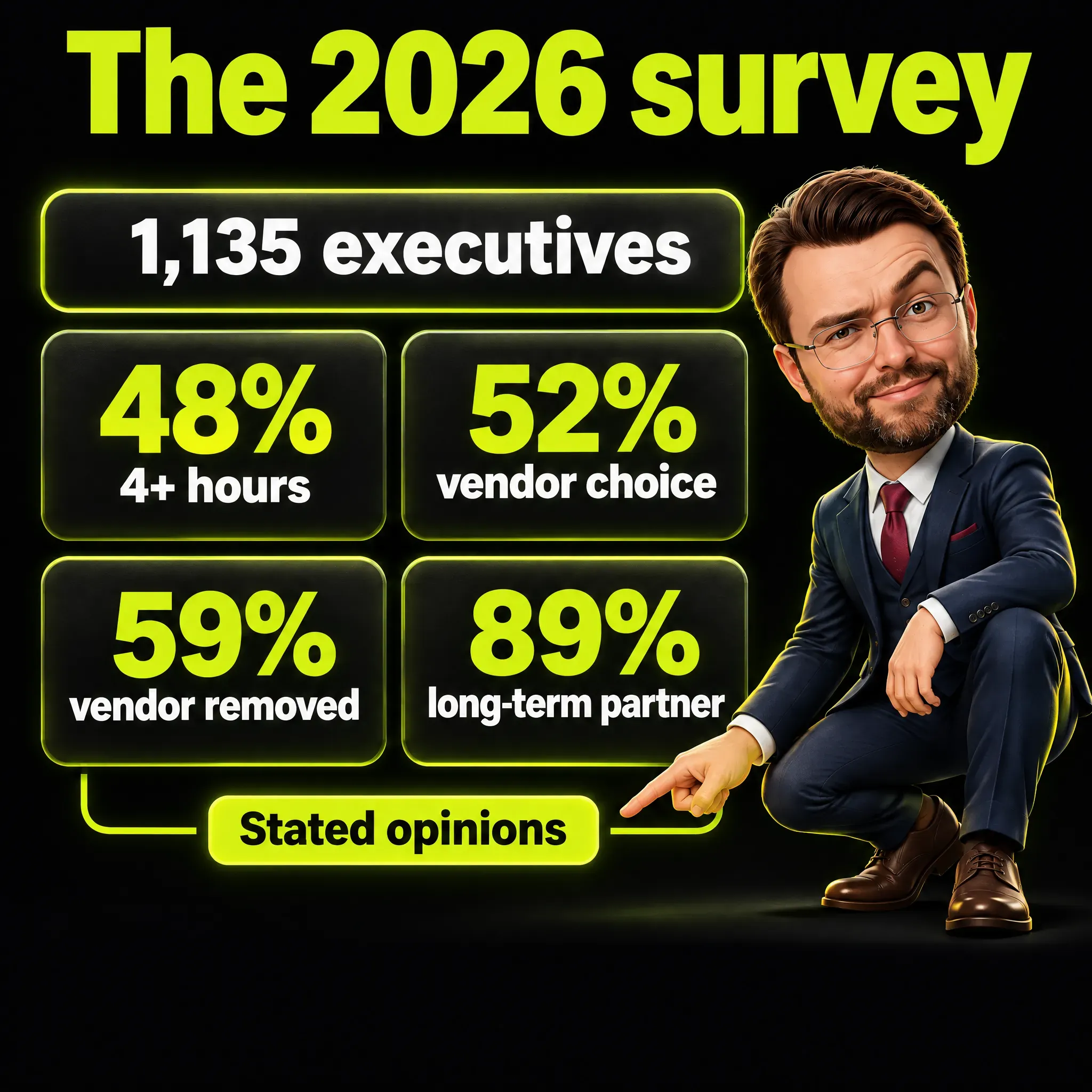
Buyers say it does, and that is the limit of the evidence. B2B means business to business, a company selling to other companies. In a 2026 survey of 1,135 executives, 52 percent said it helped their purchasing group decide which vendor to choose, according to O’Dwyer’s coverage of the 2026 study.
The survey is the Edelman-LinkedIn report From Found to Chosen. O’Dwyer’s writes that it covered respondents in seven countries, including the US, the UK and Germany, between September 4 and 21. A purchasing group, also called a buying group, is the set of people in a company who decide a purchase together.
The same article gives four more results:
- 48 percent of the B2B decision-makers said they spend at least four hours a week on thought leadership.
- 89 percent said high-quality thought leadership “makes a company feel like a long-term partner worth choosing”.
- 76 percent said it “helped assess whether the vendor understood the organization’s needs and priorities”.
- 59 percent said low-quality thought leadership, or none at all, “contributed to a vendor being removed from consideration”.
The 59 percent is the one I find most useful. It says weak material can cost you a place on the list, which is a reason to publish less and check more. All five figures are answers to a questionnaire, so they show what executives report about themselves.
Who Produces the Research Behind These Numbers?
Edelman and LinkedIn make it themselves. O’Dwyer’s calls the 2024 edition “the sixth annual collaboration between Edelman and LinkedIn”.
Edelman is a public relations firm. Joe Kingsbury, who chairs its business marketing unit, told Chief Marketer in a 2024 interview that unfocused content is a challenge “for the clients that we work with”. LinkedIn is a network where this content gets published.
So the best-known study on thought leadership comes from two parties with an interest in the answer, which limits what it can prove.
That does not make the numbers false. It means I read them as a clue about what executives think, not as a guarantee of what they will buy.
There is a second limit. Every figure here comes from third-party coverage of each edition, not from the original report, and each citation names the outlet.
Here is how I would write such a number.
- In the 2026 Edelman-LinkedIn survey of 1,135 executives, 59% said poor or missing thought leadership got a vendor removed from consideration, as reported by O’Dwyer’s. It is a stated opinion, collected by two companies with an interest in the answer.
The line is longer than a bare percentage, and the reader can judge how far to trust it.
What Did the Earlier Editions of the Survey Find?
The direction is the same in every edition I read: executives say good thought leadership influences which suppliers they consider and choose. The samples and the questions change from edition to edition, so I would not compare the percentages across years.
| Edition | Sample | One result, as stated by respondents | Reported by |
|---|---|---|---|
| Fifth, released December 2022 | Nearly 3,500 management-level professionals | 61% of decision-makers: more effective than product-oriented marketing at showing value | Press release on MarTech Series |
| 2024 | Nearly 3,500, surveyed in December 2023 | 75% researched a product or service they were not considering | O’Dwyer’s |
| 2025 | 1,934, surveyed March 17 to April 3, 2025 | 86% of hidden buyers (people from functions such as finance, legal or procurement who take part in a purchase) prefer content that challenges assumptions | ContentGrip, CustomerThink |
| 2026 | 1,135, surveyed September 4 to 21 | 52% said it helped the buying group choose a vendor | O’Dwyer’s |
The fifth edition, released in December 2022, asked about hard times, and one answer came from C-suite executives, the top managers of a company. The Edelman-LinkedIn press release, republished by MarTech Series reports that 50% of them said high-quality thought leadership weighs more on purchases in downturns than in good times.
The 2024 edition asked the same group about existing suppliers. In O’Dwyer’s 2024 article, 70 percent said a piece had “at least occasionally led them to question whether they should continue working with an existing supplier”.
The 2025 edition turned to hidden buyers. ContentGrip’s summary of the 2025 report describes them as people in finance, legal, compliance, procurement and operations who influence a purchase without being the final signatory.
The report’s own definition, as quoted by David Dodd on CustomerThink, calls each of them “a final decision-maker in group purchasing decisions”. So the two outlets differ on who signs. ContentGrip adds that 71% of them report little to no interaction with sales representatives.
How Good Is Most Thought Leadership?
Few people rate it highly, and that includes the people who make it. In the press release for the fifth edition, only 33% of thought leadership producers rated their own organization’s output “very good or excellent”. Among C-suite executives the share fell to 29%.

Joe Kingsbury, the study’s architect, speaks of a “mediocre middle” in his 2024 interview with Chief Marketer. His figure: “Roughly 40% of the executives that we surveyed believe that most of the content that they’re seeing is good”. He adds that only a small segment was rated higher.
Volume is part of the reason. The Exeter study states that more than two-thirds of professional services firms, such as law or accounting firms, now have a dedicated head of thought leadership. Professor Will Harvey, its lead author, comments that “the sheer volume of thought leadership being created suggests much of it is low quality”.
The study also describes “the tension between the idea that thought leadership is supposed to be rare and original and expectation that it is consistently produced”. Of the two expectations, I would protect rarity, even at the cost of producing less.
Do Good Ideas Beat a Well-Known Brand?
The surveys do not test this directly. Two numbers come close, and they measure different things.
In the 2025 Edelman-LinkedIn survey, 53% somewhat or strongly agreed that fame matters much less when a vendor’s thought leadership is strong. In a study by The B2B Institute, Bain & Company and NewtonX, 81% said they bought a brand that almost the whole group knew at the start. The first is an opinion about a hypothetical case and the second a report of a past purchase, so both can be true.
David Dodd set the two side by side in an August 2025 article on CustomerThink, and I take both numbers from it. The statement that Edelman-LinkedIn respondents rated reads: “In vetting vendors, if an organization produces high-quality thought leadership, it matters much less to me how well known they are”.
Dodd adds that the second study is described in a 2024 LinkedIn article by two people at The B2B Institute. The institute’s page on LinkedIn’s site calls it a “LinkedIn think tank”, so LinkedIn stands behind both numbers.
Dodd explains most of the gap with the samples. In the Edelman-LinkedIn survey, 48% of respondents worked at companies with 200 or fewer employees. In the B2B Institute study, 64% worked at companies with more than 10,000 employees, and the purchases were large technology deals.
The second study also found that hidden buyers are 31% more likely to reject brands they do not know. Dodd’s verdict: “I think the findings of the B2B Institute Study provide a more accurate picture of real-world B2B buying”.
My reading is more cautious. The two studies asked different people different questions, so neither cancels the other. For a large purchase, I would not count on an idea to replace a known name.
What Are Real Thought Leadership Examples?
The examples I use are the ones I can check in a source, and the sources are not equal. Dove comes from a business school article, HubSpot from a Wikipedia page, and Gong from the company’s own page. What they share is one clear idea that a reader can repeat in a sentence.
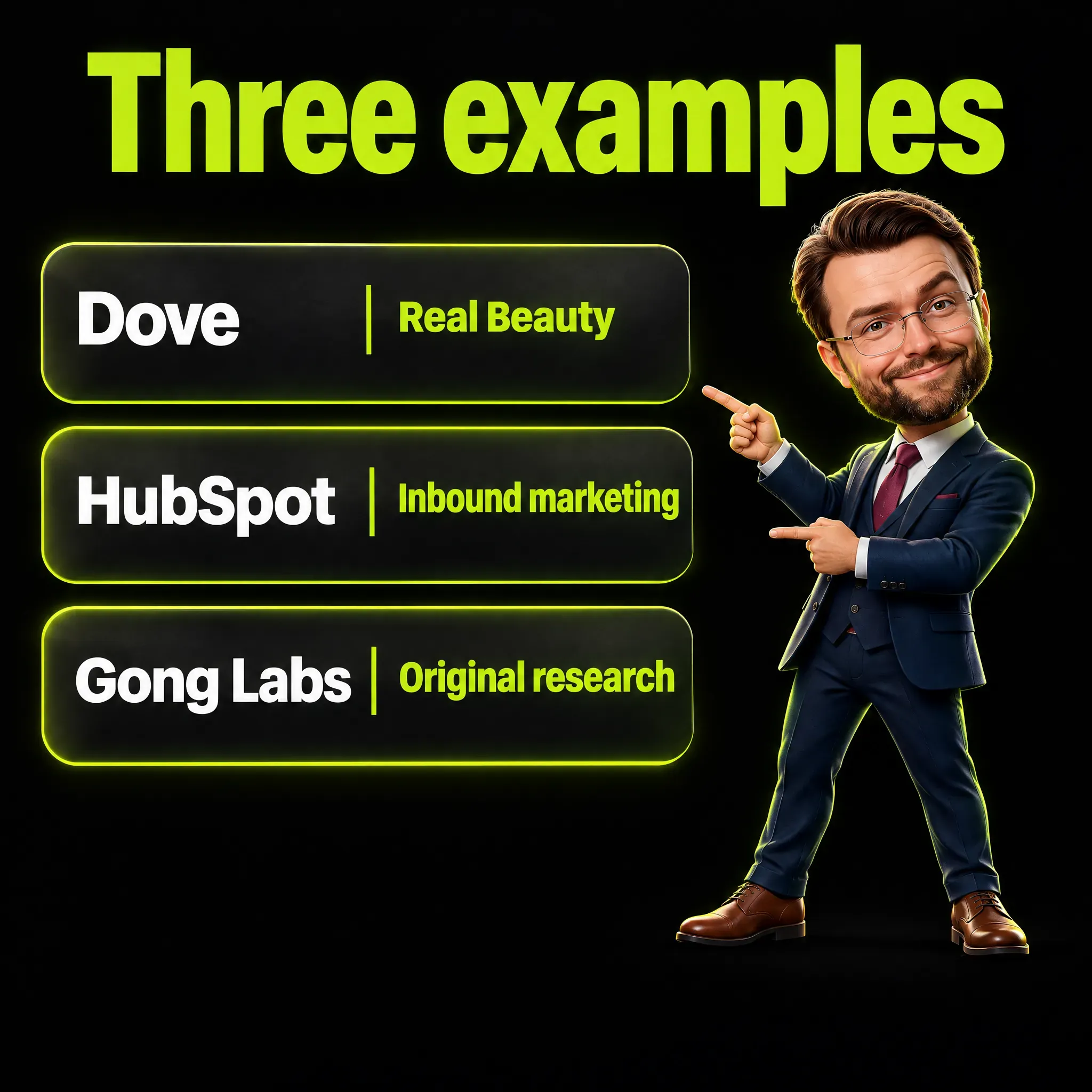
Dove. In 2003, as the Rotterdam article tells it, Unilever’s team for Dove had to revive a fifty-year-old brand and “commissioned research on the perception of beauty in ten countries”. The research found that “only 2 per cent of women described themselves as beautiful and only 12 per cent were satisfied with their physical attractiveness”.
The Real Beauty Campaign that followed showed “average-looking women instead of professional models”. In the words of the article, “Dove became an authority - a thought leader - on the social issue of beauty and our preconceptions of it”.
HubSpot. Wikipedia’s page on Brian Halligan, a co-founder of HubSpot, says he coined the term “inbound marketing” and, further down, credits him and co-founder Dharmesh Shah together. The title of the book they wrote explains it: Inbound Marketing: Get Found Using Google, Social Media, and Blogs.
Gong. On its Gong Labs research page, the company calls Gong Labs “our original research engine”. The page says “Our research draws from billions of sales interactions across 5,000+ companies” and “We publish new research monthly”.
None of the three sources measures what the idea earned. They document what was published and how, which is the part you can copy.
How Do You Build a Thought Leadership Strategy?
Start from what you know from your own work, then pick one idea you can defend. The Rotterdam article, where NPOV stands for novel point of view, gives the structure: “Thought leadership is comprised of two pillars. The first is novelty (the NPOV), and the second is trust”.
The same article describes four steps:
- Articulate a novel point of view. The article notes: “Sometimes it is enough to be the first to bring an idea or perspective to the attention of stakeholders”.
- Share the knowledge and information you have gathered around that point of view. Open sharing builds trust.
- Build strong networks with the people the idea concerns, and keep learning from them.
- Act in line with the position you claim. The warning is plain: “Organisations cannot create a thought leadership position based on hollow principles, ideas or visions”.
Two cautions come with it. The article says “Thought leadership is not appropriate for every company”. It adds that “it requires a leap of faith and a deep commitment over a period of many years”.
I would plan in years and review the idea every quarter. The choice of the idea belongs to positioning, which I cover in my brand positioning framework. Where it fits in a plan with long sales cycles is in my guide to B2B marketing strategy.
How Do You Test Whether an Idea Is Thought Leadership?
Write the idea in one sentence, then replace your name with a competitor’s. If the sentence stays true, it is not thought leadership yet, because anyone could say it. This is my own test, not a result from a study, and it takes about a minute.

Two example sentences show the difference. The first is a made-up line of the kind many companies publish, and the second is a rule I apply in my own reports.
- We believe content should put the customer first. Any competitor can say this, so it fails.
- In every report I count people, not events, and I write what I excluded. A competitor who works differently cannot say it, so it passes.
The second sentence comes from my guide to the marketing report, where the rule is to count people, not events, and say what you filtered. Anyone who receives the report can check whether I kept it.
The same check works on the common claims about thought leadership itself.
| Common claim | What the source says |
|---|---|
| It is proven to sell | The surveys record stated opinions, and their authors have an interest in the answer |
| Everyone reads it for hours | 48 percent of decision-makers in the 2026 survey said at least four hours a week, as reported by O’Dwyer’s |
| A good idea beats a known brand | In one survey 53% agreed with that idea; in another 81% said they bought a brand the group already knew. The questions differ |
| You can become a thought leader in a year | The Rotterdam article speaks of a deep commitment over many years |
Where Should You Publish Thought Leadership?
I would publish where your buyers already look and keep the full version on a site you control. In the 2026 survey, 84 percent of thought leadership suppliers use professional social media to get it found and 70 percent use traditional search, as reported by O’Dwyer’s.
If that network is LinkedIn for you, the planning side is in my guide to LinkedIn content strategy. The channel does not change the test above. A weak idea stays weak in a newsletter, a talk or a white paper, which is a long report a company publishes.
How Do You Measure Thought Leadership?
There is no agreed method, and no source here gives a verified figure for the return. The Exeter study lists “the confusion over how best to measure its impact” among the open problems. I would measure the effect on buyers with a few honest signals.
Companies admit the gap. Creative Salon’s summary of the 2024 report says “most organizations say it is under-resourced, misused, and not measured appropriately”.
The buyer surveys suggest what to ask. The first two questions below come from the 2026 survey, and the last two are mine.
- Did a piece help a buying group choose, or get a vendor removed from the list?
- Did a buyer look up the company after seeing its work cited?
- Did a prospect repeat your idea back to you in a first call?
- How many people, counted as people and not as views, read it in the companies you want to reach?
None of these is a revenue number. They tell you whether the idea reached the people who decide, which is the claim the surveys make.
What Changes for Thought Leadership With AI in 2026?
Buyers now read thought leadership through AI tools, and suppliers are behind. In the 2026 survey covered by O’Dwyer’s, 84 percent of respondents said they use AI to summarize thought leadership content and 67 percent to compare vendors. On the supplier side, only 46 percent plan for AI-generated answers.
Being cited seems to matter. In the same survey, 78 percent said they had researched a company after seeing its thought leadership cited by AI, and 70 percent read or viewed the cited content. The practice of writing so that AI tools cite you is called generative engine optimization.
Some readers say the same technology is filling their feed. Hacker News is a forum read mostly by technical people. In a July 2026 thread there about AI content on LinkedIn, one commenter wrote: “My LI feed is almost entirely AI slop at this point”.
That is one voice in one thread, not a measurement. LI is LinkedIn, and AI slop is a common name for low-effort text made by a machine. The review side of that problem is in my article on AI slop and human review.
The 2026 respondents also say they value the human part. O’Dwyer’s reports that 82 percent said the mix of “original research, distinctive perspectives and human judgment” has made thought leadership more valuable in their decisions than ever.
A Real Comment: A Survey Read as Marketing
In March 2026, Hacker News discussed a piece titled What 81,000 people want from AI, published by an AI company. One reader recognized the genre at once.
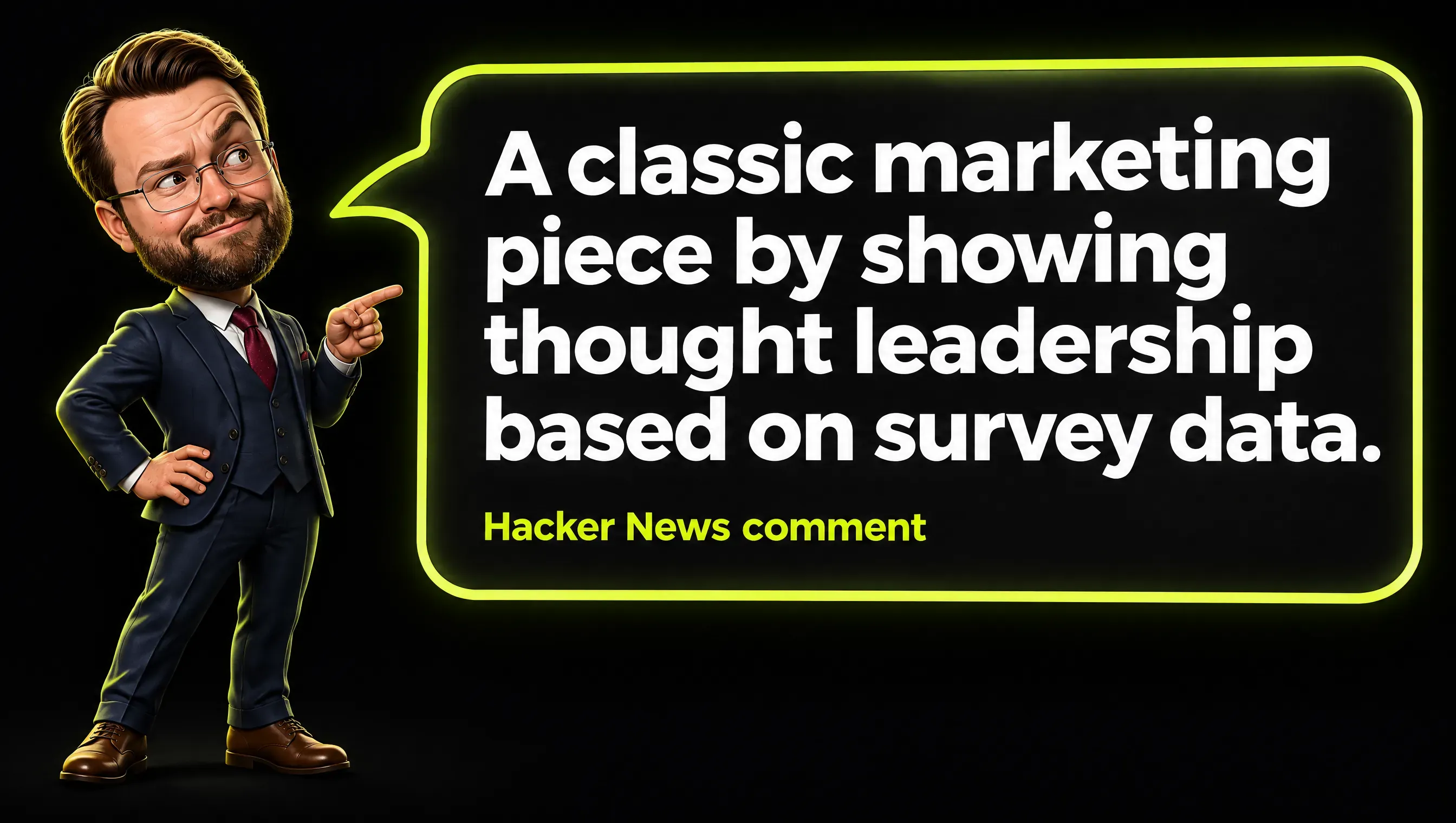
Real comment from the Hacker News thread on that survey.
The comment opens: “A classic marketing piece by showing thought leadership based on survey data”. The writer is careful about the claim: “I’m not saying they’re lying, I don’t think they are”. Then comes the point: “I am saying they are biased and have a conflict of interest on this one”.
The comment is not about Edelman or LinkedIn, and Hacker News readers are technical people, not B2B buyers. I take it as a sign of the mood, not as a sample. The structure it describes is the same, though: an organization surveys people about a subject it sells.
The commenter also suggests a fix: “I’d recommend to get an independent body (probably some university) in and let them do the interpretation and write the article”. The cheaper fix is to print the sample, the date and your own interest next to the number.
When I cite a survey, the sample, the year and the sponsor travel with the number.
Frequently Asked Questions
What is thought leadership in simple terms?
It is a new idea, backed by evidence, that helps a specific group of people see a problem differently. Other people decide whether it leads their thinking, so it is not a title you can give yourself.
How do you become a thought leader?
Start from what you know from your own work and put one idea into a sentence a competitor could not sign. The Rotterdam School of Management describes four steps: a novel point of view, shared knowledge, strong networks, and acting in line with the idea.
What are the benefits of thought leadership?
In the 2026 Edelman-LinkedIn survey of 1,135 executives, 52 percent said it helped their purchasing group choose a vendor. In the same survey, 89 percent said high-quality work makes a company feel like a long-term partner. These are stated opinions reported by O’Dwyer’s, not measured sales.
What are the key characteristics of a thought leader?
The University of Exeter study describes a source that is trusted, eminent and authoritative, with knowledge that is actionable and solves problems for the people it addresses. Wikipedia adds recognition by others as an authority in a specific field.
Is thought leadership only self-promotion?
I would say it becomes self-promotion when the idea is missing. In the 2026 Edelman-LinkedIn survey, as reported by O’Dwyer’s, 59 percent said low-quality thought leadership, or none at all, contributed to a vendor being removed from consideration.
What are the key trends in thought leadership for 2026?
The main one is AI as a reader. In the 2026 Edelman-LinkedIn survey, as reported by O’Dwyer’s, 84 percent of respondents said they use AI to summarize thought leadership. And 78 percent researched a company after seeing its work cited by AI.
Who coined the term thought leader?
The magazine strategy+business credits its founding editor, Joel Kurtzman, with coining the word in its first issue. Wikipedia records an earlier use of the phrase in a 1990 Wall Street Journal article.
What are the main platforms for thought leadership?
In the 2026 Edelman-LinkedIn survey, as reported by O’Dwyer’s, 84 percent of thought leadership suppliers use professional social media to get their content found. For traditional search the share is 70 percent. The platform matters less than the idea, and I would keep the full version on a site you control.
Thought Leadership in Short
Thought leadership is one new idea with evidence, offered by a source people trust, and the title is theirs to give. Read every survey number with its sample, its year and who made it, then test your own idea by swapping in a competitor’s name.
I write about marketing, AI and the numbers behind them. If this was useful, follow me on LinkedIn.