Social Selling: What the Social Selling Index Measures and What It Misses
Social selling is building relationships on social networks before you sell. See what LinkedIn's Social Selling Index measures, who sees it and what to track.

Social selling means selling by building relationships on social networks before you ask for anything. On LinkedIn it comes with a famous score, the Social Selling Index, and that score measures how much you use LinkedIn, not how much you sell.
Most guides still present the index as a free tool to push up, and they repeat three percentages with no year and no method. Meanwhile LinkedIn’s own page on the score says it no longer reflects how selling works. Outside observers also report that free accounts no longer see it, and that the score now sits behind Sales Navigator, LinkedIn’s paid plan for sellers.
I work as a Marketing Engineer: Digital since 12, full Marketing since 20. For this guide I read LinkedIn’s official pages line by line and compared them with what third parties observed.
Key Takeaways
- Social selling is relationship first. You earn attention with useful comments and content, and you talk business only after that.
- The Social Selling Index measures use, not sales. It is a LinkedIn score from 0 to 100 built on activity such as searches, messages and days active.
- LinkedIn itself has downgraded the score. Its own page says a high score does not always match measurable sales outcomes.
- The score is no longer open to everyone. Third-party observers report that free accounts lost it between late August and September 2026. LinkedIn has published no dated announcement, and the status of Premium accounts is unconfirmed.
- The famous percentages have no public method. LinkedIn lists all three under one undated internal study, and the 78% traces back to 2013.
- Track results in a separate column. Conversations started and meetings booked say whether you sell, so I would never mix them with an activity score.
What Is Social Selling? The Short Answer
Social selling is a way of selling in which you first build a relationship with a possible buyer on a social network, and only then talk business. A simple example: you comment with competence on a purchasing director’s posts for weeks, and you write to them only after that.
LinkedIn’s guide to social selling defines it this way: “social selling is a strategic method for sellers to connect and build relationships with prospects through social networks”. A prospect is a possible customer, for example the purchasing director of a company you would like to sell to.
Two sources from outside LinkedIn say the same. Brandwatch’s social selling glossary, updated in March 2026, writes that “social sellers share valuable content, engage in relevant conversations, and establish trust before initiating a sales discussion”. Oktopost’s guide from February 2022 calls it “the act of creating, maintaining, and fostering a relationship with prospects and customers via social media for commercial and retention purposes”.
Both companies sell social media software, so they are not neutral researchers. Still, the three definitions agree on the order: relationship first, sale second.
How Is Social Selling Different From Cold Calls and Mass Messages?
The difference is the order and the amount of personal work. A cold call is a phone call to someone who does not expect it, and a mass message is one text sent unchanged to hundreds of people. Social selling starts from what one person wrote or needs, and the offer comes later.
My reading rule is short: if the same message could go unchanged to 500 people, it is not social selling.

LinkedIn’s social selling guide asks for a personal message “instead of sending a cookie-cutter note to numerous potential buyers”. Its page From SSI to AI adds that selling is “no longer about sending mass emails or InMails and spamming buyers”. An InMail is a paid direct message to a member you are not connected with.
Here are two examples I wrote for this guide; they do not come from real people.
| Type | Example message |
|---|---|
| Generic | Hi, I saw your profile, we offer marketing solutions, do you have 15 minutes? |
| Social selling | Good morning, I read your post on acquisition costs in B2B and I agree on the leads that never reply. In my work I measure the cost of each meeting, not of each contact. If you like, I will send you the method. |
The second message could only go to one person. A lead is a contact who may become a customer. B2B means business to business: a company that sells to other companies, such as a software maker selling to factories.
Social selling is also not social commerce. Brandwatch explains that “social commerce happens when a customer buys directly through a social platform, such as Instagram Shops or TikTok Shop”. In social selling the sale usually closes off the platform, on a call or in a demo.
The table below is Brandwatch’s comparison, in its own words.
| Social selling | Traditional outreach | Social commerce | |
|---|---|---|---|
| Goal | Build relationships that lead to sales conversations | Generate immediate leads through direct contact | Complete transactions directly on social platforms |
| Approach | Share insights, engage with content, and nurture over time | Cold calls, email blasts, and door-to-door | Shoppable posts, in-app checkout, and live shopping |
| Timeline | Weeks to months | Immediate to days | Minutes to hours |
| Best for | B2B, high-value B2C | Volume-driven sales | B2C product sales |
| Key metric | Pipeline influenced, relationships built | Calls made, emails sent | Conversion rate, average order value |
B2C means business to consumer, for example a shop selling shoes to private buyers. A pipeline is the list of open deals a seller is working on. A conversion rate is the share of visitors who buy, for example 2 out of 100.
What Is the Social Selling Index (SSI)?
The Social Selling Index, SSI for short, is a LinkedIn score from 0 to 100. It rates how you use LinkedIn in four areas: your professional brand, finding the right people, engaging with insights and building relationships. It is a score about activity on one platform, not about revenue.
LinkedIn described it in a 2015 post on its sales blog: the index “helps sales professionals benchmark their social selling activities on LinkedIn”, which means compare them with others. The same post says: “We made SSI available to all LinkedIn members in August”. Vulse, a vendor of LinkedIn software, dates the first introduction to 2014.
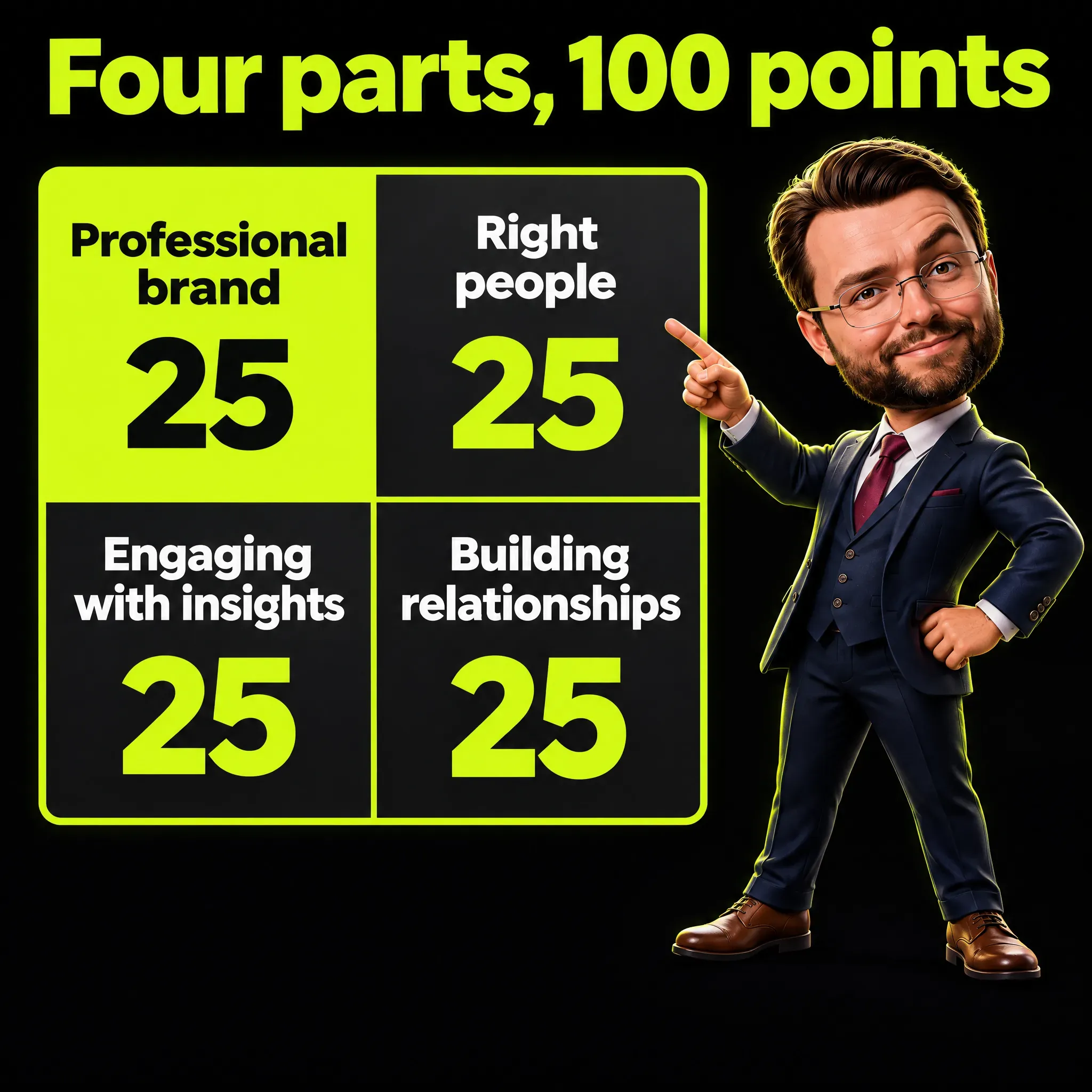
Each of the four parts is worth up to 25 points. LinkedIn’s guide puts it this way: “Each of the above elements is assigned a value between one and 25”.
The official pages do not fully agree on the scale. The 2015 post says the index “assigns an individual score from 1-100 based on effectiveness across all four elements”. The page From SSI to AI and the current guide start at 0.
What Data Does the SSI Use?
The SSI uses data about what you do on LinkedIn. It looks at how complete your profile is, how many people accept your invitations, and how often you post, comment, search and message. None of the listed signals is a sale, a meeting or a contract.
The source is LinkedIn’s help page on how the SSI is calculated, marked as last updated seven years ago. Its definition is plain: “LinkedIn’s SSI is a measure that ranks a company or individual’s utilization of LinkedIn as a selling tool”. In everyday words, it ranks how much you use LinkedIn to sell.
The page lists the signals in four groups.
- Your professional brand: how complete your profile is, including endorsements, plus your articles and the followers they brought. An endorsement is a click with which a contact confirms one of your skills.
- Your relationships: your connections and the acceptance rate of your connection requests.
- Your engagement: shares, likes, comments and reshares, messages sent and their response rate, groups joined.
- Your use of LinkedIn to find prospects: people searches, profile views and days active.
If you pay for Sales Navigator, your searches, profile views and the contacts and companies you save there count too. One line on the page is telling: “At times, we may prompt you take to actions on LinkedIn and Sales Navigator to improve your SSI score”. The word order is the page’s own, and I read the line as a sign that the score was also built to encourage more use.
LinkedIn’s guide for sales managers tells managers to track progress with daily updates of the score. One blog adds a 90-day window and shows no source, so I treat that window as unconfirmed.
Where Do You See Your SSI Score Today?
Today the score still lives at linkedin.com/sales/ssi, but third-party observers report that free accounts no longer see it there. For years any member could open it for free. LinkedIn has not announced the change with a date, so the timeline below comes from observers.
The first sign was a banner. Noleen Thompson of LadyBugz Marketing reported this notice on August 30, 2026: “Your access to the Social Selling Index (SSI) page will be discontinued soon”.
She adds: “I checked our own free LinkedIn account on 30 August 2026 and the SSI page no longer showed a score”. Her agency sells a paid LinkedIn review, so it has a commercial interest in the topic.

Rafał Szymański, a LinkedIn trainer, names a day: “Social Selling Index has been available only with a Sales Navigator licence since 8 September 2026”. He sells Sales Navigator training, so he has a stake too. An account without a license, he writes, now gets one line: “You do not have access to SSI”.
The date is less clean than it sounds. Vulse notes that “LinkedIn has published no dated announcement”. Linkedapi, a vendor of LinkedIn tools, adds: “September 8, 2026 is the most-reported date, but the rollout was not a single cutoff”.
Premium accounts, LinkedIn’s general paid subscription, are an open point. Linkedapi collects user reports that they lost the score too, and adds: “LinkedIn has not said so directly”. I would not state it either way.
In October 2025 SmartCompany’s article on the score wrote that LinkedIn had quietly killed it and replaced it with AI. That is a journalist’s reading. No LinkedIn page among the sources says the score is closed, and the observers above say paying Sales Navigator accounts still see it.
Does the Social Selling Index Predict Sales?
Not necessarily, and one of LinkedIn’s own pages now says so. Its page From SSI to AI states: “A high SSI score doesn’t always represent the efficacy of a sales person or correlate with measurable sales outcomes”. The score shows that you are active on LinkedIn, and activity alone does not close deals.
The same page writes that “the SSI score no longer accurately reflects the modern sales environment”. It also warns that “the time and effort needed for high SSI scores can distract people from closing deals and building deep customer relationships”.
One caution: that page promotes the AI features of Sales Navigator, so LinkedIn has a reason to retire the old number. Even so, on that page the company that created the score no longer presents it as proof of selling.
LinkedIn’s social selling guide still claims the opposite, a strong correlation between a high index and sales goals. The company’s two pages do not agree, and neither shows its data.
Outside voices agree. Vulse writes that the score “does not count meetings booked, opportunities created or deals won”. Szymański puts it in one line: “You can have 75 points and sell nothing, and you can have 50 and a full pipeline”.
What Is a Good SSI Score?
There is no official good score today. Vulse states that “LinkedIn published no pass mark”, and Linkedapi notes: “Today’s dashboard labels no threshold”. The number was built for comparison with your industry and your network, so a fixed target such as 70 has no current official basis.
There is one historical trace. Linkedapi reports a LinkedIn sales blog post from January 2017 that called a score above 70 high and one below 30 weak. The post reaches this guide only through Linkedapi, so I treat it as old context, not as a threshold.
A real case shows how relative the number is. Szymański writes: “My LinkedIn SSI score is 65 out of 100”. He adds: “The average in my industry is 34”.
The parts also move fast: one of his four parts, engaging with insights, went from 5 to 9.7 out of 25 in a week. He had published nothing over the summer, then one post with a few dozen thousand views did it: “One post doubled the number”. A figure that reacts like that tells you about the last few days, not about a sales year.
Where Do 45%, 51% and 78% Come From?
LinkedIn lists all three numbers under one internal study with no public year, sample or method. The 78% is older than that: I traced it to a 2014 article that credits a study reported in 2013. All three are claims from parties with something to sell, not independent measurements.
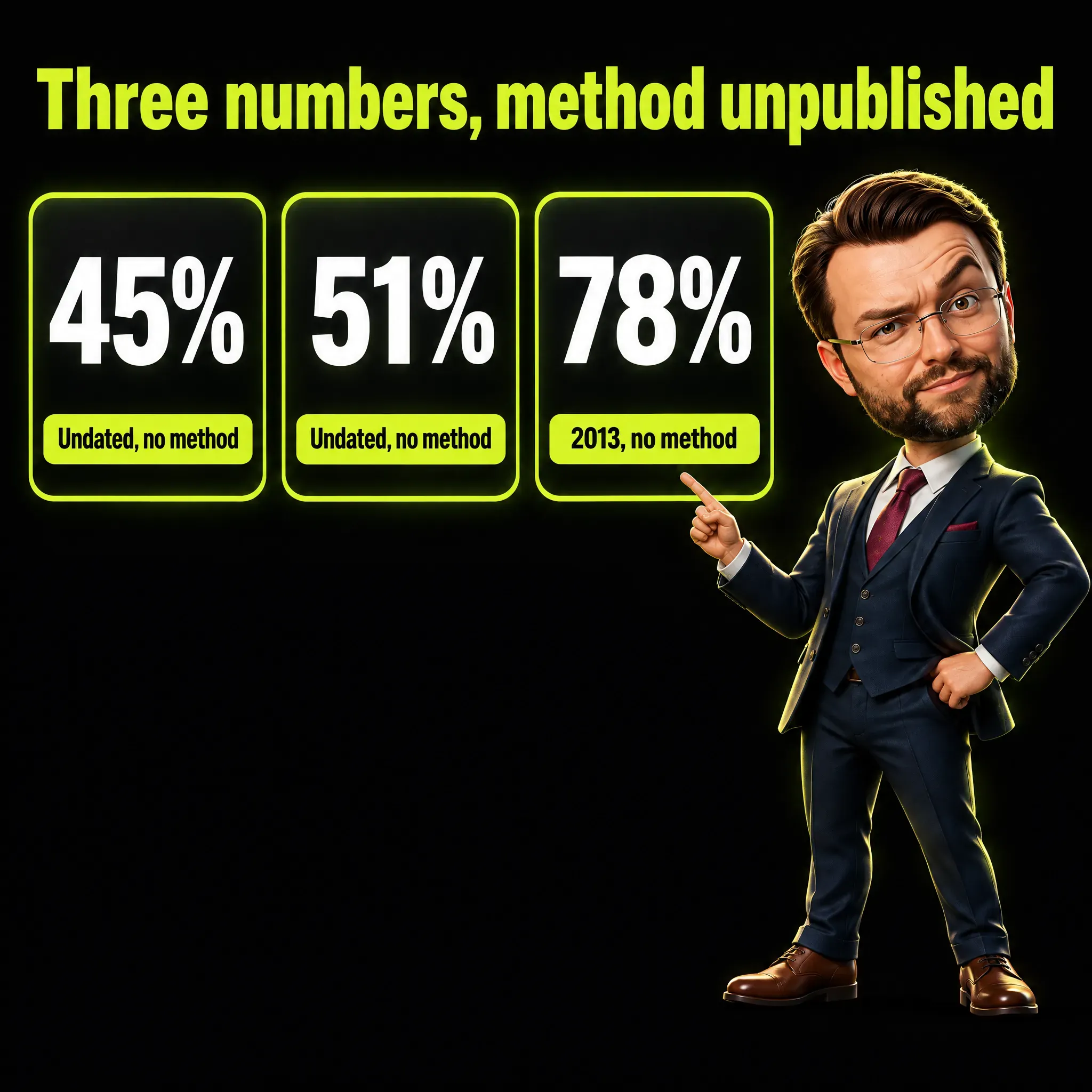
On LinkedIn’s social selling page the three numbers appear as short claims. Right under them it adds: “In an internal study we conducted, we found a strong correlation between sales reps with a high social selling index” and reaching sales goals. A correlation means two things move together, and it does not say which one causes the other.
Here is each claim next to what its source gives and what it leaves out.
| Widespread claim | What the source says | What is missing |
|---|---|---|
| 45% more opportunities | LinkedIn: “Social selling leaders create 45% more opportunities than peers with lower SSI” | Year, sample, method |
| 51% more likely to reach quota | LinkedIn: “Social selling leaders are 51% more likely to reach quota” | Year, sample, method |
| 78% outsell their peers | LinkedIn lists it under its internal study; ClickZ printed it in 2014 and credits a study by Jim Keenan reported in 2013 | Sample, method, the original study |
| 50% more likely to hit quota | A variant that none of the cited pages sources, one point from LinkedIn’s 51% | Everything |
A quota is the sales target a seller must reach in a period, for example 20 contracts in a quarter. An opportunity is a possible deal that a seller is working on.
The wording is not stable even on the same page. In one place the 78% refers to sellers, and a few lines later it reads: “78% of businesses that use social selling outperform those that don’t”. The 51% moves the same way, from social selling leaders to businesses, and those are different things to count.
The 78% has the longest trail. A ClickZ article from February 2014 says that “78 percent of salespeople using social media outsell their peers”. It credits a study by Jim Keenan covered by Forbes in May 2013 and gives no sample or method.
A number belongs in a sales argument only if the reader can follow its logic. These three numbers fail that test. I would quote them only with the words according to LinkedIn, or leave them out.
People with a high score use LinkedIn a lot, and many may have been good sellers already. That is a pattern in one company’s data, not proof that raising the score makes you sell.
Why Is Social Selling Still Important?
In my view it matters because buyers can check you before they answer. A complete profile, a few useful posts and one relevant comment give a stranger a reason to reply. None of that depends on a score, and that is why I separate the method from the index.
The evidence is thinner than most guides admit. LinkedIn’s SSI page says Sales Navigator sellers with at least four connections at a target account are “16% more likely to close a deal with their target company”. A target account is a company you want to win as a customer.
LinkedIn gives that figure in a tip with no source and no method, so I read it as a hint, not a promise. What convinces me more is the logic: Brandwatch’s table lists social selling as best for B2B and high-value B2C. Those are sales where, in my experience, trust comes before the contract.
LinkedIn Social Selling: How Do You Do It in Practice?
LinkedIn’s own guide comes down to four habits. Keep a complete profile, connect with the right people through personal notes, grow your network with useful content, and keep every interaction relevant and short. None of them needs a score, and I would add a fifth: write down the results.
Start with the profile. LinkedIn’s guide puts it first, and the first part of the index was built around it. I cover the details in my guides to LinkedIn profile optimization and LinkedIn personal branding.
Then connect one personal note at a time. The guide asks you to “focus on the needs of the prospect first and selling second”. It also warns: “Avoid sending too many connection requests or cold messages”.
Next, publish content that helps the people you want to reach. A plan makes this easier, and I describe one in my LinkedIn content strategy guide. For topics, see my list of LinkedIn post ideas and the piece on thought leadership.
Order matters in social selling: give something useful before you ask for attention.
Keep each exchange short and relevant. In the guide’s words: “Keep your interactions as relevant as possible, with concise yet valuable information”. It also sets expectations on time: “Don’t expect immediate results”.
How Do You Measure Social Selling?
I would measure social selling in two separate columns. The first holds activity, such as posts, comments, invitations and the score, and the second holds results, such as replies, conversations, meetings booked and deals closed. Only the second column tells you whether you are selling.
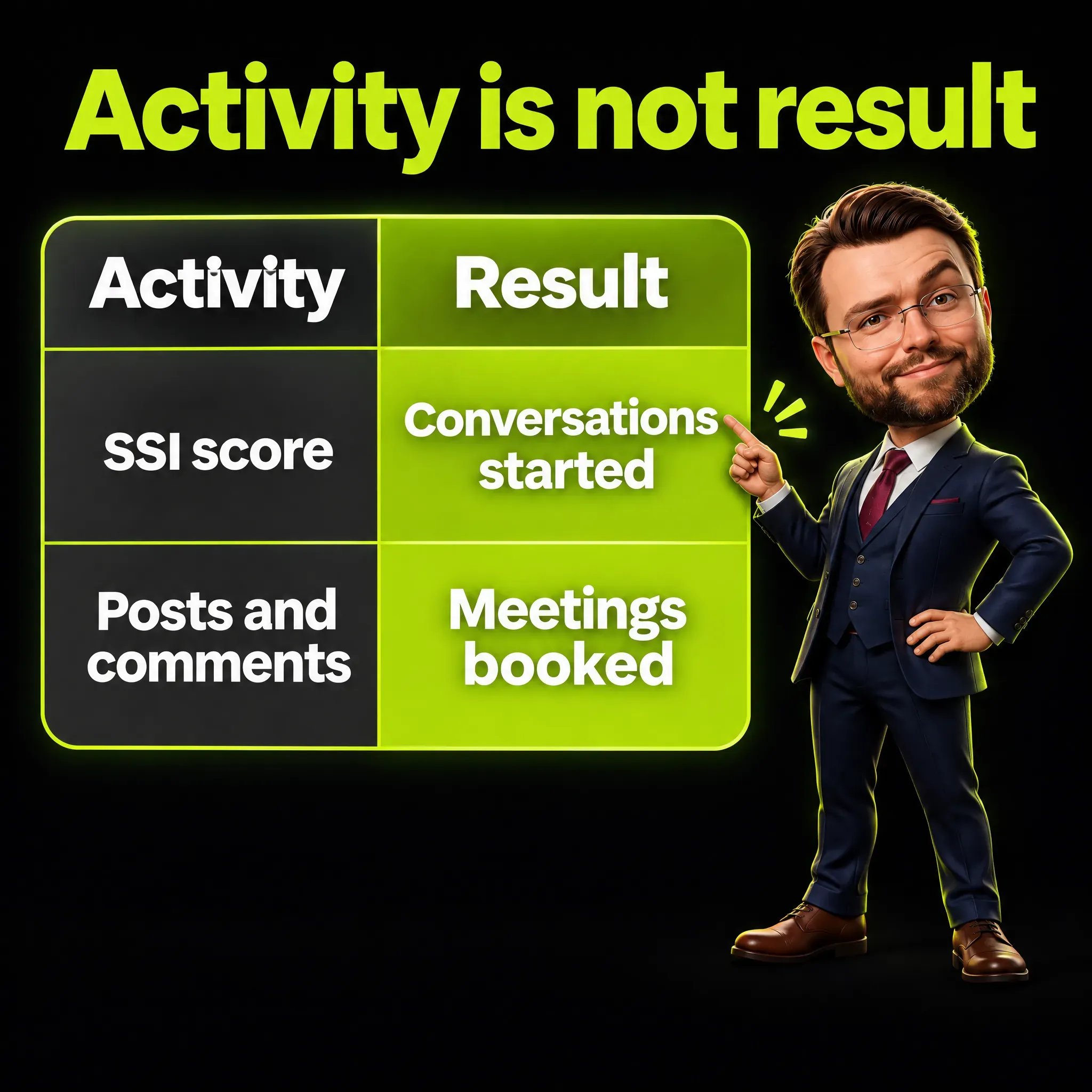
Vulse gives the same advice: “Keep activity and outcomes in separate columns, so posting and pipeline are each read on their own”. The table sorts the measures that the sources in this guide name.
| Measure | Type | Named by |
|---|---|---|
| SSI score | Activity | |
| Posts, comments, messages sent | Activity | LinkedIn’s help page, as inputs of the score |
| Connection acceptance rate | Early result | Brandwatch, Szymański |
| Replies to InMails | Early result | Szymański |
| Sales conversations started | Result | Brandwatch, Szymański |
| Closed-won deals per sales rep | Result |
Two rows overlap with the score: LinkedIn’s help page lists the acceptance rate and the response rate among its inputs. The score still stops before conversations, meetings and deals.
LinkedIn’s own page asks sales leaders to “Ease the pressure around SSI scores by shifting focus to more relevant success metrics”. The page promotes its AI tools: to measure their return, it suggests pre-set targets “like quarterly and annual closed-won deals per sales rep”. A closed-won deal is a signed sale, and a sales rep is a seller.
Here is an example of reading two numbers side by side. A score of 70 out of 100 with no meetings booked shows activity on LinkedIn and no selling yet. I would log both numbers and never add them together.
Results also need a cost next to them. I cover that side in my guides to customer acquisition cost, the money spent to win one customer, and the marketing report.
What Does Sales Navigator Cost, and Should You Buy It for the Score?
As of November 2026, LinkedIn’s plan comparison page lists Sales Navigator Core from US$119.99 per month per license, which means per user. I would not buy it to get the score back. I would buy it only if its search filters and messages fit how you find customers.
The page was updated on September 27, 2026 and states: “The Sales Navigator Core plan pricing starts at US$119.99 per month/license or US$1,079.88 per year/license”. LinkedIn calls its prices estimates that may exclude value-added tax and may change.
| Plan | Per month, per license | Per year, per license | Meant for |
|---|---|---|---|
| Core | US$119.99 or €120.99 | US$1,079.88 or €1,088.88 | Individual sellers |
| Advanced | US$159.99 or €148.21 | US$1,799.88 or €1,693.88 | Sales teams |
| Advanced Plus | Custom price | Custom price | Sales teams using an integrated CRM |
A CRM, short for customer relationship management, is the software where a company keeps its customer records. Every plan includes 50 InMail messages per month, and LinkedIn advertises “50+ advanced search filters”.
Linkedapi points out that the plan comparison “has no SSI row for any plan”. So I would treat the idea that every plan keeps the score as reported, not promised.
Szymański recommends Sales Navigator himself, and still writes: “A score I have criticised for years does not become valuable because you now have to pay for it”. In his words, “Navigator earns its money through search, lead lists and alerts”. I suggest the same: pay for the search if you need it, not for the number.
Which Social Selling Mistakes Should You Avoid?
LinkedIn’s own pages warn against four mistakes in social selling. They are chasing the score, sending the same message to everyone, collecting contacts without talking to them, and expecting immediate results.
The first is chasing the score. LinkedIn admits that “Some sales leaders and sellers may be reluctant to abandon SSI scores as a performance measure because it feels safe and familiar”. I would replace a ranking by score with a count of meetings booked.
The second is the copied message. Use the test from earlier in this guide: if the text could go unchanged to 500 people, rewrite it for one.
The third is collecting contacts. LinkedIn’s guide says: “Social selling is not about increasing your contact list”. Brandwatch says the same about volume: “Social selling isn’t about blasting promotional messages across every platform”.
The fourth is impatience. With Brandwatch’s timeline of weeks to months, a quiet first week means nothing yet. I would judge the method after a full quarter of steady work.
From Activity to Result: Why a Score Is Not a Sale
The lesson is short: an activity indicator is not a result. Posts, new contacts and scores show that you did something. The result is the conversation that leads to a meeting, and in B2B marketing I have learned to look for that line in every report first.
For a first-person account I turn again to Rafał Szymański. As noted above, he sells Sales Navigator training, so he has a commercial interest in the topic.
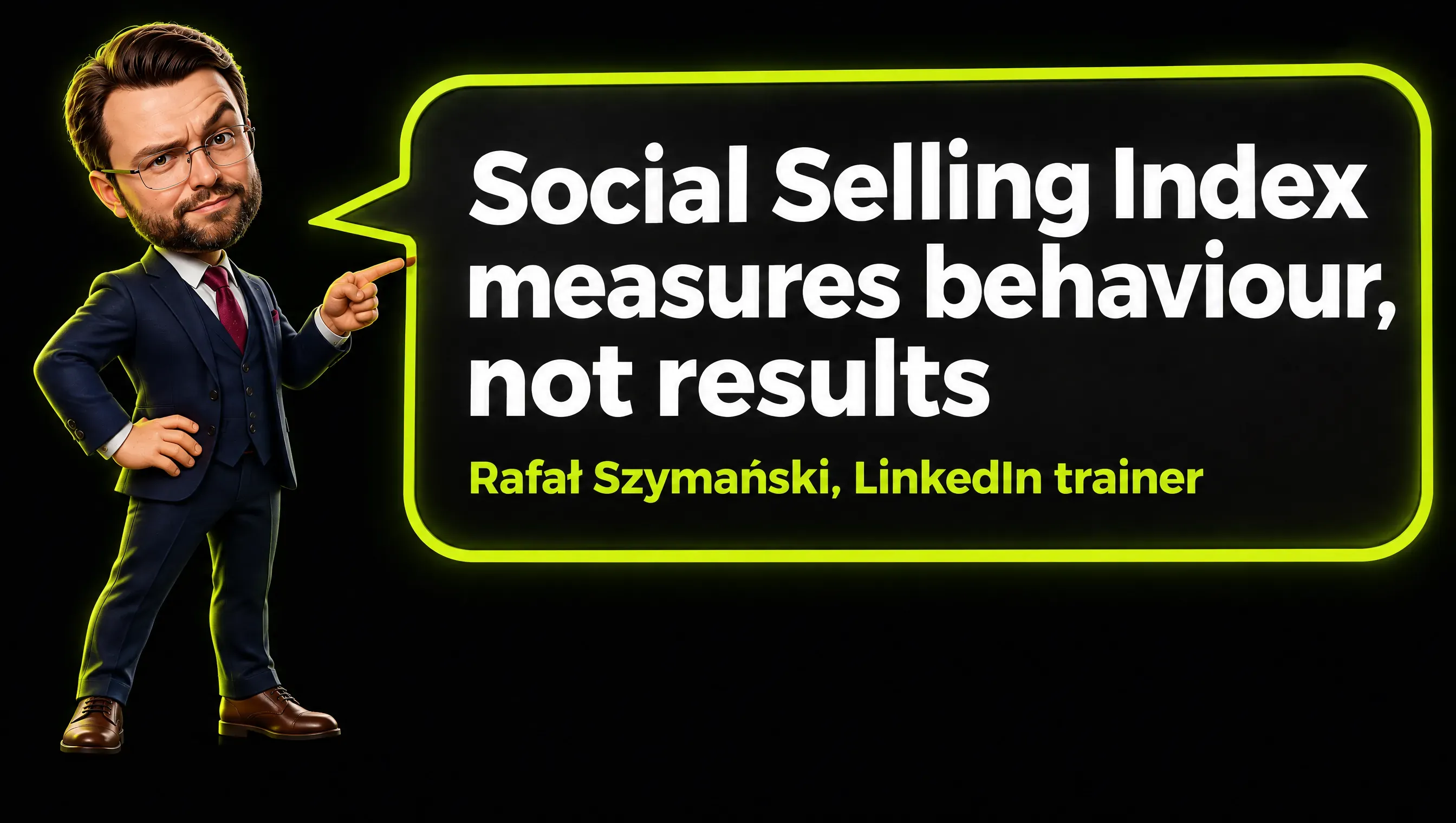
Line from Rafał Szymański’s article on the SSI and Sales Navigator.
He writes: “Back when I tried to push everything up, I got to 85”. And then: “It changed nothing in my life or my sales”. His summary is the line on the card: “Social Selling Index measures behaviour, not results”.
One account is not a study, but it matches LinkedIn’s own page and the lesson above.
Treat every score the same way: a hint until real replies, meetings and deals confirm it.
Frequently Asked Questions
What is social selling?
Social selling is a way of selling in which you build a relationship with a possible buyer on a social network before you talk business.
What is the Social Selling Index?
The Social Selling Index, or SSI, is a LinkedIn score from 0 to 100. It rates four areas of your LinkedIn activity, each worth up to 25 points.
Where do I see my SSI score?
The address is linkedin.com/sales/ssi. Third-party observers report that free accounts no longer see a score there, and September 8, 2026 is the most-reported date. LinkedIn has published no dated announcement, and the status of Premium accounts is unconfirmed.
What is a good SSI score?
There is no current official threshold. The score was built to compare you with your industry and your network, so the same number can be strong in one field and average in another.
Does a high SSI score mean more sales?
Not necessarily. LinkedIn’s own page says a high score does not always correlate with measurable sales outcomes. The score measures activity on LinkedIn, not meetings or deals.
How much does Sales Navigator cost?
As of November 2026, LinkedIn lists the Core plan from US$119.99 per month per license, or US$1,079.88 per year. LinkedIn calls these prices estimates that may exclude value-added tax and may change.
How do you do sales on social media?
Start with a complete profile, then follow and comment on the people you want to reach. Write to each of them with a personal note about something they said. Talk about your offer only after that.
Is social selling only for LinkedIn?
No. For companies that sell to other companies the usual place is LinkedIn, and Oktopost’s 2022 guide also names X and Facebook. Brandwatch points to Instagram and TikTok for consumer products, and the Social Selling Index exists only on LinkedIn.
How long does social selling take?
Brandwatch’s comparison gives a timeline of weeks to months, against immediate to days for traditional outreach. LinkedIn’s guide also tells sellers not to expect immediate results.
Social Selling in Short
Social selling is earning the right to a sales conversation by being useful on a social network first. The Social Selling Index can show how active you are on LinkedIn, and only replies, meetings and signed deals show whether your social selling works.
I write about marketing, AI and the numbers behind them. If this was useful, follow me on LinkedIn.