What Does a Marketing Consultant Do? Five Situations, Before and After
What does a marketing consultant do? A good one arrives with one or two solutions, not a list of questions. Five client situations, before and after.

A client writes: “The website is not working.” Here is an invented example of two possible answers.
The first consultant replies with six questions: which browser, which page, since when, do you have access to Analytics, can you send a screenshot, who touched the site last? The second repeats the client’s path through the site, checks the domain settings, the code and the server calls alone, and writes back what was found, what is already fixed, and one decision for the client, if one is needed.
So what does a marketing consultant do? In my practice, the answer is in the second reply. A marketing consultant finds out where the problem is, fixes what can be fixed, and asks the client only what the client alone can decide.
This is my practice, not an industry standard, and below I say where the professional bodies agree with it and where they do not. The claim is “fewer and better questions”, never “no questions”.
Key Takeaways
- A marketing consultant’s value is the work taken off you. The client hires one precisely because they do not know where the problem is.
- Ask the client only what only the client can decide: offers, prices, contracts, legal texts and principles. In my practice, everything an account, a code file or a public record can answer, I check myself.
- Arrive with one or two solutions. A list of questions hands the diagnosis back to the person who cannot make it.
- Show the change already made. A page with the edits applied in the client’s own design is easier to judge than a list.
- Open every report with the problems solved, with true facts and no retouched numbers. A missing figure is written “n/a”, never zero.
- Two professional bodies in management consulting set the base: establish the facts, stay independent, communicate honestly. They do not say “ask fewer questions”: that part is my practice.
What Does a Marketing Consultant Do? What the Professional Bodies Say
The sources below describe management consulting in general, of which marketing is one area.
The Institute of Management Consultants in Australia defines the job this way: Management Consultants “assist clients and organisations to successfully implement solutions aimed at improving organisational performance through the provision of sound, independent and objective advice.” Its definition document lists, among the skills, “problem identification with the ability to apply diagnostic and analytic skills using relevant tools and techniques”.
My reading: the job starts with diagnosing the problem and giving an independent opinion, not with a questionnaire. The Institute does not rank these skills; the emphasis is mine.
The International Council of Management Consulting Institutes (ICMCI) sets a related rule in its code of conduct for certified consultants. Clause 1.3 says to “act independently and objectively, exercising professional care, establishing the facts of a situation to enable an informed and experienced judgement.” Clause 2.7 adds: “Be honest, open and truthful in all external communication.” The code does not say how many questions to ask the client; that part is my practice.
On what the work covers, ICMCI says a Certified Management Consultant “must learn and show competency across a broad professional body of knowledge”, which includes six functional areas: “Human Resources, Strategic Planning, Finance, Operations, Information Technology, and Marketing”. The European federation of consulting associations, FEACO, describes Sales & Marketing work in its annual survey: “these activities aim to evaluate and redesign Sales & Marketing activities in terms of customer insight and relationship management, sales and channel management, product portfolio management and branding, and digital marketing.”
In plain words, the job covers understanding customers, deciding how to reach them, positioning the offer, and running the digital side. It also covers the part clients rarely list: making sure that what is measured is true. How I organize that work day to day is in my article on marketing operations.

Judgment counts as much as technique. On the ICMCI Insights page “Defining the right question to be answered is key”, Christopher Harper, a certified management consultant, writes: “Our pragmatism can be a valuable asset that helps clients see their true challenges clearly, and it is important that we ensure our pragmatism remains intact so that we are addressing the true problems.” The publisher’s description of the book The Trusted Advisor says that “technical mastery of one’s discipline is not enough” and that “the key to professional success, they argue, is the ability to earn the trust and confidence of clients.”
Judgment and trust are part of the job. My claim is narrower: it is about which questions the consultant puts to the client.
Trust can also start before the first call, with an idea a client can check. In my guide to what thought leadership means, I separate an idea backed by evidence from a title people give themselves.
The Test: What a Consultant Asks and What They Find Out Alone
My rule comes from one day in October 2026. A draft for a client contained technical questions: whether the client already used a certain email marketing tool, whether automatic emails were being sent, how many subscribers there were. The decision was to look at the tool instead of asking. Questions of that kind are answered by DNS records, the site’s code, public endpoints and APIs.
When access is missing, I do not turn the gap into a quiz for the client. I note what is missing and ask for exactly that access, nothing more.
Here is the test I use: if the answer sits in a tool, it is not a question for the client.
What stays with the client is what only the client can know or decide:
- the offer and the prices;
- contracts and legal texts;
- the principles of the business;
- how the business works in practice, such as “do you already follow up with people who asked for a quote?”
The client is not a technician, and I do not want them to become one. They hire me because they do not know where the problem is. A client may think the fix lies in a completely different direction from the real one, and cannot tell which problem is which. So I arrive with one or two solutions already thought through.
When the topic is new to the client, I use a fixed pattern:
- A direct question about their practice, not about their tools.
- “If you do not know what this means, it means this”, in two lines written for the client.
- “If you do not do it yet, I suggest A or B.”
One message covers one topic. The urgent one goes first and alone, with at most three decisions per message, facts before the proposal.
There is an honest exception: actions that only the account owner can take. In one client note, a DNS record had to be added in the client’s account at their registrar. I had already checked the public DNS records myself, so I asked no opinion. I wrote the two steps, ready to follow, about five minutes of work, because the credentials were theirs and not mine.

Five Situations, Before and After
Unless I say otherwise, the weaker consultant in each case is an invented example, written for this article. The facts under “what I do” come from real client work, anonymized, except Situation 3, which shows my method with an invented message.
1. The client writes “the site is not working”
The weaker answer is the questionnaire from the opening. Every question moves work onto the client, who either cannot answer or has no tool to check.
What I do is repeat the client’s path myself: the form, the payment, the tracking. I check domain settings, code and server calls alone. Then I write what I found, what is already fixed and, if a choice is needed, one decision: “I suggest A or B; I would pick A because…”. The professional base is clause 1.3 of the ICMCI code, “establishing the facts of a situation”. How I get those facts without handing the work to the client is my practice.
A concrete case: on a site that collects contact requests, the chart showed four “lead” events in four weeks. I compared them with the real submissions in the lead channel, and there were three, from two people: a tracking test, a check, and one form submission that had been recorded twice. To confirm it, I ran the site in a test where every server call answered with a fake success. The form event fired twice for the same submission, 50 milliseconds apart.
In three steps for a reader who is not technical. Where the number comes from: events in the chart, compared with real submissions. What it means: the leads were fewer than the chart showed. What changes: the fix went online before Analytics was connected to the ads, where the doubled event would have doubled the conversions sent to the ad platform.
The earlier test could not see the problem, because it blocked the calls the listener waits for. The principle behind the new one, a check that can say no, is in my article on human-in-the-loop AI verification.
2. A legal text is needed
The weaker answer is a questionnaire (“which email, do you use X, do you want a lawyer?”), or a generic template pasted with the question “can you approve?”.
What I do: I build it. When I took over an online shop, its site had no privacy page at all. I had three questions ready for the owner: which email address to use, whether to involve a lawyer, whether they used a certain advertising platform.
I dropped all three. They were my questions to settle, and the owner would not have known what to answer.
I built the page and the cookie banner on the structure of a recognized privacy-text provider, in the client’s colors. Missing data came from documents we already had, such as the legal notice and the signed quote, or from reasonable values that I declare in the message.
My method is one message to the client once the work is done: what I did, and an invitation to have a look. The final approval stays with the client. For the rules on tracking consent, I keep a Swiss tracking consent checklist.
3. A price has to change
The weaker answer asks “what price do you want?” with no proposal, or changes the price alone and tells the client afterwards.
A price is the owner’s business decision. I verify the facts I can reach, arrive with two options and the likely effect of each, and say which one I suggest. A message looks like this (invented example, no figures, effects only illustrative):
Two options for the free-shipping threshold. A keeps it where it is. B raises it.
With A you keep the current order mix; with B the average order grows but fewer
people reach checkout. I suggest A for now. Which do you prefer?
Never write a value as decided if it is still to be asked. The same applies to the words of the client’s trade, such as product names: I verify, offer the options and the client picks the wording. For budgets and how to set them, see marketing budget.
4. A problem that is not the consultant’s fault
The weaker answer hides it, or writes “it is Google’s fault”, “the agency before us” or “yours”.
What I do is facts first: what happened, what we did, the result. No cause if the cause is not verified. A voice in the report can say “cause unknown”. Two cases from real reports:
- On one lead-generation site, 242 of the 525 sessions in a four-week period (46 percent) came from countries where data centers sit, with an average engagement of 0.4 seconds: computers, not people. Raw, the drop against the previous period was 53 percent (525 sessions against 1,111). The report leaves out those 242 sessions and 2 test sessions of mine, and shows 281 against 464, a drop of 39 percent. It declares the filter in a footnote. I tell the full case in my article on the marketing report.
- For a small shop, the search data had a hole of several months, and the cause is not verified. In the last eight days of the data there were 14 search clicks, against 42 in thirty days a year earlier. Side by side, that reads as a crash. On the same eight days a year earlier the count was 7, so the real comparison was 14 against 7. The report wrote “n/a” and a note, not an invented variation.
A real harm to the client (money lost, a site down for a long time, wrong prices online, personal data) is different. I tell the client first, in a direct message, one topic per message, before any report goes out.
Clause 2.7 of the ICMCI code, written for certified consultants, is the benchmark I use for reports: facts first, and no cause I cannot verify.
5. The weekly report
The weaker answer is a list of charts, one big number that goes up, a zero where the data is missing, and comparisons of one week against another with two or three orders in each.
What I do is open with the problems solved, declare the headline indicator, write “n/a” where the data does not exist, compare 28 days against 28 and show the days the ads were running next to the results, and write in the client’s language. Every entry says what happened, what we did and the result, labelled “Solved”.
Take a small online shop with few orders per week. The weekly view showed zero orders in one week, which looks like a crash. Three steps make the number readable. Where it comes from: orders counted in a rolling 28-day window. What it means: nine orders over 28 days, against six in the 28 days before, which is too few to call a trend but enough to show that the zero of one quiet week was not a crash. What changes: the report is read over 28 days, not over one week.
When the ads were off for part of a period, the report shows the live days beside the results. In one report the ads had been live on 7 of the 20 weekdays they were scheduled to run, against 20 of 20 before, and the comparison was made per live day.
The same report states a limit. Two orders came from a Google Ads campaign, which I recognized from the click parameter stored in the order. Google Ads recorded only one of them as a purchase, and the cause is not verified. So the report says that the purchases counted in Ads may undercount the sales the ads brought, instead of trusting a single number. For how I measure what a customer costs, see customer acquisition cost.

Show the Change Already Made
Describing a change is hard for a client to judge. A list of edits asks them to imagine the result. I show it applied.
For text changes, I build one self-contained HTML file: the edits are already in place, inside the client’s own design, taken from a sister page that is already online. A switch labelled “Highlight changes” is on by default. A color legend explains it: green for new, amber for changed, blue for moved. A before-and-after panel shows the title, the description and the character count. A short line says what is not part of the proposal.
I used it for the first time in late October 2026. The file opens with a double click. The preview and the final commit come out of the same script, so what the client approves is exactly what goes online.
The client sees their own design, and what changed is easy to spot. The preview is a static file: it shows text and layout, not the live site, its speed, its indexing or how its forms behave, so I check the published page after it goes out.

How a Good First Report Opens
If you hire a consultant, the first report shows what kind of consultant they are.
A good one opens with what was solved: what happened, what we did, the result. It states the headline indicator it chose. Where a number does not exist, it says “n/a”. The comparison covers a period long enough to mean something, and shows the days the ads were running. Limits are stated beside the figures they affect.

It also tells you the ways its own numbers can mislead. When the cause of a problem is not the consultant’s and has been solved, showing it is not a weakness. The structure of the report, block by block, is in my guide to the marketing report, and the measurement side is in my guide to marketing ROI.
What to Ask a Marketing Consultant: Signals That They Verify
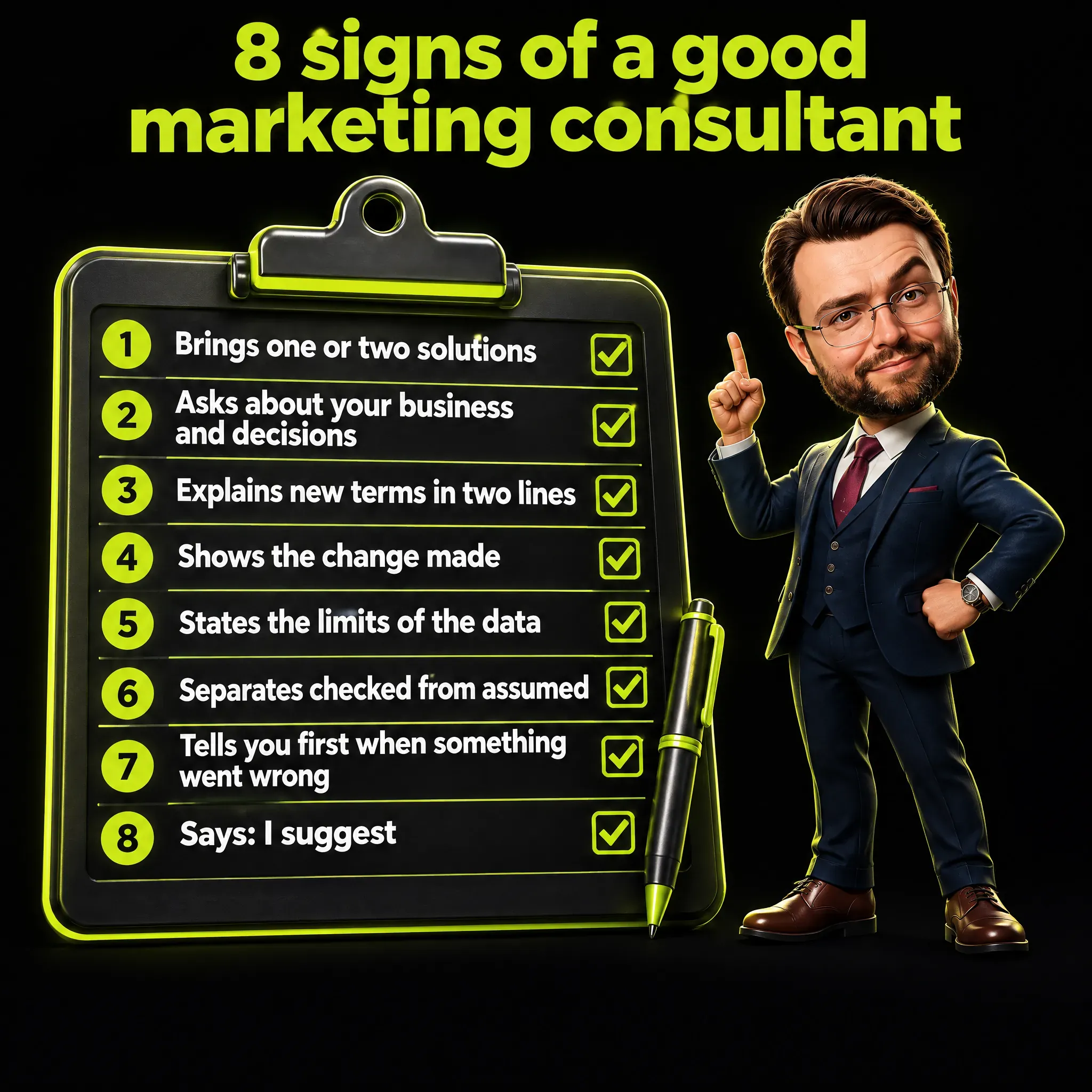
If you want to hire a marketing consultant, these signals are easier to check than a pitch. They are what I do, and what you can ask for:
- They bring one or two solutions, not an opening list of questions.
- They ask about your business and decisions, not about what a tool can tell them.
- They explain new terms in two lines and propose options you can pick between.
- They show you the change made, not a list of tasks.
- They state the limits of their data and write “n/a” instead of zero.
- They separate what they checked from what they assume.
- They tell you first when something went wrong at your expense.
- They say “I suggest”, and leave the decision to you.
To see how I build my own tools, read my marketing tech stack, which lists what each layer does and what it costs. If you also use AI in your marketing, why AI marketing implementations fail lists the failure patterns of AI projects. For what a consultant costs, I wrote a separate guide on SEO consultant costs.
One signal is visible before the first call: the line under the consultant’s name on LinkedIn. What a clear one looks like is in my LinkedIn headline examples, sorted by situation.
So, what does a marketing consultant do? They find the problem for you, fix what they can fix, show you the result, and ask only what you alone can decide.
Frequently Asked Questions
What does a marketing consultant do? They find where the marketing problem sits, fix what can be fixed, and bring the client one or two solutions to choose from. The Institute of Management Consultants in Australia defines the work as providing “sound, independent and objective advice”.
How does a consultant make money? Fees vary by firm and by project: consultants are usually paid per project, on a monthly arrangement or by the hour. For what an SEO consultant costs, read my guide on SEO consultant costs.
What should a consultant ask me, and what should they find out on their own? Ask: the offer, prices, contracts, legal texts, how the business works in practice. Find out alone: records, code, APIs, tools and data. When access is missing, a good consultant asks for exactly that access and nothing more.
What should I expect in the first report? Problems solved first, each with what happened, what was done and the result. “n/a” where data is missing, comparisons over 28 days, the days the ads were running shown next to the results, and the limits stated. A real harm to you comes before the report, in a direct message.
How do I know a consultant is verifying instead of guessing? Look for the signals in the list above: they arrive with one or two solutions, they show you the change already made, and they state the limits of their data. Ask for an example in which a check refuted what they first thought.
How do I hire a marketing consultant? Ask what they would check before they ask you anything, and ask for a recent report with the problems-solved block. A short call will show you whether they begin with your tools or with your decisions.