Abliteration Explained: How an Open Model Loses Its Refusals
Abliteration removes an AI model's refusals by editing its published files. What a 2024 paper and Anthropic's GLM-5.3 tests show, and what it costs a team.

Abliteration is a technique that removes an AI model’s habit of refusing harmful requests by editing the model’s published files, called weights, so the refusal behavior switches off while the model’s other abilities stay largely intact, according to the researchers who measured it.
Anthropic’s report on GLM-5.3, published on September 29, 2026, uses the term for an edit of GLM-5.3, an open-weight model from Z.ai (open-weight means the maker publishes the model’s files, so anyone can download them). A refusal is the model declining a request that looks harmful, and the weights are the files that hold everything the model has learned. An abliterated model is a copy of an open model that has been edited this way.
I work in marketing and I use AI models every working day, mostly local ones trained for my own needs. I read the sources behind this term because it affects how far I can rely on a model’s built-in safety when I choose what an agent runs on. This article explains the mechanism in plain words and shows what Anthropic measured, with each source’s interest stated next to its claim.
It gives no instructions for doing it, and it passes no judgment on any country or company. The full comparison of the GLM-5.3 cyber tests is in my article on how to read AI cyberattack tests.
Key Takeaways
- Abliteration edits the published files of an open-weight model so that it stops refusing. It needs a copy of the weights, which is why Anthropic says it cannot be done to Claude.
- Anthropic points to a 2024 research paper for the technique. Arditi and co-authors found that in 13 open chat models of up to 72 billion parameters (the adjustable numbers inside a model), refusal is mediated by a single direction inside the model, and they call their method a “white-box jailbreak”.
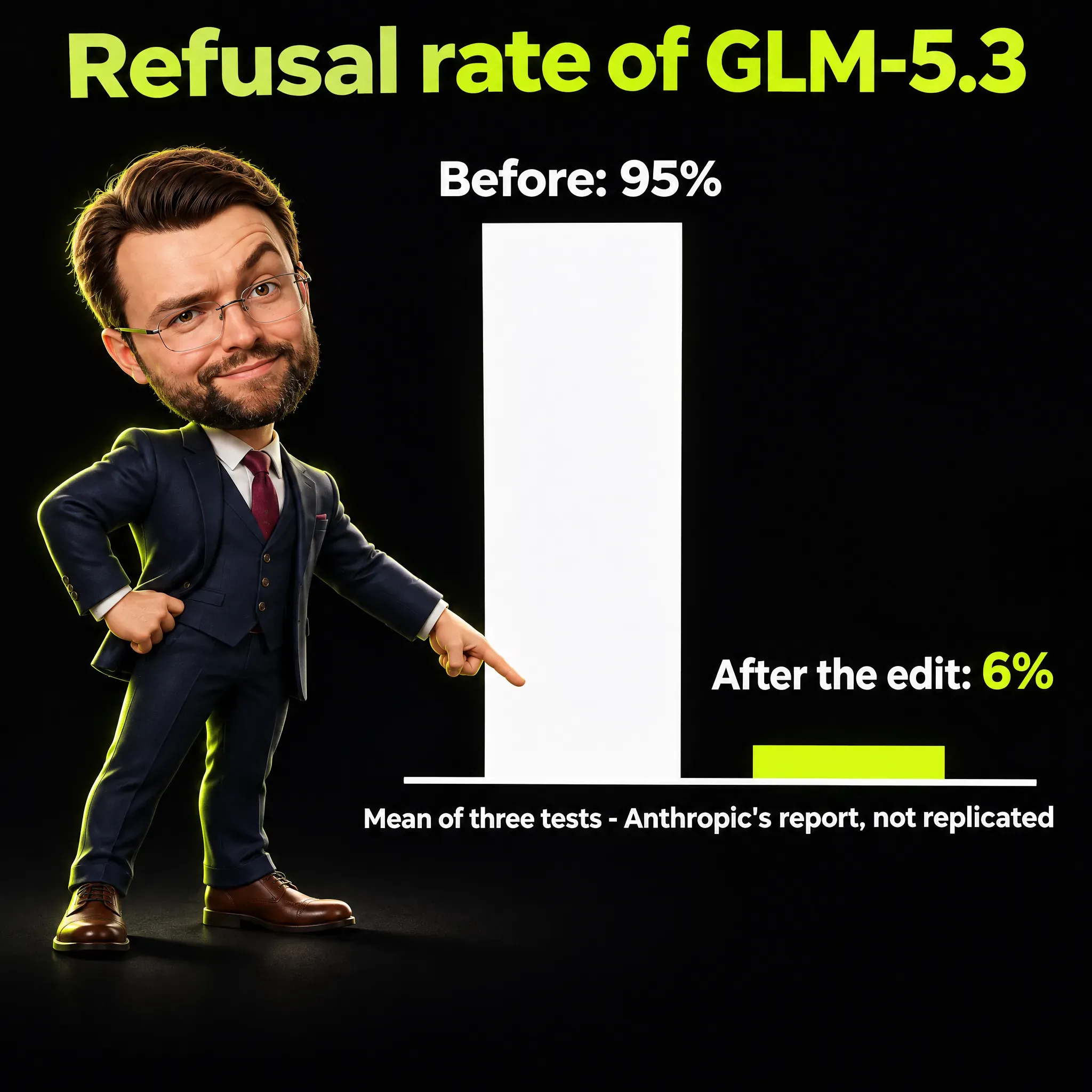
- Anthropic reports that the mean refusal rate of GLM-5.3 fell from 95% to 6% after the edit. No independent test has confirmed this. The Cloud Security Alliance (CSA), an industry security group, says Anthropic’s figures “warrant the same scrutiny as any interested party’s” and that the two government testers, CAISI and AISI, have not replicated them.
- Two government bodies make a similar point in general terms, and neither tested abliteration. The UK AI Security Institute (AISI) calls refusal training “often easily reversible with access to the weights”, and on its GLM-5.2 page the US Center for AI Standards and Innovation (CAISI) writes that safeguards “can be circumvented when self-hosted”.
- Anthropic puts the cost at roughly 4,400 dollars of computing for a first attempt, and estimates about 1,200 dollars for an experienced team. CSA and The Decoder restate these figures, and no independent test has confirmed them.
- No source I read measures how abliterated models are used in practice. My conclusion: for a company, the controls that matter sit around the model, meaning who can reach it and who approves what it does.
What a Refusal Is, and Where It Lives
When you ask a well-built chat model for something clearly harmful, it declines. That decline comes from several places at once, and abliteration touches only one of them.
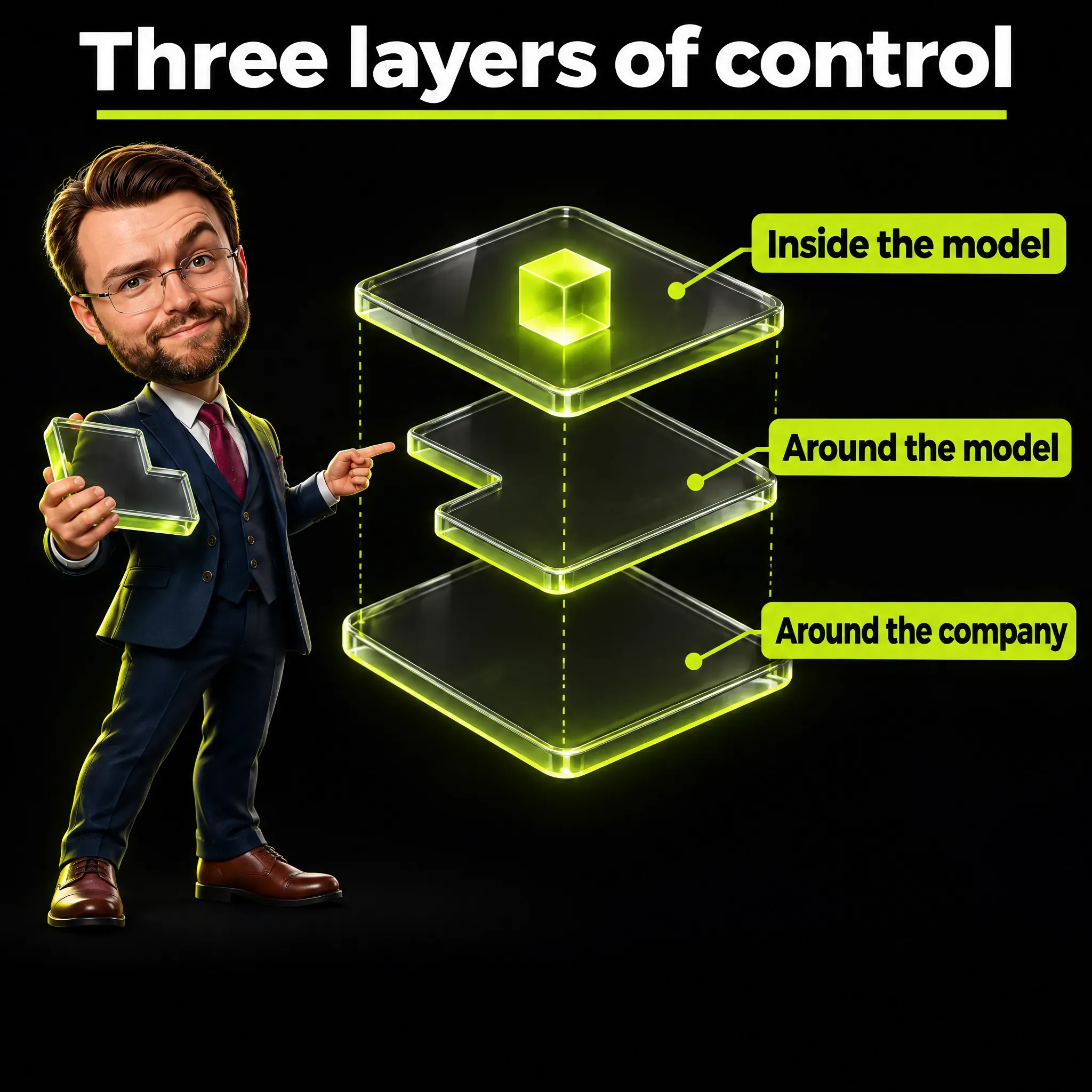
I find it useful to separate three layers. The first two follow AISI’s description of open-weight models, and the third is my own framing:
- Inside the model. Refusal training, which is training a model to decline harmful requests, builds the habit into the weights themselves.
- Around the model, at the provider. The provider can monitor requests, run classifiers (programs that sort requests into harmless and harmful) and ban users who misuse the service.
- Around the company that uses the model. This is what the user controls: which accounts and tools the model can reach, and which actions need a person’s approval.
With a hosted service such as Claude through Anthropic’s API (the way software sends requests to a model over the internet), the first two layers sit with the provider. With an open-weight model the maker publishes the first layer and hands over the files, so the maker no longer controls the second.
AISI’s conclusion is that measures at the second layer need control over access to the model and “cannot be universally applied once weights are made public”. What remains is refusal training, which AISI describes as “often easily reversible with access to the weights”.
What Abliteration Does, in Plain Words
Anthropic links a 2024 paper for the technique, called “Refusal in Language Models Is Mediated by a Single Direction”, by Andy Arditi and six co-authors, posted on arXiv, an open site for research preprints. Anthropic calls abliteration “a standard refusal reduction technique”. The abstract of the paper does not use the word, and its authors call their method a “white-box jailbreak”.
A white-box method is one where the attacker can see inside the model, which needs the weights. A black-box method, such as a cleverly written prompt, works from the outside and sees only the answers.
The paper’s finding is that refusal is mediated by “a one-dimensional subspace”, a single direction in the model’s internal calculations, in each of 13 popular open-source chat models of up to 72 billion parameters. Erasing that direction stops the model from refusing harmful instructions, and adding it makes the model refuse even harmless ones.
Here is my own analogy: picture a mixing desk with dozens of sliders, one of them labelled “caution”. In these models refusal behaves like that one slider, and the authors report that pulling it down has “minimal effect on other capabilities”. Their conclusion about safety is that the results “underscore the brittleness of current safety fine-tuning methods”, meaning the extra training that teaches a model to decline.
This article stays with the principle, which is enough for me to judge the risk. As I read the sources, the edit happens on a copy of the files, so it does not involve the maker’s servers at all. AISI says that once models are released, “copies can be downloaded, redistributed, and run on private systems beyond monitoring”.

What Anthropic Measured on GLM-5.3
To see how far the technique weakens GLM-5.3’s safeguards, Anthropic made an abliterated copy itself. It ran the copy on three public benchmarks, JailbreakBench, HarmBench and StrongREJECT, which measure how often a model complies with clearly harmful requests. A refusal rate is the share of those requests that the model declines.
Anthropic reports that the edit took GLM-5.3’s refusal rate from above 90% to the following values:
| Benchmark | Refusal rate of GLM-5.3 after the edit |
|---|---|
| JailbreakBench | about 3% |
| HarmBench | about 2% |
| StrongREJECT | 12% |
Anthropic’s chart averages the three benchmarks. The mean refusal rate falls from 95% to 6% for GLM-5.3 and from 95% to 14% for the smaller GLM-5.3-Flash, while the Claude models refuse about 96% of the time.
Capability barely moved: on GPQA-Diamond, a test of general scientific knowledge, the standard and abliterated models scored the same, and on a tested subset of the CyberGym cyber benchmark the abliterated version scored a few percent lower. Anthropic summarizes that abliteration “leaves capability largely intact”.
Where the numbers come from: one company, its own abliterated copy and three public benchmarks. What they mean: on these tests the edit removed most of the refusals while a science test and a cyber test barely changed. What changes: until someone else repeats the test I treat the figures as Anthropic’s claim, and CSA says CAISI and AISI have not replicated Anthropic’s figures.
Anthropic also says that several developers released abliterated versions of GLM-5.3 to the public “within days of the model’s release”. CAISI gives August 14, 2026 as the model’s release and says Z.ai published the weights two weeks later, so I cannot tell from the sources which date the days are counted from. I found no figure in any source for how many people downloaded or used these versions.
Three Ways Around a Refusal, and What Each One Needs
Abliteration is one of several ways around a refusal, and the difference that matters for a company is what the person needs to have in hand. Anthropic tested three of them against GLM-5.3 in a simulated world where the model received overtly malicious requests to attack critical systems. Out of the box, GLM-5.3 refused in all trials.
In this simulation, “engaged” means the model tried to connect to a remote target system after the harmful request. Each cell rests on 50 samples, and no code is executed, so Anthropic describes such simulations as “imperfect measures of how a model would behave in a given situation”. A footnote adds that the cyber tasks in Anthropic’s earlier tests “did not trigger such refusals on the released model”, so the 0% in the first row describes overtly malicious requests only.
| Way around the refusal | What the person needs | GLM-5.3 engaged in | Claude, per Anthropic |
|---|---|---|---|
| A direct request | Access to the chat or API | 0% | 0% |
| A false cover story in the prompt | Access to the chat or API | 64% | 0%, the safeguards blocked the requests |
| Prefilled reasoning, where the attacker writes the start of the model’s thinking | An API that allows it | 92% | Not possible, the API offers no way to prefill |
| An abliterated copy | The weights | 100% | Not possible, the weights are not provided to users |
The first two methods are aimed at the provider’s layer: a provider that serves the model can screen prompts and decide not to offer prefilling, which is what Anthropic says it does for Claude. The third has no provider in the middle, because it is done on a copy of the files. That is my reading of the table: the abliterated row is the one that no provider-side measure can reach, which fits AISI’s point that those measures do not apply once weights are public.
The numbers are Anthropic’s alone, and it summarizes that attackers can bypass GLM-5.3’s safeguards “between 64% and 100% of the time with simple techniques” in its tests. The complete simulation, including how the samples were built, is laid out in my comparison of the AISI, CAISI and Anthropic tests.
Who Says What, and What Each Source Has at Stake
The sources agree on a principle, and only Anthropic gives numbers for abliteration. This table keeps each source’s interest visible next to its claim:
| Source | What it says | What to keep in mind |
|---|---|---|
| Arditi et al., 2024 (arXiv paper) | Refusal is mediated by a single direction in 13 open chat models; safety fine-tuning is brittle | Models up to 72 billion parameters; the abstract does not use the word “abliteration” |
| UK AISI | Once weights are public, monitoring, classifiers and user bans cannot be universally applied; refusal training is often easily reversible | Government testing body; its post tested GLM-5.2 and DeepSeek V4-Pro, not GLM-5.3, found its evaluations “largely unimpeded by safeguards” and reports no abliteration test |
| CAISI (page on GLM-5.2) | Safeguards for open-weight models can be circumvented when self-hosted | US government body; this is one caveat on its GLM-5.2 page, and its GLM-5.3 page reports cyber benchmark results and does not mention abliteration |
| Anthropic | Mean refusal rate 95% to 6% after the edit; cost of about 4,400 dollars | Does not release its own weights; CSA says its figures “warrant the same scrutiny as any interested party’s” and have not been replicated |
| Cloud Security Alliance | ”Safeguards Appear Not to Survive Self-Hosting” | Rests on Anthropic’s figures for one model; the extension to open-weight systems in general is CSA’s own inference |
| The Decoder (news outlet) | Anthropic’s warning “also serves its business”, and CAISI’s assessment backs up the capability numbers | Reports on the others and ran no test; CSA says Anthropic’s cyber framing “sits in tension with” CAISI’s “significantly lower” assessment |
Read together, the sources agree in general terms that public weights take away the provider’s control and that built-in refusals are the weak part. Only Anthropic measured how weak, and only on GLM-5.3 and GLM-5.3-Flash. The Decoder points out that Anthropic does not release its own weights and that a cheap open-weight model close to the frontier “is also a direct competitor”.
AISI is also direct about the other side. Open-weight models, it writes, have real benefits: they can be hosted privately with no data returning to the provider, adapted to specific tasks and run at the cost of computing. They also offer a dependable base that the provider cannot change or deprecate.
My reading: the principle is stated in general terms by a 2024 paper and by both government bodies, while the size of the effect on GLM-5.3 rests on one report from Anthropic. CSA and The Decoder restate that report, and neither government body tested abliteration.

What It Costs
The cost is the part of the story I would check most carefully, since it decides how many people could do this. These are the figures in the sources, each with its owner:
- Anthropic’s first attempt on GLM-5.3. About 2,200 GPU hours at a computation cost of roughly 4,400 dollars, by a team that had never done it. A GPU hour is one hour on one graphics processor, the chips that AI models run on. By my own arithmetic that is about 2 dollars per GPU hour.
- The smaller model. Abliterating GLM-5.3-Flash took about 600 GPU hours. Anthropic gives no dollar figure for it.
- An experienced team. Anthropic estimates that a team experienced with the technique, starting from scratch on this model, would need closer to 600 GPU hours, or 1,200 dollars.
- Where the hours went. Anthropic writes that most of the 2,200 hours went to exploring variants in parallel and to testing the model’s capabilities after the modifications.
- Everything else. People’s time, hosting and the cost of what is done with the edited copy are not available in any source I read.
Anthropic is the only source that gives a number, and it comes from one team, one model and one report. CSA says refusal “can be removed for a modest sum”, and CSA and The Decoder restate Anthropic’s figures.
By these figures, abliterating a model of this size took thousands of dollars of computing, which moves the open question from whether anyone could afford this to who would do it and why. I found no source that answers that.
The 1,200 dollar figure deserves a caution of its own. It is an estimate for a hypothetical experienced team, given in a footnote, and Anthropic did not measure it.
What This Changes for a Company That Uses Open Models
The mechanism and the cost lead to one practical consequence. For an open-weight model, I treat the maker’s refusals as a default setting, since the sources give no basis to promise they survive in someone else’s copy. CSA reaches the same conclusion for companies: they “should not treat a model provider’s safeguards as a primary control against misuse by others” when the system is open-weight.
Two kinds of company face this differently:
- A company that runs an open-weight model on its own servers, often for the privacy reason AISI lists, owns a copy of the weights that counts as an asset. The second layer, the monitoring and approvals around the model, is whatever the company builds, and CSA’s advice is to inventory such models and “treat model weights as sensitive assets”.
- A company that only uses AI through a service sees the abliteration question as one about what others do with open copies. The more useful question is what its own agents can reach and what an outsider could talk an agent into, for example by hiding instructions in a web page or an email that the agent reads, which I cover in AI agent security.
An invented example: a design agency of 12 people runs an open-weight model on its own server so that client files never leave the building, which is the first benefit AISI names. An agent on that server reads incoming client emails and drafts replies. The model’s built-in refusals are a first layer, and the agency adds the one it controls: the agent can read only the inbox folder, and nothing it drafts is sent without a person’s approval.
Now suppose someone at the agency swaps in a modified copy of the model that answers more freely. The built-in refusals are gone, yet the agent still reads only the inbox folder and every outgoing draft still waits for a person. In this made-up setup the two limits keep applying, though no source tests that they hold, and a draft that slips past a hurried approver would still be a way for information to leave.
CSA recommends the same direction for companies with tool access: review it “on the assumption that refusal-based safeguards will not hold under adversarial prompting”, meaning prompts written to trick the model. I describe the approval step in human-in-the-loop AI verification, and the setup I use for agents in AI marketing agents.
I would not read any of this as an argument against open-weight models. AISI itself names benefits that matter to a company keeping client data in house, and what running one costs is the subject of self-hosted LLM cost. The consequence I draw is narrower: I choose the model for its quality and price, and I build the safety controls around it myself.

What Is Not Known
The sources leave these questions open:
- Replication. CSA says CAISI and AISI have not replicated Anthropic’s figures. AISI’s published tests covered GLM-5.2 and DeepSeek V4-Pro, and each cell of Anthropic’s attack simulation rests on 50 samples.
- What the simulation shows. Because it executes no code, The Decoder points out, it shows what the model tries to do and cannot show whether an attack would have worked.
- Size and method. The 2024 paper tested models of up to 72 billion parameters, while the Hugging Face page for GLM-5.3 lists 753 billion. Anthropic abliterated GLM-5.3 itself and links the paper for the technique, but I cannot verify how closely the two methods match.
- Real-world use. I found no figures on how often abliterated models are used, or on any harm that followed.
- The law. Whether modifying, sharing or using such copies is lawful is a question for a legal adviser, and I give no legal advice here.
A Checklist Before You Use or Buy an Open Model
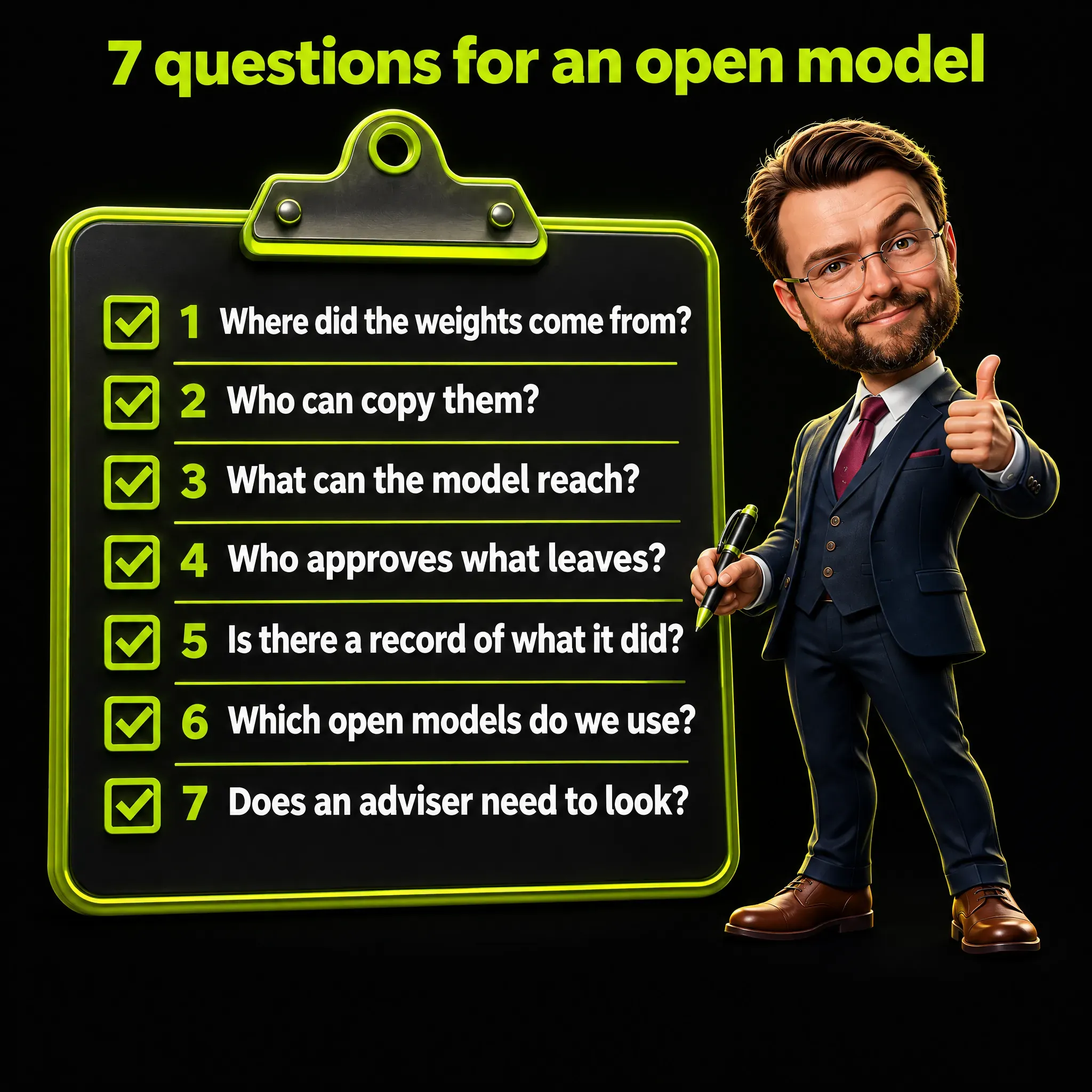
This table turns the sources into questions that a non-technical manager can ask a provider or an IT team:
| Question | Why it matters | What I would ask for |
|---|---|---|
| Where did the weights come from? | Anthropic says several developers published abliterated versions of GLM-5.3 | The maker’s own page as the source, written down |
| Who can copy the weights on our side? | CSA: treat model weights as sensitive assets | A named owner and a short list of people with access |
| What can the model reach? | CSA: assume refusal-based safeguards will not hold | A list of the accounts, folders and tools the model can use |
| Who approves actions that leave the company? | CSA: a provider’s safeguards should not be the primary control | A person who approves anything sent outside |
| Is there a record of what the model did? | AISI: provider-side monitoring cannot be universally applied to public weights | Logs that someone reads |
| Which open-weight models do we already use? | CSA: inventory them | A list with owner, purpose and source of each |
| Does an adviser need to look at it? | License and personal data are legal questions | A short note from the legal or data-protection adviser |
Frequently Asked Questions
What is abliteration?
Abliteration is a technique that removes a model’s refusals by editing its published weights, as described in the opening of this article. Anthropic uses the word for “a standard refusal reduction technique” and links the 2024 paper by Arditi and co-authors.
What is an abliterated model?
It is a copy of an open-weight model whose refusal behavior has been edited out. Anthropic made one of GLM-5.3 to test it and says developers published others “within days of the model’s release”.
How does abliteration work?
The 2024 paper that Anthropic links found that in the 13 open chat models it tested, refusal is mediated by a single direction inside the model. Removing that direction stops the refusals while leaving other capabilities largely as they were.
Is abliteration the same as jailbreaking?
A jailbreak in the usual sense is a prompt that talks a model into complying, and it works from the outside. Abliteration changes the model’s files, which needs a copy of the weights. The 2024 paper calls its method a “white-box jailbreak”, so the two terms overlap.
Can Claude be abliterated?
Anthropic says Claude cannot, because its weights are not provided to users. By the same logic a model whose weights are not published cannot be edited this way, unless the weights get out; that is my inference, CSA names weights being exfiltrated (copied out without permission) as a risk for companies’ own copies, and I found no test of other closed models.
Does abliteration make a model less capable?
Anthropic reports the same score on GPQA-Diamond and a few percent lower on a subset of CyberGym. The 2024 paper reports minimal effect on other capabilities.
How much does abliteration cost?
Anthropic reports about 2,200 GPU hours and roughly 4,400 dollars for its first attempt on GLM-5.3, and estimates about 1,200 dollars for an experienced team. CSA and The Decoder restate these figures, and no independent test has confirmed them.
Should a business avoid open-weight models?
I would not, based on these sources, since AISI lists real benefits such as private hosting and a base the provider cannot withdraw. The sources suggest treating the weights as an asset and putting the safety controls around the model.
My Take
The core of the story is a principle: when the files are public, the maker’s refusals are a default that others can change. A 2024 paper tested it on other, smaller models, and AISI and CAISI state it in general terms.
The size of the effect on GLM-5.3 rests on one report from Anthropic. CSA and The Decoder restate it and no independent test has confirmed it, so until a replication by CAISI or AISI appears I read the figures as one company’s measurement.
For my own work this changes the order of my questions. I used to ask whether a model refuses harmful requests, and now I ask what the model can reach and who approves what it does, because those answers hold whatever the refusal rate is.