Chinese AI Models for Business: Where They Run Matters
What Chinese AI models like GLM-5.3 cost, what the license allows, what the data terms promise, and the three routes for running one inside a company.

The first question people ask about a Chinese AI model is whether it is safe. A better first question is where it runs.
Chinese AI models are large language models built by companies in China, such as Z.ai’s GLM, DeepSeek or Kimi. Some are rented through the maker’s own service; others publish their weights, the files that hold the trained model, so any company can host them on its own servers.
That second group is what changes the picture for a business. The same model can sit behind the maker’s service in Singapore, behind a provider in the United States or Europe, or on a machine you control. Each choice gives a different answer on price, on data and on risk.
I use AI models every working day, mostly local models trained for my own needs, to build tools for my own marketing work and my consulting work, and I read the price lists, the licenses and the privacy documents before I recommend anything. This article does that reading for the GLM family: what it costs, what the license allows, what the privacy documents promise, and which route fits which kind of company.
Key Takeaways
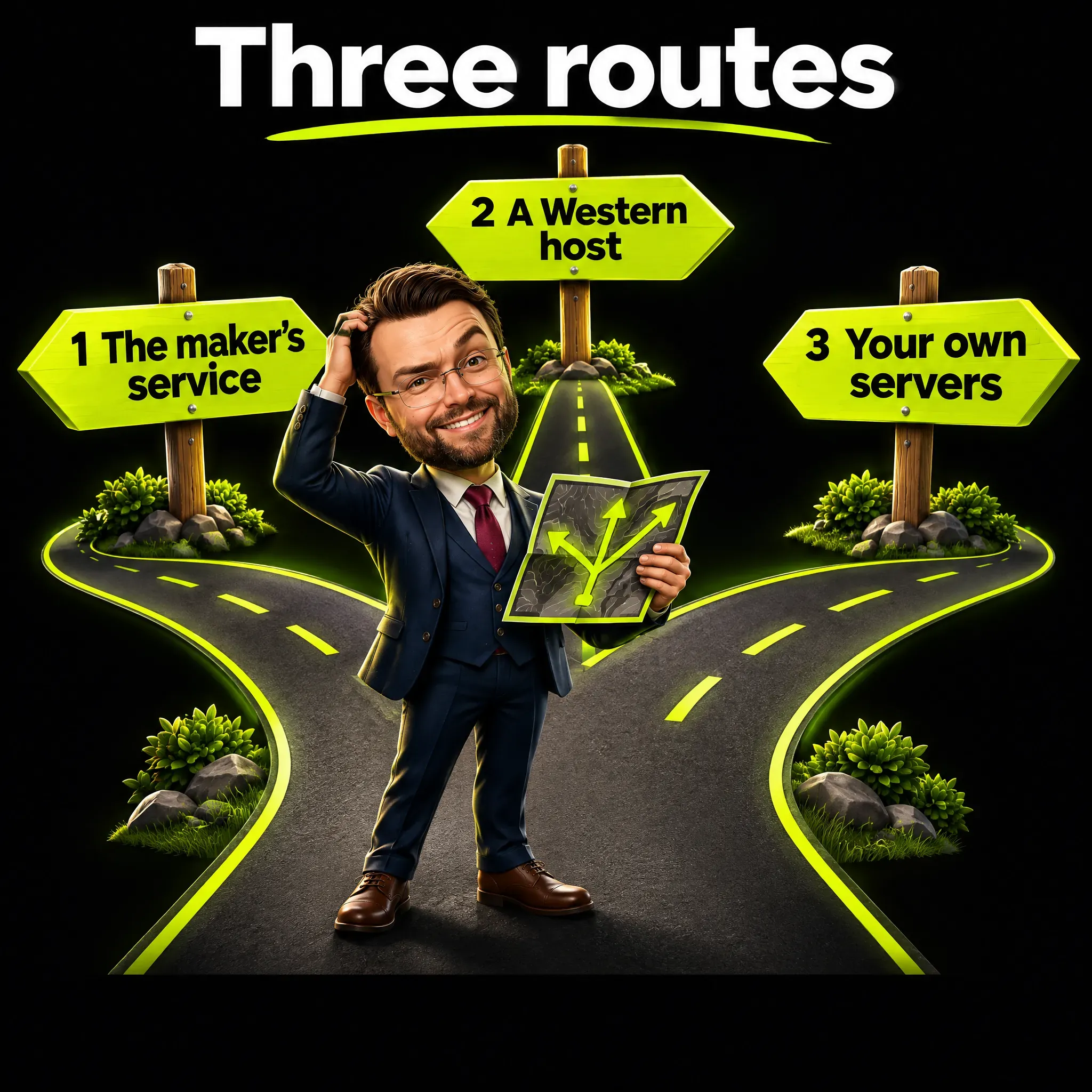
- Ask where the model runs before you ask who built it. There are three routes: the maker’s own service, a Western provider that hosts the published weights, or your own servers. Each one answers the data question differently.
- The prices are public. GLM-5.3 lists at 1.40 dollars per million input tokens and 4.40 dollars per million output tokens, and its Flash version at 0.15 and 0.50. Two older Flash models are free.
- The license is permissive. By its one extra clause, only a company that runs a model-as-a-service business and whose group revenue passes 10 billion dollars over 12 months must pass the maker’s security review. In my reading, a normal business is not caught by it.
- Independent testers put the best Chinese open-weight model about four months behind the US frontier on cyber tasks, and the UK institute puts the gap for open-weight models at four to seven months. Nobody I read measured marketing work.
- The privacy promises are the maker’s own. Z.ai’s API addendum says that content is not stored. No third party has verified that, so personal data is a question for your data-protection adviser.
- Match the model to the job. Use the Flash tier for bulk work, the full model for hard work, and test both on your own samples.
What Chinese AI Models Are, and Why Businesses Look at Them
A language model is the engine behind chat tools, writing helpers and AI agents. Most people meet it through a product from a US company. Models from China are now part of that picture: Z.ai’s GLM family, DeepSeek and Kimi among them.
Two features make some of them interesting to a business: the published price list, which I cover below, and the weights. A closed model, like the ones behind the big US chat products, keeps its parameters private and is reached only through interfaces its maker controls.
An open-weight model publishes the trained files, so someone other than the maker can run it, test it and place it where the company wants.
Z.ai released GLM-5.2 on June 16, 2026, and GLM-5.3 followed on August 14. The weights were published at the end of August.
Z.ai says GLM-5.3 uses the same base model as GLM-5.2, with gains from post-training, the stage where a finished model is further trained on specific skills. I covered that story in my article on GLM 5.3 and the best open source LLM, so here I stay with the business questions.
One note on size: the company reports 753 billion parameters for GLM-5.3. Parameters are the adjustable numbers inside a model, and the count is a rough measure of its size. A model that large does not run on an office computer, as the routes below show.
What Independent Tests Say About the Quality
Quality claims from model makers are marketing. Quality claims from government testers are worth reading, so I rely on those.
In the United States, the Center for AI Standards and Innovation (CAISI) at NIST tests models from major developers. It assessed GLM-5.2 and wrote: “GLM-5.2’s overall capabilities are similar to that of GPT-5.2, released in December 2025.” On cyber tasks it found them “similar to that of Opus 4.6, released in February 2026.”
Where the number comes from: CAISI’s own benchmarks, run by the institute itself. What it means: GLM-5.2 performs like a top model from four to six months before its release. What changes: a model of that class is a serious candidate for a test on your own work, and the questions become cost and where it runs.
For GLM-5.3, CAISI’s September report calls it “the most cyber-capable open-weight model released to date”. It also says its capabilities are “significantly lower” than those of current US frontier models, with a lag of about four months on an aggregate measure.
The UK AI Security Institute, which publishes its own work, estimates that open-weight models trail the closed frontier by four to seven months on cyber tasks, down from six to ten months in 2025. I take the method of those tests apart in my article on how to read an AI cyber test.
Both institutes measured security tasks, not marketing tasks. No source I read tests these models on ad copy, email drafts or report summaries. For that reason I would not treat a cyber score as a score for your work, and I suggest testing the model on your own samples, which I describe in the checklist below.
The Price List: What a Million Tokens Cost
A token is a small piece of text, often a short word or part of a longer one. Models bill by the token, separately for what you send in (input) and what the model writes back (output). Cached input is repeated text that the provider bills at a lower rate.
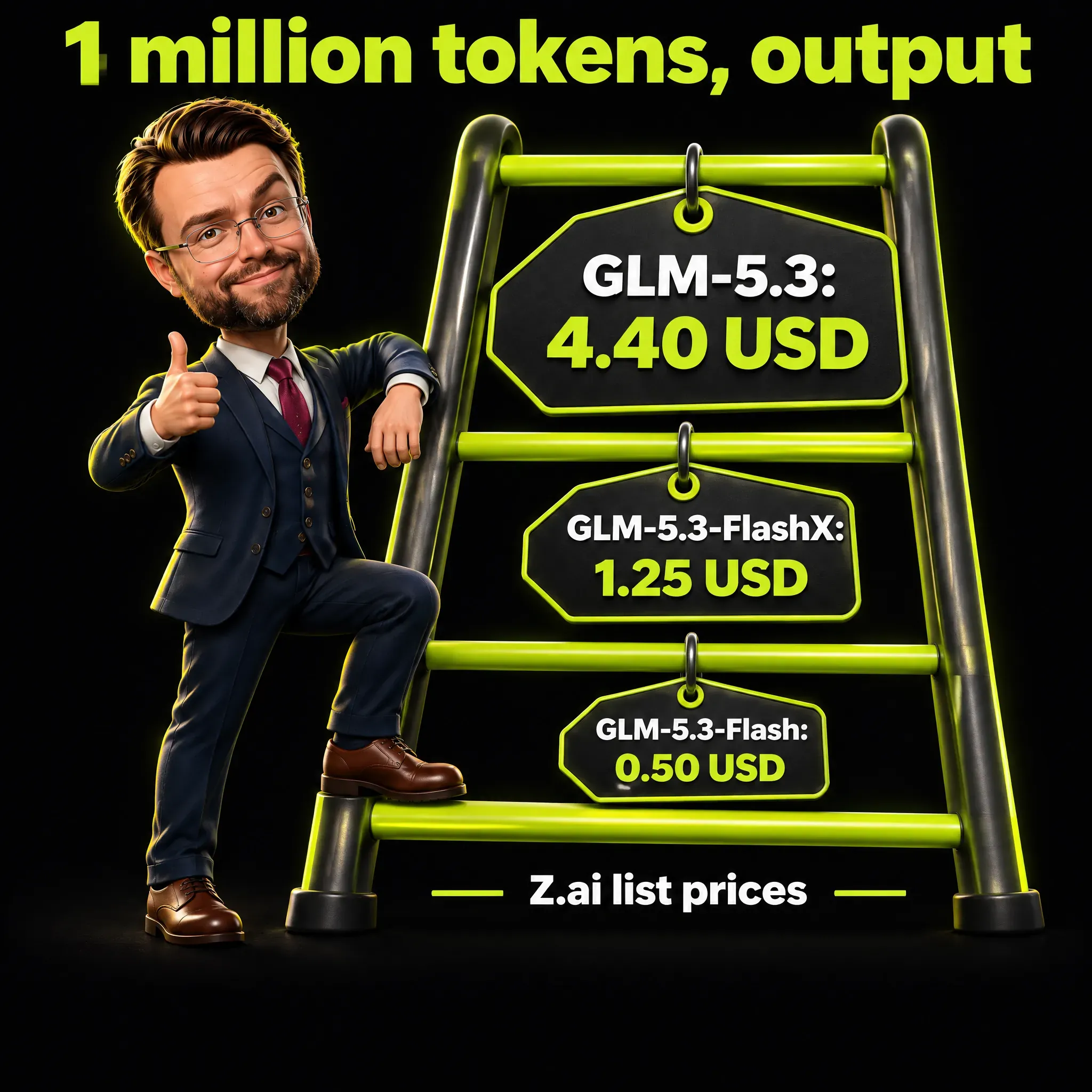
Z.ai’s published API prices, in US dollars per million tokens:
| Model | Input | Cached input | Output |
|---|---|---|---|
| GLM-5.3 | 1.40 | 0.26 | 4.40 |
| GLM-5.3-FlashX | 0.37 | 0.075 | 1.25 |
| GLM-5.3-Flash | 0.15 | 0.03 | 0.50 |
| GLM-5.2 and GLM-5.1 | 1.40 | 0.26 | 4.40 |
| GLM-5 | 1.00 | 0.20 | 3.20 |
| GLM-4.7 and GLM-4.6 | 0.60 | 0.11 | 2.20 |
| GLM-4.7-FlashX | 0.07 | 0.01 | 0.40 |
| GLM-4.5-Air | 0.20 | 0.03 | 1.10 |
| GLM-4.7-Flash, GLM-4.5-Flash | free | free | free |
The table shows two things. A newer model does not cost more here: GLM-5.3 is priced exactly like GLM-5.2 and GLM-5.1. And the Flash tier is small money: GLM-5.3-Flash is roughly nine times cheaper than the full model on both input and output.
To see what that means for a budget, here is an invented workload, not a measurement: a team sends 10 million input tokens and writes 2 million output tokens in a month. I ignore the cheaper cached rate, so the figures are an upper bound for repeated text.
| Model | Calculation | Monthly cost |
|---|---|---|
| GLM-5.3 | 10 x 1.40 + 2 x 4.40 | 22.80 dollars |
| GLM-4.7 | 10 x 0.60 + 2 x 2.20 | 10.40 dollars |
| GLM-5.3-Flash | 10 x 0.15 + 2 x 0.50 | 2.50 dollars |
The UK AI Security Institute publishes a cost comparison across makers, based on advertised prices. For a Cyber Range run, a long simulated attack on a network, that used 100 million tokens, it puts the cost at roughly 85 dollars for Opus 4.5 and Opus 4.6, an estimated 46 dollars for GLM-5.2 and 1.19 dollars for DeepSeek V4-Pro. The institute adds that it did not use the makers’ own services for the open-weight models, so real compute costs may vary.
For tasks that both models solved reliably, it reports 15.17 dollars per task with Opus 4.6 against 6.12 dollars with GLM-5.2, about 40 percent, on the same estimated basis. These are cyber tasks, so I treat the figures as a sign of the price gap, not a promise for your use.
Three Ways to Run a Chinese AI Model
This is the part that matters most for a company. The model is the same file in all three routes. What differs is who operates the machine that runs it and where that machine is.
Route one: the maker’s own service. You send text to Z.ai’s API and get answers back, which makes it the simplest start, and the price list above applies. Z.ai’s privacy policy says the services are provided from Singapore, and its API addendum says customer data is generally processed there.
Route two: a Western provider that hosts the published weights. Because the weights are public, a cloud provider in the United States or Europe can run the model and sell access, so the company deals with a provider whose country and contract it already knows.
In a talk at the AI Engineer conference in New York, published in October 2026, Revolut’s Ops & Infrastructure Leader David Abitbol made the case for this logic. His message for the CIO in the room was that using the model does not mean sending requests to a dedicated endpoint in China: you take the weights and put them “on a US-based service”. The conference page itself warns that his remarks on regulatory classification and hosting locations describe Revolut’s circumstances, not those of every company.
Route three: your own servers. You download the weights and run them yourself. The Register reported that GLM-5.1, a model of the same size class as GLM-5.3, needs roughly 380 GB of GPU memory for the weights alone, a figure that depends on how compactly the weights are stored.
Revolut serves about 2,000 engineers with 56 Nvidia B200 GPUs, which is a data-center project, not a laptop. I take the arithmetic apart in my article on the real cost of a self-hosted LLM.
| Maker’s service | Western host | Own servers | |
|---|---|---|---|
| Who runs the machine | Z.ai | A cloud provider | You |
| Where data goes | Mostly Singapore, per Z.ai | The provider’s region | Your premises or cloud |
| Cost shape | Per token or subscription | Per token, set by the provider | Hardware, power, staff |
| What you need | An account | A contract | An infrastructure team |
| Main question | Is the DPA enough? | Which provider and region? | Can we operate it? |
For a marketing team or a small business, route one or two is realistic. Route three belongs to companies with a platform team.
The License in Plain Words
The GLM-5.3 license is short, and a business can read it in five minutes. It grants the right to use, copy, modify, publish, distribute, sublicense and sell the software, including the weights, and to run, deploy and fine-tune the model. The conditions are that you keep the copyright notice and follow the law.
One additional condition exists, and it has two parts that must both be true. The company or one of its affiliates operates a “Model as a Service” business, and the total revenue of the company and its affiliates exceeds 10 billion US dollars in any consecutive 12 months. In that case it must pass Z.AI’s security review before using the software for any commercial purpose.
The license defines Model as a Service as giving a third party access to inference or fine-tuning, for example through an API, in a way that gives them meaningful control over inputs, parameters or training data. It excludes end-user products where the model is solely embedded in specific features, and the simple relaying of requests to models hosted by others.
In practice, a company that uses the model to write, summarize, analyze or power its own tools is not in that group. In my reading, the condition is aimed at the largest cloud companies that could resell the model. It also matters for route two, so I would ask a host how it handles that condition.

The license also contains a disclaimer: the software and any output and results are provided on an “as is” basis, without warranty of any kind. A wrong answer from the model is yours to catch, which is one more reason to keep a person in the checking step, a topic I cover in human-in-the-loop AI verification.
The Coding Plan: A Subscription Instead of a Meter
Z.ai also sells a subscription called the GLM Coding Plan, which starts at 18 dollars a month. Its documentation says it works with agent tools such as Claude Code, Codex, OpenCode and OpenClaw, and that all plans support GLM-5.3 and GLM-5.3-Flash. Requests for GLM-5.2 and GLM-5.1 are routed to GLM-5.3 automatically, and requests for GLM-4.7 go to GLM-5.3-Flash.
The plans work with credits, not dollars per token. The Lite plan has 2,000 credits per five hours and 10,000 per week; Pro has 12,000 and 60,000; Max has 28,000 and 140,000.
A model call burns credits according to multipliers: GLM-5.3 uses 6.9 for input, 1.7 for cached input and 24 for output, and the documentation divides the weighted total by 10,000. Peak hours are Monday to Friday, 14:00 to 18:00 Singapore time; outside them, usage is charged at half the standard rate.
Where the number comes from: the plan page’s own allowance table. What it means: with 95 percent of input served from cache, the Lite plan allows 48 to 97 million GLM-5.3 tokens a week, depending on whether use falls in peak or off-peak hours. What changes: a heavy daily user gets a fixed monthly bill instead of a meter, and work moved to off-peak hours uses half the credits.
Z.ai states that by fully using the off-peak discounts you can “save up to 92%” compared with pay-as-you-go calls to the GLM-5.3 standard API. That figure is the company’s own claim, and it describes the best case, so I would not plan a budget around it. The Pro and Max prices are not on the overview page I read, so I do not quote them.
The Register quotes Abitbol on why a predictable bill matters to larger teams: he described “seeing engineers spend $1,000 a month, $10,000 a month with not so much ROI”, and said Revolut launched its AI tools with strict budget limits. After the move to self-hosted models, he said, “the billing is flat, we don’t have any bill shock at the end of the month”. That was Revolut’s own hosted setup, not Z.ai’s plan, so read it as a reason to care about the shape of the bill, not as a price for the Coding Plan.
The two big US makers count usage in their own ways too. In my Claude vs ChatGPT guide I compare how Claude Code shares one pool with your chats and how Codex draws on a separate Work and Codex allowance.
Data: What the Documents Promise and What They Do Not Prove
For most companies, this is the real question. Z.ai publishes two relevant texts.
The first is the privacy policy. It names a Singapore company as the controller and says personal data is “generally processed in Singapore”, with safeguards for transfers. For individual users of its consumer services, the policy lists training and improving the models among the purposes it handles under legitimate interests.
The second is the Data Processing Addendum for API customers. It states: “The Company do not store any of the content the Customer or its End Users provide or generate while using our Services.”
The content, it says, is processed in real time and is not saved on its servers. Other data may be stored temporarily to provide the service or to meet legal duties and is deleted when the terms end. Under the addendum, Z.ai acts on the customer’s instructions.
These are two different documents for two different kinds of use, and the second makes a stronger promise than the first. Both are promises by the company that wrote them, and I found no third-party audit of either.
I would not claim that data sent through the API is used for training, and I would not claim it is not. What I can say is that the contract contains a no-storage clause and that nobody outside the company has confirmed it.
My practical suggestion has three parts:
- Test any Chinese model with material that is already public or invented. That covers most of what a marketing team needs to learn in the first month.
- Put personal data, such as customer lists or lead exports, behind a conversation with your data-protection adviser before it goes to any model, from any country.
- If the data matters, use route two or three, where the contract and the location are ones you already know.

I am not a lawyer, and this is not legal advice. It is the order in which I would ask the questions.
Which Model for Which Job
I did not find a source that benchmarks the GLM models on marketing tasks, so this table is my suggestion, not a measurement. Use it as a starting hypothesis and test it.
| Job | Where I would start | Why |
|---|---|---|
| Sorting comments, tagging leads, bulk summaries | GLM-5.3-Flash | Cheapest paid 5.3 tier, high volume |
| Drafting and rewriting copy that a person edits | GLM-5.3-FlashX or GLM-5.3 | Better wording justifies a higher price |
| Reading long reports and finding contradictions | GLM-5.3 | Hard reading is where a stronger model pays |
| Experiments with non-sensitive data | GLM-4.7-Flash (free) | No cost, low stakes |
| Agents that use tools | GLM-5.3 through route two | Needs the strongest option and a known contract |

To test the table on your work, take 20 real samples of one task, run them through two models, and have a person judge the results without knowing which model wrote which. If the cheaper one is good enough on that task, the saving is yours. I compare two Claude tiers the same way in Claude Haiku vs Sonnet for marketing.
What It Costs in Practice
The sticker price is only part of the cost. Here is what I would add up before choosing a route.
- Tokens or a subscription. The price list above, or the plan: from 18 dollars a month, with credits that run out per five hours and per week.
- Hosting. There is no single number. Revolut’s setup used 56 Nvidia B200 GPUs and reached a blended cost of about 30 cents per million tokens, and the conference page notes that these figures describe Revolut’s deployment and usage, not a portable price. I go through the arithmetic in my article on the real cost of a self-hosted LLM.
- Checking time. The cost that no price list shows. A cheaper model that produces more errors moves cost from the invoice to the person who checks.
- Switching. Prompts, tool connections and test samples written for one model need adjusting for another. I would budget a few days of testing before moving a live workflow.
- Compliance review. The time of the people who read the data terms. For the maker’s API this is the DPA described above.
Nothing here is a claim that Chinese models are cheaper at every scale. The one cross-maker comparison I found is the institute’s estimate for cyber tasks, the independent quality gap is measurable, and the rest depends on how much checking your work needs. Where these costs sit next to the rest of a team’s tools is covered in my marketing tech stack for 2026.
A Checklist Before You Use a Chinese AI Model
- Name the job and the data it touches.
- Pick the route (the maker’s service, a Western host, or your own servers) before you pick the model.
- Read the license for the model version you use. For GLM-5.3, check the revenue and model-as-a-service condition.
- Read the data terms for the exact product: the consumer policy and the API addendum say different things.
- Test with public or invented data first.
- Run 20 samples through the Flash and the full model, with a blind judge.
- Write down who checks the output and what the check costs.
If you can answer all seven, the question “is it Chinese” turns into the more useful question “is it the right route for this job”.

Frequently Asked Questions
What are Chinese AI models?
Large language models built by companies in China, including Z.ai’s GLM, DeepSeek and Kimi. Some keep their weights private and are reached through the maker’s service; others publish their weights so that third parties can host them.
What are open-weight and closed-weight models?
A closed-weight model keeps its parameters private and is reached only through interfaces its maker controls. An open-weight model publishes the trained files, so anyone can run it, within the license. Open weight is not the same as open source in the full sense, because the training data may stay private.
Is GLM open source?
GLM-5.3 weights are published under a license that grants broad rights, and its only extra condition applies to companies running a model-as-a-service business whose group revenue passes 10 billion dollars over 12 months. That makes it open weight with a permissive license. I use “open weight” because it describes the files that are published.
How much does GLM-5.3 cost?
On Z.ai’s API, 1.40 dollars per million input tokens, 0.26 dollars per million cached input tokens, and 4.40 dollars per million output tokens. GLM-5.3-Flash costs 0.15, 0.03 and 0.50. The Coding Plan subscription starts at 18 dollars a month.
Which Chinese AI model is the best?
There is no single answer. On cyber tasks, CAISI calls GLM-5.3 “the most cyber-capable open-weight model released to date” and rates it above Kimi K3, the previous best open-weight model it had evaluated, but that is a cyber result, not a marketing result. For your work, the best model is the one that does best on your own samples.
Can I run GLM on my own computer?
Not the full model. The Register reports roughly 380 GB of GPU memory for the weights of a model in this size class, and Revolut serves 2,000 engineers with 56 B200 GPUs. Smaller models exist, but they are different and weaker models.
Is it safe to use a Chinese AI model with company data?
It depends on the route and the data. The maker’s API processes data mainly in Singapore, and its addendum says content is not stored, which is a promise no third party has verified. For personal or confidential data, I suggest asking your data-protection adviser first, or using a host whose contract you already know.
Are there free Chinese AI models?
Z.ai lists GLM-4.7-Flash and GLM-4.5-Flash as free on its API. Free is useful for experiments with non-sensitive data, and I would still read the data terms first.
My Take
Chinese AI models deserve the same treatment as any other supplier: read the price list, the license and the data terms, then choose the route that fits the job. Fear and enthusiasm are both poor substitutes for that reading.
For most small teams, I suggest starting with the cheap tier on public material, measuring the result on 20 real samples, and deciding about personal data only after that. For companies with a platform team, the Western host and own-server routes open options that the closed models do not offer.
In both cases, the model is one component. The checking around it is what makes the output safe to use, and that part is the same whether the model was built in California or in Beijing.